|
Find resources to help your clinic prepare for and navigate respiratory virus season on the new Respiratory Season Resources section of the CVP webpage. Designed for providers enrolled in the Childhood Vaccine Program, the new page includes guidance, product ordering information and tools to support planning before the season begins and successful vaccine management throughout the season. Answers to frequently asked questions can also be found here. Add it to your bookmarks today for quick reference throughout the season!
RSV monoclonal antibody product ordering opened Monday, August 10, in advance of administration beginning October 1.
- We encourage you to place smaller, more frequent orders in alignment with your monthly Recommended Order Quantity (ROQ). No ordering cap beyond ROQ will be in place this season.
-
RSV orders will initially be processed each Thursday. The first day of RSV order processing will be Thursday, August 13. Order processing frequency will increase as product availability improves and supply is able to meet demand.
-
•Allow for at least 3 days for order approval from time of submission for accountability checks
•Orders need to be in “pending state approval status” in the IIS by close of business the weekday before the processing day
-
RSV products are under allocation by CDC and there will be a limited number of doses available each month. This is expected each season.
-
Abrysvo will be available to order through special request only. This product is used for pregnant people <19 years old through the CVP. This special-order process is to reduce waste from unnecessary ordering. Please send a request email to
-
Use Last Year's Data to Plan Orders: Review your clinic's monthly vaccine administration from the 25-26 respiratory season and use the Recommended Order Quantity (ROQ) calculation to determine appropriate quantities.
- Use the Pediatric Respiratory Doses Administered Spreadsheet 2025-26 to review administration data from seasons passed. Check out the tabs at the bottom of the spreadsheet to see data for RSV, Flu, and COVID-19 vaccines.
- The ROQ calculator helps determine how many doses of vaccine your facility should order. The calculator does not account for seasonality or other factors that may impact need.
Ordering appropriately from the start of the season helps minimize excess inventory, transfers, and waste. Providers are responsible for transferring excess product to another enrolled provider.
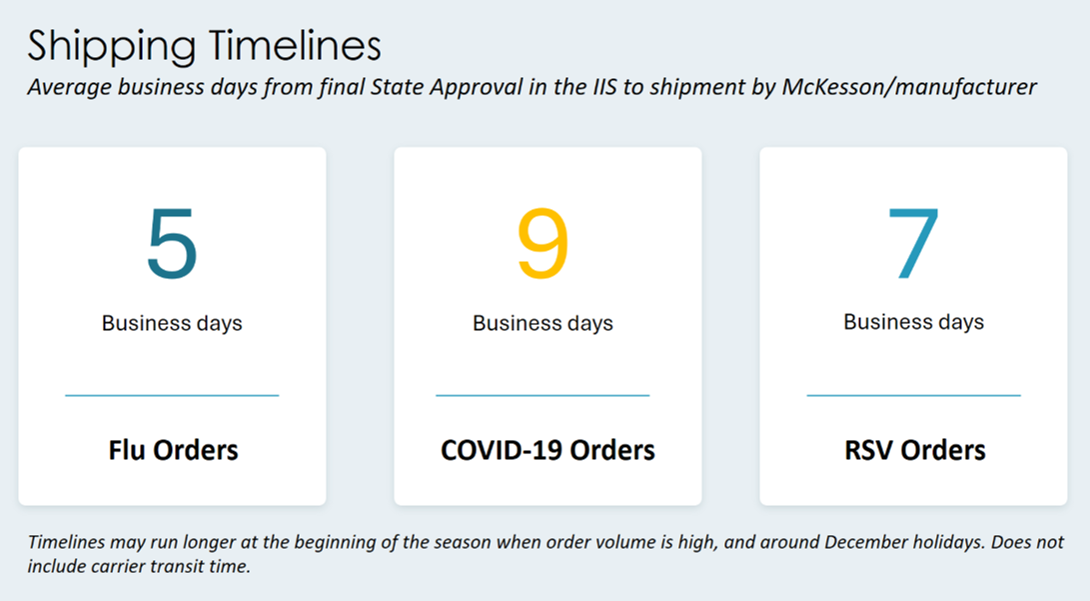 The above table shows the typical time between final approval of an order in the IIS ("State Approval") and shipment of the vaccine by McKesson or the manufacturer during the 2025-26 respiratory season. The timelines include weekends and holidays, but do not include time in transit after vaccine has shipped. DOH does not control the shipping timeline. This information is provided as a reference to help providers prepare.
Ordering Timelines
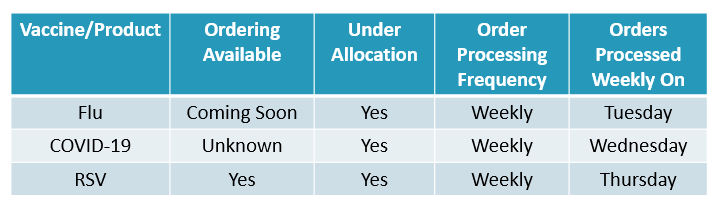 Ordering timelines are dependent on several factors, including product availability, manufacturer shipments, and federal approval processes.
Additional updates will be shared through the Vaccine Blurbs as information becomes available.
As we approach the 2026-2027 season, we want to provide an update about the availability of the 2025-2026 formulation COVID-19 vaccines for the remainder of the 2025-2026 season.
Moderna: 2025-2026 vaccines will continue to be available for provider ordering until the 2026-2027 formulation is approved. This includes vaccines for children 6m-11 years ( 80777-0113-80) and vaccines for those 12 years+ (80777-0112-96).
Pfizer: 2025-2026 vaccines are no longer available.
Sanofi: 2025-2026 vaccines are no longer available.
At this time, we do not have information about when 2026-2027 formulation COVID-19 vaccines will be approved. We will share updates as we receive them.
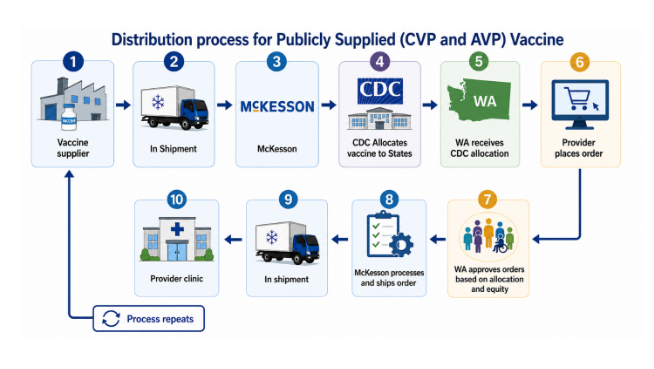 Respiratory season vaccine distribution works differently than distribution of routine childhood vaccines. Limited availability at the beginning of respiratory season is expected every year and is a normal part of the vaccine supply process.
It is not possible to manufacture and ship hundreds of millions of vaccine doses at one time. Instead, vaccine is distributed in phases throughout the season.
As individual lots receive FDA approval, manufacturers begin shipping product to CDC's McKesson distribution facilities. From there, CDC and DOH use an allocation process to distribute available vaccine equitably among providers.
Because vaccine becomes available in phases, there are limited doses available at the start of every respiratory season. Allocation timing and quantities may vary by product and throughout the season as additional supply becomes available. Supply typically improves over time. Early-season limitations do not necessarily indicate a shortage for the entire season.
Understanding this distribution process can help you plan clinics, set appropriate expectations, and understand DOH limitations.
The Washington State Department of Health is hosting a respiratory season vaccine updates webinar in September. The webinar will cover:
- Respiratory season clinical overview and vaccine recommendations.
- Respiratory season vaccine allocation and the ordering process.
- Strategies to improve clinic workflow for respiratory season vaccines.
Date: September 17, 2026
Time: 12:00 p.m. PDT
Webinar Registration - TRAIN.org
Continuing education (CE) credits are available for nurses, medical assistants, pharmacists, pharmacy technicians, and naturopathic physicians. The webinar will be recorded and CEs will be available for watching the recording.
A recording of the August 6 CVP Training Series: Respiratory Season Preview webinar is now available on our Training webpage, along with the training slides.
If you have any questions, please contact us at WAChildhoodVaccines@doh.wa.gov.
If your facility experienced vaccine loss as a result of the wildfires in the Spokane area, please document the event in the “Corrective Action” section of the August Vaccine Loss Survey.
The archive of past Vaccine Blurbs has moved! You can catch up on past editions using the links posted in the Vaccine Blurbs section of the Childhood Vaccine Program webpage.
|