|
Please join us for our upcoming CVP Training Series: Respiratory Season Preview
We will share updates on influenza, COVID-19, and RSV products for the 2026-2027 respiratory season. There will be a focus on vaccine ordering and distribution to support timely and effective immunization efforts as well as information on specific storage and handling requirements.
Date: August 6, 2026
Time: 12PM-1PM
As we approach the 2026-2027 season, here is an update on the availability of the 2025-2026 COVID-19 vaccines for the rest of this season:
-
Pfizer: The 2025-2026 vaccines will be available for provider ordering until 5 p.m. on Wednesday August 5. This includes vaccines for children aged 5 to 11 years (00069-2501-10) and those 12 years and older (00069-2528-10).
-
Moderna: The 2025-2026 vaccines will be available for provider ordering until the 2026-2027 formulation is approved. This includes vaccines for children aged 6 months to 11 years (80777-0113-80) and those 12 years and older (80777-0112-96).
-
Sanofi: 2025-2026 vaccines are no longer available.
- Before submitting a new COVID-19 vaccine order, please check the Vaccine Advertisement screen within the Immunization Information System (IIS) to see if the vaccines you need are available for transfer from another provider. Likewise, if your facility has vaccine or immunization products that cannot be used before they expire, please advertise them through the IIS so they can be transferred to another provider and administered before expiration.
- The CDC may ship COVID-19 vaccine with as few as 28 days until expiration. To help minimize vaccine waste, providers are encouraged to place smaller, more frequent orders.
- At this time, we have not received information regarding the approval of the 2026–2027 COVID-19 vaccine, however, based on previous seasons, ordering is expected to open in late September to early October. We will share updates with providers as they become available.
The supply chain and distribution of respiratory season vaccine products, namely influenza and COVID-19 vaccines, follows a different process from other routine childhood vaccines. Because it is impossible to produce and ship hundreds of millions of doses all at once, distribution of these vaccines occurs in a phased manner. As lots are FDA approved, manufacturers begin shipping to CDC’s McKesson facilities. Due to the phased distribution, there are a limited number of doses available at the start of every respiratory season. CDC and DOH uses an allocation process to equitably distribute the limited doses. The timing and schedule of allocations can vary by product and time of year. Vaccines are limited at the start of the season and supply improves over time. These limitations can last a few weeks, a few months, or all season. Sharing this background may be helpful for clinic planning purposes as well as understanding DOH limitations. The process follows a specific cycle once shipped by manufacturers:
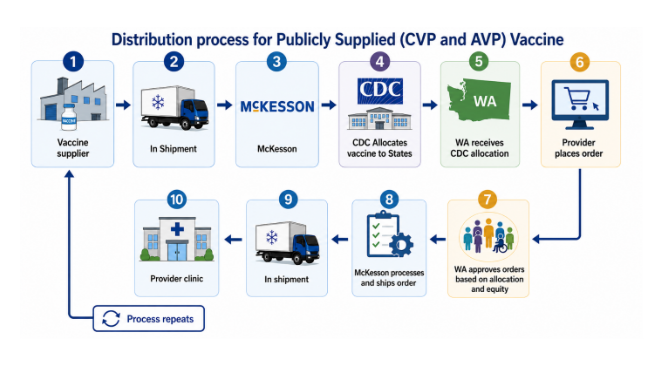
Ordering timelines are dependent on several factors, including product availability, manufacturer shipments, and federal approval processes.
RSV Products
- Ordering is expected to open on August 10
Influenza Vaccine
- Ordering timeline is dependent on FDA approval and receipt of doses from manufacturers
- Based on recent seasons, ordering is expected to open between mid-August and Labor Day
COVID-19 Vaccine
- Ordering timeline is dependent on FDA approval and receipt of doses from manufacturers
- Based on previous seasons, ordering is expected to open in late September to early October
Additional updates will be shared through the Vaccine Blurbs as information becomes available.
RSV ordering will open August 10 in advance of RSV administration beginning October 1. This will allow time for providers to order and receive product without being impacted by possible shipping delays from the volume of orders processed for COVID and flu at this same time.
- Providers are encouraged to place smaller, more frequent orders in alignment with their monthly Recommended Order Quantity (ROQ). No ordering cap beyond ROQ will be in place this season.
-
RSV orders will initially be processed each Thursday. Order processing frequency will increase as product availability improves and supply is able to meet demand.
-
RSV products are under allocation by CDC and there will be a limited number of doses available each month. This is expected each season.
-
Abrysvo will be available to order through special request only. This product is used for pregnant people <19 years old through the CVP. This special-order process is to reduce waste from unnecessary ordering. Please send a request email to
Steps to Prepare:
- The flyer Respiratory Success- Tips to Start the Season Strong contains helpful tips and best practices for a successful start to the season.
- The Preparing for RSV Season webinar recording and slides are now available. We encourage you to watch the recording and download the slides to revisit key information and share them with your team.
-
Prepare your Systems Before the Season: Ensure your EHR/EMR, scheduling processes, standing orders, and billing systems are ready for respiratory season. Additionally, clean up IIS inventory by deactivating expired lots. Preparing now can prevent delays, missed opportunities, and billing issues.
-
Use Last Year's Data to Plan Orders: Review your practice’s monthly vaccine administration (not just your order history) from the 25–26 respiratory season. Use the Recommended Order Quantity (ROQ) calculator before placing vaccine orders.
-
This Spreadsheet contains vaccine administration data from the IIS as reported by your facility. The Washington State Department of Health (DOH) will use this data this season when reviewing and approving order quantities. The spreadsheet contains data on flu, COVID-19, and RSV, which can be filtered by your facility's PIN. Please review your facility's data for awareness and against your own data and address any data quality concerns.
-
The suggests how many vaccine doses your facility should order. It is a general guide and does not account for seasonality or other factors that might increase your vaccine needs. Regularly check your vaccine inventory to ensure you have enough supply. Use your past administration data when calculating your order and make sure your inventory is correct.
Healthcare providers who have nirsevimab (Beyfortus) that is expiring before October 1 may use clinical judgement in determining when to give infant RSV antibodies and may give them outside the usual recommended timing of October through March. Special circumstances may also need to be considered, such as international travel or domestic travel to areas of increased RSV activity, or concerns that the infant or child may not return for a visit when infant RSV antibodies should ideally be administered. Healthcare providers can use clinical judgment to adjust the timing of infant RSV antibody administration for individual patients. Reference: RSV Immunization Guidance for Infants and Young Children | RSV | CDC
New this year, all providers must submit a Vaccine Choice form to select RSV and/or COVID-19 vaccine order sets for the upcoming season.
You will not have access to a respiratory order set without a completed form.
If you have not submitted yours, please send the completed form by email to WAChildhoodVaccines@doh.wa.gov as soon as possible.
|