|
With Spring in full swing, we wanted to share some updates about WA PRAMS.
Funding
Washington PRAMS (WA PRAMS) received Supplemental funding from CDC for 2026 data collection, from May 2026–April 2027. Additional funding from the federal Maternal and Child Health Block Grant and state general fund will support data dissemination and use.

Survey Operations
WA PRAMS began data collection for the 2025 birth cohort in October 2025. Given the delayed start, we committed to 6 monthly cohorts. As of mid-May, we have closed 4 cohorts with unweighted response rates just under 50%.
We plan to collect 12 months of data in 2026, pending no major loss in resources. We received CDC IRB approval to reduce phone call recruitment. This reduction will allow us to continue operations with our current staff.
|
Data Availability
WA PRAMS 2023 weighted dataset is available through our request link on our website. CDC has contracted with a vendor for data cleaning and weighting for the 2024 and 2025 data sets. We will post them on our webpage when they are ready.
Experiencing depression and anxiety during the perinatal period can have negative effects on the birthing person and their babies. In 2023, we expanded our survey questions on mental health to include postpartum anxiety symptoms, provider mental health screening and referral practices, and self-identified need for mental health services and barriers to receiving care.
In 2023, 1 in 5 postpartum people reported either depression or anxiety symptoms since their baby was born. Anxiety symptoms were more common than depression symptoms (19% vs. 10%). Reported symptoms were higher among those 20–24 years old, not married, and those enrolled in Medicaid.
Provider screening rates for mental health symptoms was high—86% (83%–88%). However, fewer people reported receiving education about what do if they felt depressed or anxious (79%,76%–82%). About 1 in 4 people reported feeling like they needed mental health services postpartum. Of those, 28% (24%–30%) were able to receive the services they needed.
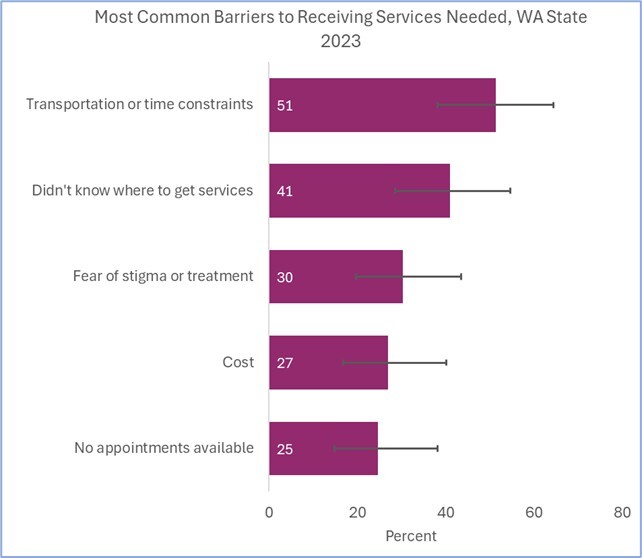 Top barriers to getting services included not having transportation or time (51%) and not knowing where to access services (41%).
What the Data Show: Even with strong provider screening and patient education, not knowing where to find services remains a top barrier. Understanding barriers to mental health services could potentially inform new policies and programs to expand postpartum mental health access, a recommendation from Washington’s 2025 Maternal Mortality Review Panel Report.
Guest Article by JanMarie Ward and Cindy Gamble, American Indian Health Commission
American Indian and Alaska Native (AI/AN) mothers and infants face severe, persistent health disparities—in Washington State and nationwide. Washington State Maternal Mortality Review Panel data (2019, 2023, 2025) consistently identify AI/AN people as facing the greatest risk of maternal mortality in the state.[1] AI/AN infants are born preterm at consistently high rates, and infant mortality exceeds the state average—driven primarily by preterm birth and low birth weight.[2] Our health system has failed to prevent or address this crisis.
The missing piece is Tribal leadership. Meaningful solutions must be tribally-led—from planning and implementation to data collection and dissemination—and informed by AI/AN communities from the start. Sustainable, tribally developed surveillance methods are essential to ensure that institutional systems hold accurate, relevant data grounded in Tribal sovereignty.
This critical and necessary process has resulted in the innovation of the AIHC AI/AN PRRAAMSS: a Tribally designed survey and surveillance structure informed by an AI/AN Advisory Committee and researchers. It documents the experiences of AI/AN mothers and parents across their lifetime and current perinatal journey—capturing not just the what of maternal health disparities, but the why.
This work intentionally applies Indigenous, trauma-informed approaches, shifting away from two-hundred years of extractive harmful western research practices. It addresses root causes, upholds Tribal sovereignty and honors elders and cultural knowledge keepers while building trust at the community level.
The history, culture, and lived experiences of AI/AN people are shaped by more than five-hundred years of racism, discrimination, and systemic harm. The depth of intergenerational trauma is difficult to fully comprehend—not only the losses, but the relentless accumulation of microaggressions and erasure that AI/AN people navigate every day.
In January 2026, the Department of Health and Human Services published a notice in the Federal Register (Docket No. CDC-2025-0750) proposing 3 additional years for data collection for PRAMS.
Many of you responded to the call to action to submit comments in support of PRAMS—thank you. Your advocacy for this important surveillance system is invaluable.
Two recently published reports reflect on changes to PRAMS over the past year and the overwhelming response to the Federal Register Notice:
- WA PRAMS 2023 weighted dataset is available through our request link
- Washington DOH Perinatal Dashboard is updated and live
-
NEW COVID-19 Vaccination During Pregnancy data brief is available on the WA PRAMS webpage. Upcoming data briefs will also be posted here when available.
Funding for PRAMS is provided by Cooperative Agreement 6 U01DP006601-05-02 from the U.S. Centers for Disease Control and Prevention (CDC). Additional support is provided by Washington State.
|