|
We work together to connect resources, champion equity, and strengthen health systems across rural Washington. |
|

Apply for Washington’s Rural Health Transformation (RHT) Program Advisory Committee to help shape projects and policies that make a difference in rural communities. Professionals in public health, health care, and community members with lived experience are encouraged to apply. Review the details HERE and submit your information by April 24 for consideration.
Disclaimer: This program is supported by CMS/HHS as a financial assistance award totaling $181,257,515.06 with 100 percent funded by CMS/HHS. The contents are those of the author and do not necessarily represent the official views of, nor an endorsement, by CMS/HHS, or the U.S. Government.
|
|
|
DOH is hosting two meetings for public feedback on its draft rule language for Charity Care. The proposed change includes updating language to clarify hospital responsibility in order to ease patient burden and improve patient access. Visit Charity Care Rules in Progress to view materials from past workshops and additional details about this rulemaking effort.
Register for the Public Feedback Meetings
|
|
TriState Health in Clarkston and Providence Mount Carmel Hospital in Colville were recognized as 2026 Top 100 Critical Access Hospitals by the Chartis Center for Rural Health. The Top 100 awards program celebrates outstanding performance among the nation’s rural hospitals based on the results of the Chartis Rural Hospital Performance INDEX®.
“The delivery of care within rural communities is perhaps more complex today than at any point in recent memory. This year’s Top 100 Critical Access Hospitals and Top 100 Rural and Community Hospitals have emerged as true leaders – committed to their mission through a powerful combination of resilience, dedication and innovation,” said Michael Topchik, executive director of The Chartis Center for Rural Health. “We’re delighted to recognize this year’s winners and celebrate their Top 100 status.”
Now in its 16th year, the INDEX is the industry’s most comprehensive and objective assessment of rural hospital performance. Leveraging publicly available data, the INDEX is used nationwide by rural hospitals, health systems with rural affiliates, hospital associations, and State Offices of Rural Health to measure and monitor performance across hospital operations, quality, patient perspective and finance.
|
|
|
When you are an NHSC-approved site, you can hire NHSC Scholars or Student-to-Service participants. Eligible clinicians at your approved site can apply for NHSC Loan Repayment Programs. And you can post job opportunities on the Health Workforce Connector and participate in HRSA Virtual Job Fairs.
To apply, your site must:
- Be an eligible health care facility
- Provide comprehensive primary health care services (medical, oral, or behavioral health)
- Be located in a Health Professional Shortage Area (HPSA)
- Meet all requirements in the NHSC Site Reference Guide and NHSC Site Agreement
Apply by May 19, 2026
|
|
|
The public comment period is open for feedback on the Centers for Medicare & Medicaid Services’ (CMS) proposed information collection as part of a new program. The program would let certain types of providers and facilities attest that they meet the applicable CMS Conditions of Participation instead of having to go through state recertification surveys every 6 years. This would apply to:
- Comprehensive Outpatient Rehabilitation Facility (CORFs)
- Outpatient Physical Therapy/Speech Language Pathology (OPT/SLP)
- Rural Health Clinic (RHC) Providers
- Portable X-Ray (PXR) Suppliers
|
|
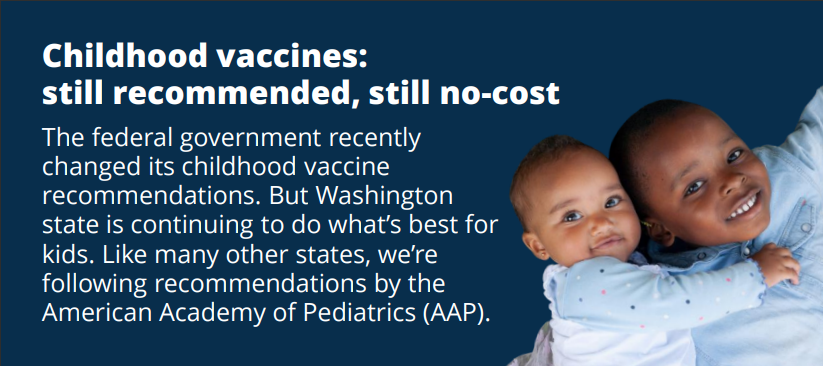 DOH and Seattle & King County Public Health have released a new co-branded postcard highlighting that childhood vaccines remain recommended and available at no cost through the Childhood Vaccine Program (CVP).
Designed for community outreach, the postcard is available in 19 languages to support equitable access to vaccine information. Providers and partners can download this and other resources from the Immunization Materials website.
|
|
|
Washington's Health care, Emergency, and Logistics Tracking Hub, WA HEALTH, is seeking investment to transition WA HEALTH from a temporary emergency tool into a sustainable surveillance system to support health care system readiness and response.
What This Means
Rapid, data-driven responses require accurate and timely data on our health care system’s capacity. This year we face increased health threats from Washington hosting FIFA World Cup games, growing global instability, and communicable diseases such as measles.
Our Request to You
We are asking hospitals to continue submitting WA HEALTH data during this transition period. Continued participation will:
- Support statewide situational awareness to provide a near real-time pulse on system capacity
- Enable more effective coordination and interoperability with regional and national federal systems, especially during emerging or high-visibility events
- Maintain data integrity to ensure continuity of historical data and trend analysis, preventing gaps in health care and public health planning
- Inform ongoing development of WA HEALTH to better meet your operational needs
Where We’re Headed
We are working on strengthening WA HEALTH to deliver value to health care partners, not just during emergencies, but in day-to-day operations. This includes:
- Enhancing data usability and timeliness
- Aligning with federal reporting requirements where appropriate
- Reducing reporting burden through improved system design and integration
|
|
 |
|
DOH is now accepting nominations for the 2026 Immunization Champion Award by May 15, 2026. This annual award, presented in partnership with national immunization organizations, recognizes individuals who demonstrate leadership, innovation, and commitment to promoting immunizations at the community level. Nominations are reviewed by health professionals across Washington, with one champion selected to represent the state. More information, including past state immunization champions, is available here. |
|
|
|
DOH is evaluating health profession licensing fees in response to direction from the state legislature. Our goal is to ensure that licensing fees are equitable, transparent, and aligned with the cost of regulation. We are seeking input from licensed professionals, associations, and community members to better understand how current fee structures may impact different professions and populations.
Listening Sessions
1. Monday, April 27
Time: 11:00 am - 1:00 pm PT
Register here to participate
2. Tuesday, April 28
Time: 5:30 pm - 7:30 pm PT
Register here to participate
3. Wednesday, April 29
Time: 11:00 am - 1:00 pm PT
Register here to participate
4. Thursday, April 30
Time: 5:30 pm - 7:30 pm PT
Register here to participate
Written comments may be submitted by April 30, 2026, using one of the following options:
|
|
Rural Health Information Hub's latest podcast episode features Kathy Griffis, COO of Titus Regional Medical Center in Mount Pleasant, TX. She focuses on her facility's recent efforts to reduce violence and ensure safe healthcare environments for their staff and patients. |
|
 |
|
|

The Rural Health Community Capacity Academy supports underserved communities by providing organizations with personalized guidance on rural health development and community health. NRHA is now accepting applications through May 31, 2026 for the 2026-2027 cycle of the Rural Health Community Capacity Academy. Eligible organizations include but are not limited to non-profit organizations, rural health clinics, federally qualified health centers, medical centers, local governments, and Tribal governments.
|
|
|
|
Presented by Southwest Washington AHEC and Pri-Med Institute
This free, on-demand course will provide you with clarity and confidence in patient pain assessment, treatment planning, and ongoing pain support.
- Pain Assessment: deepen your understanding of pain assessment and identification of risk factors for opioid misuse.
- Patient Safety & OUD Management: Techniques to counsel patients on safe use, storage and disposal of opioid analgesics.
- Evidence-based Pain Management: Explore strategies for non-opioid and non-pharmacologic pain treatments and learn how to develop effective individualized multimodal pain management plans.
|
|
|
Washington's Health Workforce Sentinel Network questionnaire is open now! With rapidly changing funding and policy conditions, employer experiences are more important than ever.
When employers complete the Sentinel Network questionnaire, it ensures that Washington’s workforce decisions are grounded in real-world knowledge.
|
|

A recent article published by the National Academy for State Health Policy (NASHP) describes strategies states are implementing to meet the oral health needs of their rural communities. It covers initiatives related to telehealth, expanding the dental workforce and medical-dental integration.
2026 National Association of Rural Health Clinics Office Hours
Do you have RHC questions? Mark your calendars for the 2026 NARHC Office Hours! Join the Zoom room anytime between 10 am and 11 am PT.
- May 13 | 27
- June 24
- July 8 | 22
- Aug. 5 | 19
Register here
USDA Rural Development has launched a new program eligibility lookup tool. The tool can be used to determine eligibility across multiple USDA programs including Community Facilities, Electric, OneRD Guarantee, Rural Business and Cooperative Services, and Water and Environmental Program.
Rural Health Information Hub's topic guide focusing on education and training of the rural health care workforce just received an update. This guide provides information on career awareness, exploration, and development programs to grow the health care workforce in rural areas. It also explores rural training programs offered by medical schools and rural residency programs and covers other types of training and educational opportunities that can be used to support and enhance the rural health care workforce.
|
|
Questions? Contact us at RuralHealth@doh.wa.gov |
|
|
|
|