|
Dear CVP and AVP Providers,
We hope everyone is safe and well during this period of intense weather and record-breaking flooding. First and foremost, please prioritize the safety of your staff during any emergency, as outlined in your (pg. 18). Please stay safe.
We recognize that many of you have emergency plans in place should vaccine product need to be evacuated. If you need support, the Office of Immunization (OI) can assist in the following ways:
- Due to the holiday vaccine shipping pause, new orders cannot be placed. If doses are needed before the first week of January, providers will need to rely on transfers. DOH Vaccine Management can help locate product, if supply is available.
- If both your primary location and required backup location are impacted, we can help identify an alternate location for storage.
Physical Transport or Storage of Vaccines
The Office of Immunization and the Office of Emergency Medical Logistics are coordinating closely. During a declared emergency, Medical Logistics teams may be able to assist with the physical transport or short-term storage of vaccines if a provider has exhausted all other options. Support is dependent on available resources at the time of the request.
To request Medical Countermeasure (MCM) logistics support, email logistics@doh.wa.gov and mcm@doh.wa.gov. The Medical Logistics or MCM team will respond during business hours and assess how best to support based on available resources. For urgent, after-hours requests, please contact the DOH Duty Officer at HanAlert@doh.wa.gov or call 360-888-0838.
This is the last week for vaccine choice. The last day to request changes is Friday December 19th.
During this time providers can fill out the Vaccine Choice form to request a change in the brand of vaccine they receive for vaccines with more than one brand available. Vaccines with only one brand option are included on all order sets.
You only need to submit a form if you are requesting a change. If you are keeping the same vaccines no form is needed. Submit forms by e-mail to WAChildhoodVaccines@doh.wa.gov.
If you have any questions please contact Jacki Stockdale at jacki.stockdale@doh.wa.gov.
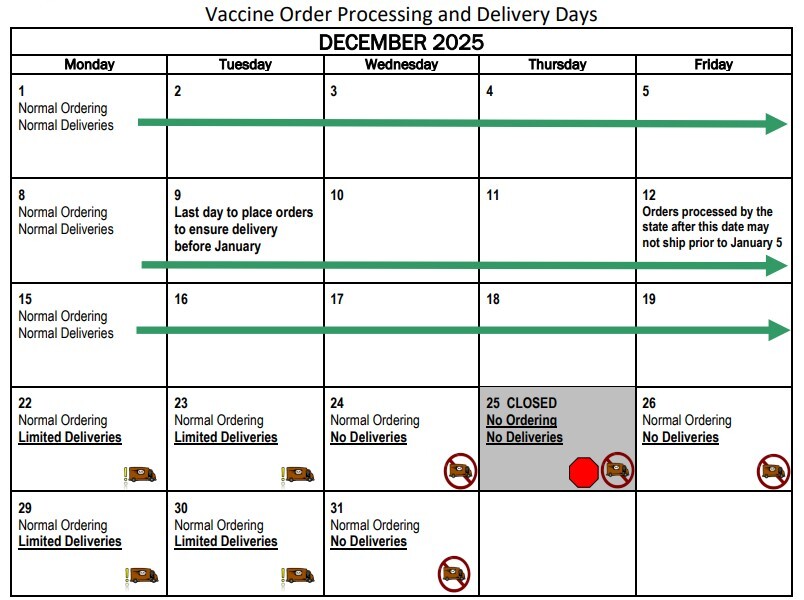
With the holidays quickly approaching, please be mindful of shipping delays, limited or no shipping days, and plan your vaccine orders accordingly. Orders submitted after December 9th may not ship before January 5th. Please note that there will be no vaccine deliveries made during the week of Christmas and New Year's. You can place an order off your typical schedule if needed. Please ensure your accountability reports are up to date prior to placing orders to ensure expedited processing. It's also a good idea to update your shipping hours in your provider agreement if needed. Check out the holiday shipping calendar on our website for more information.
 |
Our Vaccine Temperature Monitoring Logs have been updated to make documentation easier and to meet current accessibility standards. All refrigerator, freezer, and ultra-cold storage logs are now combined into a single document. The new fully fillable PDF allows you to record daily temperature readings on your computer or print the form for handwritten entries.
Reminder: You must check vaccine temperatures twice each workday, when you start and end your shift, and write them on the log. Each morning, also record the highest and lowest temperatures the unit reached in the past 24 hours (the min/max reading). As a final step, reset or clear the min/max readings.
Starting January 1, 2026, all temperature excursions must be reported immediately through your REDCap portal. Timely reporting of temperature excursions helps ensure vaccines remain safe and effective before being administered to patients. Prompt review of excursion details allows for quick determination of vaccine viability, protecting patients and preventing the use of compromised vaccine.
Please do not wait until you submit your monthly temperature logs to report an excursion.
To report a temperature excursion:
-
Log in to your REDCap portal and select "Report temperature excursion and vaccine viability."
-
Gather any viability information you have from the manufacturer and your DDLs, along with a list of the affected vaccines.
-
Follow the prompts in the form and submit your report. We will reach out if we need any additional details.
-
Once your excursion report is submitted, you won't need to complete another viability survey when submitting your monthly temperature logs. However, when you submit your monthly temperature logs you will still need to note the temperature excursion in your REDCap survey.
-
At the beginning of your monthly survey under the storage unit affected select “Yes” for “Did a temperature excursion occur over this month for this unit?”
-
At the end of the monthly survey, you’ll see this question: “Have you completed a vaccine viability survey for this excursion?" If you’ve already reported the excursion, simply select "Yes" and continue with the rest of the form.
If you have any questions or need help with a temperature excursion, please email us at wachildhoodvaccines@doh.wa.gov and we will connect you with our Storage and Handling Coordinator.
Check out The Unbiased Science: Flu Vaccine Interactive Escape Room! This interactive training provides several clinical scenarios to increase your knowledge and confidence to address questions about pediatric flu vaccination.
The West Coast Health Alliance (WCHA), Washington State Department of Health (DOH), and leading national medical groups continues to recommend hepatitis B vaccine at birth and recognizes that this routine recommendation has reduced pediatric hepatitis B infections by 99 percent. Health care providers should continue to routinely offer hepatitis B vaccination to all newborns, with the first dose given within 24 hours of birth for infants weighing at least 2,000 grams (4 pounds, 7 ounces), followed by completion of the full vaccine series. Read the full DOH News Release.
The newly formed Advisory Committee on Immunization Practices (ACIP) recently met and voted the following:
- The birth dose of hepatitis B vaccine is changed from a routine recommendation to individual-based decision making (also known as shared clinical decision-making) for infants born to parents who test negative for hepatitis B infection. ACIP also voted to suggest that the initial dose be given no earlier than 2 months of age. ACIP did not change recommendations for infants born to parents who test positive for hepatitis B infection or have an unknown status – these infants should continue to be vaccinated and given hepatitis B immunoglobulin within 12 hours of birth.
- When evaluating the need for a subsequent hepatitis B vaccine dose in children, parents should consult with health care providers to determine if a post-vaccination anti-HBs serology testing should be offered.
Resources:
We’ve received several questions recently about the need for a 0.25 mL influenza vaccine for infants. Sanofi Pasteur discontinued the 0.25 mL Fluzone presentation after the 2017–2018 flu season.
For children 6 months through 18 years of age, the appropriate products are the 0.5 mL pre-filled syringe formulations of Fluzone, FluLaval, or Flucelvax. All three vaccines are licensed for use starting at 6 months of age.
Please note: The 0.5 mL pre-filled syringe is the full recommended dose. Do not administer a 0.25 mL dose, as this is not a complete dose for children 6–35 months and will leave the patient under-immunized.
|