|
|
Welcome to the Vaccines for Respiratory Illnesses (VRI) Newsletter! Here you'll find the latest news and information on respiratory illness vaccine related topics.
- Special Observance
- Question of the Week
- Latest News
- Clinical Updates
- Training and Events
- Resources
Hi VRI Newsletter subscribers,
We’re conducting a short survey to help us improve the content of this newsletter. Your feedback will guide us in making future editions more relevant, useful and engaging for you.
Please submit your response by October 31, 2025 (survey will close at 11:59 PM). Thank you for helping us make the VRI Newsletter better!
|
|
|
Dear CVP and AVP Providers, and Immunization Partners,
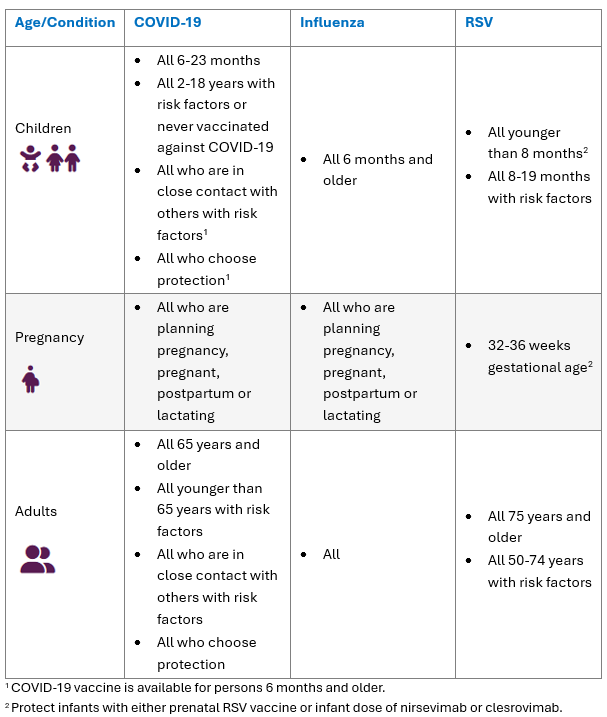
DOH affirms the West Coast Health Alliance (WCHA) respiratory vaccine recommendations that were announced for the 2025-2026 season. These recommendations have been reviewed and are supported by the Washington Vaccine Advisory Committee (VAC).
COVID-19 vaccine has benefits for all individuals 6 months and older, and is recommended for those in the specified age and risk groups below and for all who choose protection. Influenza vaccine is recommended to all individuals 6 months and older. RSV immunization is recommended for those in the specified age and risk groups.
 MMRV Vaccine Guidance DOH MMRV vaccine guidance aligns with WCHA recommendations, the American Academy of Pediatrics' (AAP) science-based guidance, and has been reviewed and supported by the Washington Vaccine Advisory Committee (VAC).
- DOH recognizes multiple safe and effective options to immunize children against measles, mumps, rubella, and chickenpox, including MMR, varicella, and MMRV vaccines. Choosing the right vaccine should be a shared decision between parents and healthcare providers.
- For children 12 months through 4 years old, DOH continues to recommend the MMRV vaccine as an option when appropriate based on clinical considerations and shared decision-making.
- DOH continues to offer MMRV for children under 4 through the CVP.
Ordering Update CDC has opened COVID-19 vaccine ordering for the 2025–2026 season. DOH has completed pre-ordering with providers, and vaccine shipments should begin arriving within this week. More details are available here.
- All respiratory products (flu, COVID-19, and RSV) are available for provider ordering through the Childhood Vaccine Program (CVP) and Adult Vaccine Program (AVP).
- Providers may continue to order MMRV for children under 4 through CVP.
Helpful Resources
Thank you for your continued partnership in protecting Washington communities through immunization.
Warm regards,
Office of Immunization
October marks the unofficial start of respiratory disease season
DOH Publishes Flu Reports
DOH sends annual vaccination reminder letter to Aging and Long-Term Support Administration (ALTSA) Providers and Administrators
CDC opens COVID-19 vaccine ordering for 2025-2026 season
October 1 kicks off the season of giving RSV preventive antibody to infants in most parts of the United States
Upcoming ACIP Meeting (Dates TBD)
- The ACIP was scheduled to reconvene on October 22-23; however, the CDC website now indicates that dates for the next 2025 meeting are now TBD.
- CDC advisers create new work group to review childhood vaccines, according to a document posted on the CDC website.
|
|
|
In Case You Missed It: DOH Launches New Respiratory Immunization Dashboard
DOH has launched a new Respiratory Immunization Dashboard, which brings together immunization data on flu, COVID-19, and RSV for both adults and children in one place. You can explore vaccine coverage by region and demographic, uptake trends over time, and total doses administered statewide. With respiratory virus season here, vaccines remain the best protection against serious illness, especially for young children, older adults, pregnant people, and those in group settings.
New Vaccine Data Tool from the Vaccine Integrity Project
The Vaccine Integrity Project released a data visualization tool to access the data they reviewed along with an interactive infographic to view medical society immunization recommendations in one place. These resources promote transparency, reproducibility, and allow for customized and interactive analysis. A peer-reviewed journal manuscript and summary from this systematic review and meta-analysis are forthcoming.
NFID/Fraym US Vaccine Uptake Dashboard is Now Available Via Open Access
This dashboard is intended for stakeholders working to improve vaccination rates across the US. Use the US Vaccine Uptake Dashboard to map attitudes, behaviors, and barriers to adult (18+) vaccination against COVID-19, influenza (flu), respiratory syncytial virus (RSV), and pneumococcal disease to create custom messages and resources for specific groups in communities across the US.
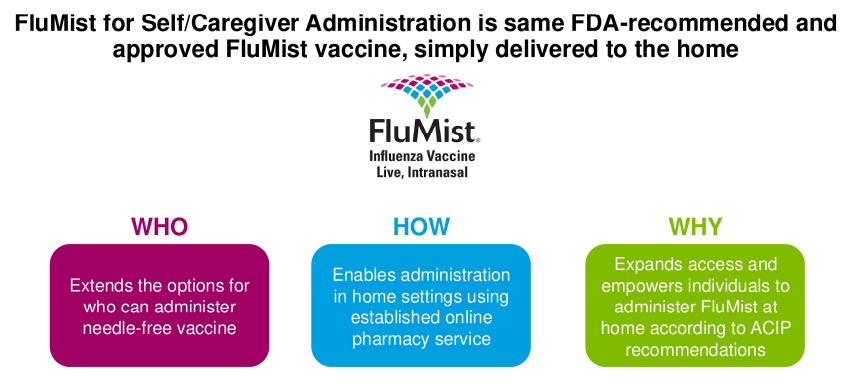
FDA approved AstraZeneca’s FluMist nasal spray (live attenuated influenza vaccine) for self- and caregiver-administration for persons 2 through 49 years old. A caregiver (18 years or older) should administer FluMist to children 2 through 17 years. Find out more about ordering, eligibility, insurance, shipping, administration guidance, documentation. Note: The self-administered FluMist home program is not available through the WA Childhood Vaccine Program (CVP) or the Adult Vaccine Program (AVP).
Self-administered doses of FluMist will be electronically reported to the WA Immunization Information System (WAIIS). Providers should be aware of the possibility for invalid doses and the need for a second dose for some patients.
- There may be increased doses of FluMist, MMR, or varicella showing up as invalid due to a shorter than recommended interval between live vaccines.
- If not given on the same day, a 28-day minimum interval is recommended between live vaccines, including FluMist, MMR, or varicella for optimal protection.
- For example, a 4-year-old patient who received self-administered FluMist, then MMR and varicella less than 28 days later will have the MMR and varicella doses flagged as invalid. The MMR and varicella doses will need to be repeated. If FluMist is given too soon after MMR or varicella, the FluMist needs to be repeated to achieve the best immune response.
- In addition, a child 6 months through 8 years who did not receive 2 or more flu vaccine doses before July 1, 2025, or whose vaccination history is unknown requires 2 doses of flu vaccine this season. Providers can reinforce this recommendation with parents/guardians.
 |
From Flu to RSV: What You Need to Know About Overlapping Viruses – Flu season is no longer just about the influenza virus. Instead, multiple respiratory viruses circulate simultaneously, notably influenza (flu), respiratory syncytial virus (RSV), and, more recently, COVID-19. Understanding these viruses, how they spread, their symptoms, their risks, and the preventive steps you can take is vital to protecting your family this fall and winter.
The Burden of Flu — How Influenza Hits Your Family’s Wallet (and What You Can Do About It) – For families, seasonal influenza isn’t just a health problem, it’s an economic one. Medical bills, lost wages, childcare and the hidden costs of disrupted daily life combine to make flu a recurring financial stressor. This post explains where those costs come from, who feels them most, and concrete steps families can take to reduce the financial hit.
|
|
 |
- In the largest study of young people to date (over 460,000 children and young adults), those infected twice were twice as likely to develop Long COVID, with symptoms affecting major organs, fatigue, and changes in taste and smell. Researchers emphasize the cumulative impact of reinfections and the continued importance of vaccines and preventive measures to protect long-term health.
- A large study of U.S. military veterans published on October 8 found that the 2024–2025 COVID-19 vaccine helped prevent severe outcomes. Researchers followed participants for six months to assess the risks of three outcomes: COVID-19–associated emergency department visits, hospitalizations, and deaths.
-
A French study finds no link between mRNA COVID vaccines early in pregnancy and birth defects. "Our study confirms the fetal safety of mRNA COVID-19 vaccines during pregnancy, showing no increased risk of major congenital malformations (MCMs) and reassuring the millions of women worldwide who received these vaccines early in pregnancy," the authors wrote.
|
|
|
The Coalition to Stop Flu released their third annual “after action” report, The 2024-2025 Influenza Season: Outcomes and Policy Recommendations. The report summarizes the 2024-2025 season and the ongoing pandemic threat; highlights success stories and opportunities for improvement; and provides recommendations for federal policymakers.
Key Takeaways:
- Vaccination rates declined for the fourth consecutive season.
- Less than half of U.S. children were vaccinated, and only 38% of pregnant women received the flu vaccine.
- Tragically, 281 children died from flu last season, breaking the record we set just the previous year for the most pediatric deaths in a non-pandemic season.
- About half of these children had no underlying medical conditions, and 89% were not fully vaccinated.
|
|
|
Fall Vaccines for Marginalized Communities: Building Clarity, Guidance, & Trust
Date: October 22, 2025
Time: 10:00 AM PST
Register: Webinar Registration - Zoom
This webinar will equip clinicians, clinic staff, and community health workers with the latest guidance on delivering flu, RSV, and COVID-19 vaccines to marginalized and underserved populations, including migratory and seasonal agricultural workers, mobile people, and uninsured or underinsured individuals. The session will present current clinical recommendations, clarify evolving federal and state policies, and highlight strategies to reduce access barriers and strengthen vaccine uptake in community and workplace settings.
Vaccine Communication in an Age of Polarization
Date: October 23, 2025
Time: 11:00 AM PST
Register: North Dakota State University Center for Immunization Research and Education.
This webinar explores how false information and messaging missteps, particularly during the COVID-19 pandemic, have contributed to hesitancy and distrust. Participants will examine responses to vaccine hesitant individuals, learning which approaches foster productive dialogue and which may inadvertently reinforce skepticism. This session provides a deeper understanding of the factors driving vaccine hesitancy and the role of communication in public health. You can claim continuing education credit.
Vaccines and the Prevention of Bacterial Sepsis
Date: November 6, 2025
Time: 11:00 AM PST
Register: Sepsis Alliance Institute: Vaccines and the Prevention of Bacterial Sepsis
This informative webinar hosted by the Sepsis Alliance explores the essential role vaccines play in reducing the prevalence and burden of bacterial sepsis. This presentation highlights how immunization strategies disrupt the pathways that lead to severe infection, the rigorous processes that ensure vaccine safety and effectiveness in the fight against life-threatening illness, as well as key factors influencing vaccine confidence and hesitancy. CME and RN CE credits are available.
What's New With the Flu?
Date: November 13, 2025
Time: 10:00 AM PST
Register: Webinar Registration - Zoom
Join Immunize Colorado as they host Dr. Suchitra Rao, MBBS, MSCS, for her annual update on the 2025-20256 flu season, as well as other important information about respiratory virus season and vaccinations.
|
|
|
DOH VACCINE RECOMMENDATIONS
WHERE TO GET VACCINATED
COVID-19
FOR EVERYONE
FOR HEALTH CARE PROVIDERS & PARTNERS
FLU
RSV
RESPIRATORY ILLNESS DATA
FOR INDUSTRY
FOR SCHOOLS & CHILD CARE FACILITIES
FOR LONG-TERM CARE FACILITIES
FOR HEALTH PARTNERS
|
|
|
If you aren't already signed up for Vaccines for Respiratory Illnesses Newsletter, please visit the Department of Health's email subscribers page here. Once you enter your email, on the next page expand the Immunization topic, select Vaccines for Respiratory Illnesses Newsletter, and click submit.
|
|
This newsletter summarizes content beginning the week of October 5, 2025, and was sent out on October 17, 2025. |
|
|
|
|