|
Ordering of RSV products will not be opened until the excess in the field is transferred to providers who can use it. We currently have 1,800 doses of the 50mg product expiring 10/31/25 and 3,200 doses of the 100mg product expiring 11/30/2025. If you are in need of RSV vaccine, please check the Vaccine Advertisements in the IIS or email WAChildhoodVaccines@doh.wa.gov and we will help you locate product in your region. If have product in your inventory that expires later in the season, please consider accepting a transfer of the short dated product to help ensure it gets used.
As a reminder, do not attempt to return or discard RSV products currently in your inventory that have not yet expired. These doses are still viable and can be used until their expiration date.
We anticipate ordering for COVID-19 vaccines to be available between end of September and early October. CDC will open ordering following the CDC Director’s acceptance of the ACIP recommendations. ACIP is anticipated to meet September 18 & 19.
To minimize the risk of vaccine administration errors, providers should:
- Immediately remove all 2024-2025 COVID-19 vaccines from storage units, even if not yet expired
- Reconcile inventory of 2024-2024 COVID-19 vaccines in the IIS using the category "Spoiled" and reason "Expired BUD"
- After reconciling inventory, complete the Vaccine Return process to get a return label
- Remember to submit the return before inactivating the vaccine in the IIS
The Washington Department of Health (DOH) will host a webinar on Thursday, September 11th to discuss influenza, COVID-19 and RSV epidemiology, vaccination coverage, clinical overview, vaccine recommendations, and vaccine ordering and distribution. The webinar will be recorded and continuing education (CE) credits will be available for nurses, medical assistants, and pharmacists/pharmacy technicians. Please note that a Train.org account is required to register for the webinar and receive CE credits.
Date: September 11, 2025
Time: 12 noon PDT
Register Here
The Washington Chapter of the American Academy of Pediatrics (WCAAP) will host a webinar on Wednesday, September 17th to discuss best practices for reducing vaccine waste and protecting our communities this respiratory season. This webinar compliments the August 21st webinar hosted by Washington State Department of Health, "Ordering and Inventory Controls". You'll learn how to put DOH tools into practice, strategies to right-size your orders, and how your clinic can reduce waste while keeping vaccines available.
Date: September 17, 2025
Time: 7 am PDT
Register Here
The Washington Department of Health (DOH) published the WA COVID-19 Vaccine Standing Order. The standing order authorizes health care providers to administer the most updated versions of COVID-19 vaccine to all persons 6 months and older, including pregnant individuals. It is intended for individuals to receive COVID-19 vaccine “off label” when guidance differs from federal guidance. The standing order references guidance from national medical organizations:
- Pediatrics (ages 6 months–18 years): American Academy of Pediatrics (AAP)
- Pregnant Individuals (all ages as applicable): American College of Obstetricians and Gynecologists (ACOG)
- Adults (ages 19 years and older): American Academy of Family Physicians (AAFP)
Links to WA DOH COVID-19 Vaccine Standing Order, Summary of COVID-19 Vaccine Schedule and FAQs:
Standing Order:
COVID-19 Vaccine (PDF) | Russian - Русский (PDF) | Spanish - Español (PDF) | Vietnamese - Tiếng Việt (PDF)
For more details, refer to the COVID-19 Vaccine Schedule for Health Care Providers (PDF)
FAQs:
COVID-19 Vaccine Standing Order FAQ for Health Care Providers (PDF) | Russian - Русский (PDF) | Spanish - Español (PDF) | Vietnamese - Tiếng Việt (PDF)
COVID-19 Vaccine Standing Order FAQ for the Public (PDF) | Russian - Русский (PDF) | Spanish - Español (PDF) | Vietnamese - Tiếng Việt (PDF)
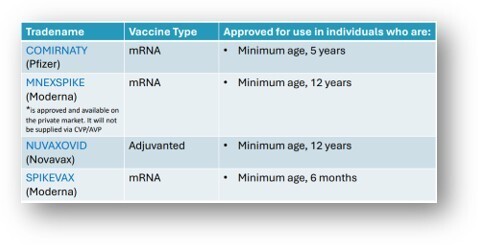
On August 28, FDA authorized updated 2025-26 COVID-19 vaccines. At the same time, FDA revoked Emergency Use Authorization for Pfizer vaccine for children 6 months through 4 years, Novavax COVID-19 Vaccine, Adjuvanted; Moderna COVID-19 Vaccine; and Pfizer-BioNTech COVID-19 Vaccine. See Emergency Use Authorization--Archived Information | FDA for details.
Moderna Spikevax is currently the only vaccine available for 6 months through 4 years. Vaccines with revoked EUAs must no longer be administered. Here’s a summary of FDA authorizations:
Here’s a summary of the available 2025-26 COVID-19 vaccines as covered in the WA DOH COVID-19 Vaccine Standing Order:
We have received questions from health care providers about administering nirsevimab in September, especially to infants born in January and later who haven’t previously received nirsevimab and will be turning 9 months old in October. The Department of Health Office of Immunization is following CDC guidance that allows for clinical judgement with special circumstances. Reference: RSV Immunization Guidance for Infants and Young Children | RSV | CDC
- Healthcare providers may use clinical judgement in determining when to give infant RSV antibodies and may give them outside of October through March. Special circumstances may also need to be considered, such as travel to areas with increased RSV activity or concerns that the infant or child may not return for a visit when infant RSV antibodies should ideally be administered. Healthcare providers can use clinical judgment to adjust the timing of infant RSV antibody administration for individual patients, and do not need to consult with state or territorial healthcare providers.
CDC published Use of Clesrovimab for Prevention of Severe Respiratory Syncytial Virus–Associated Lower Respiratory Tract Infections in Infants: Recommendations of the Advisory Committee on Immunization Practices—United States, 2025 on August 28, 2025.
All infants should be protected against RSV through either maternal RSV vaccination or a long-acting RSV monoclonal antibody (clesrovimab [Enflonsia] or nirsevimab [Beyfortus]). The new preventive antibody product, clesrovimab (Enflonsia), is an option for protection of infants younger than age 8 months before or during their first RSV season IF:
- The mother did not receive RSV vaccine during pregnancy or the mother’s RSV vaccination status is unknown
- The infant was born 14 days or less after maternal RSV vaccination
For infants less than 8 months of age born during or entering their first RSV season, the recommendations for nirsevimab and clesrovimab are the same, with the exception that the dose of clesrovimab (105 mg) is the same for all infants, whereas the nirsevimab dose differs depending on the infant’s weight. There is no preference between Beyfortus and Enflonsia for infants younger than 8 months. Only Beyfortus is licensed and recommended for older children, age 8 through 19 months, who are at high risk for severe RSV disease and entering their second RSV season.
Resources:
CDC published Prevention and Control of Seasonal Influenza with Vaccines: Recommendations of the Advisory Committee on Immunization Practices — United States, 2025–26 Influenza Season | MMWR on August 28, 2025.
Here’s a summary of influenza vaccine recommendations:
- Everyone 6 months and older should receive flu vaccines only in single-dose formulations that are free of thimerosal as a preservative. DOH state-supplied 2025-26 flu vaccines are only available as prefilled syringes
- All eligible persons should receive an age-appropriate influenza vaccine
- Solid organ transplant recipients 18 through 64 years on immunosuppressive therapy may receive either trivalent high-dose inactivated influenza vaccine or trivalent adjuvanted inactivated influenza vaccine
- Adults 65 years and older are preferentially recommended to receive Fluzone HD, Flublok recombinant, and Fluad adjuvanted. If none of these vaccines is available, any other available age-appropriate flu vaccine should be used
- FLuMist (LAIV3) is not recommended during pregnancy, for immunocompromised persons, for persons with certain medical conditions, or for persons who are receiving, have recently received, or are about to receive influenza antiviral medications. LAIV3 should be administered to persons 2-49 years
-
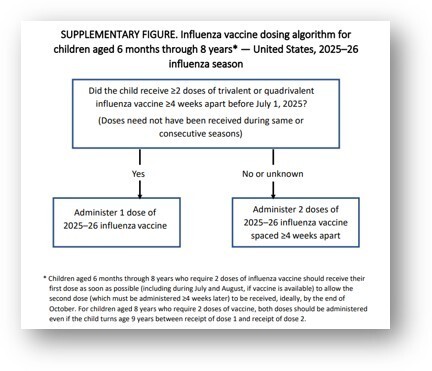
Children 6 months through 8 years should receive a second influenza vaccine dose 4 weeks or more after the first dose if they meet one of the following criteria: 1) receiving influenza vaccine for the first time, 2) have not received a total of at least two doses of any seasonal influenza vaccine before July 1 of the current year, or 3) vaccination history is unknown. The two previous doses need not have been received during the same season or consecutive seasons
 |
- FDA approved the nasal spray live attenuated influenza vaccine FluMist (LAIV3) for self-administration (for 18 through 49 years) or administration by a caregiver who is ≥18 years (for children and adolescents aged 2 through 17 years)
- Consumers use FluMist Home program to provide information to determine their eligibility to order the vaccine. For persons who meet eligibility criteria to receive FluMist, vaccine will be shipped under temperature-controlled conditions to the address provided by the person placing the order
- ACIP recommendations, contraindications, and precautions for use of FluMist for self-administration or caregiver administration are the same as those for health care provider administration
- WA DOH is waiting for the WA Pharmacy Commission and the manufacturer before FluMist is allowed to be ordered in WA and working to resolve WAIIS data transmission issues.
- self-administered FluMist will not be available to order through the Childhood Vaccine Program
 |
Remember that inventory reconciliation requirements have changed! Providers are now required to submit all inventory at least monthly but within 14 days of vaccine orders.
Do you still need to complete an inventory reconciliation if you are not placing a vaccine order? YES! Inventory needs to be submitted at least once per month. It doesn't have to be completed at the beginning of the month, but it is required to ensure all inventory is reconciled and submitted within 14 days of vaccine order.
|