|
This is a Provider Alert from the Washington State Department of Health to alert you to recent cases of measles in Washington and to provide you with updated guidance and tools for assessment and testing of patients with rash illness.
Current Situation in Washington: From January 1 through June 25, 2025, 10 cases of measles have been confirmed in King, Snohomish and Whatcom Counties. All 10 cases of measles have been associated with international travel or close contacts and have NOT been linked to an ongoing outbreak in the state at this time. Secondary cases linked to the most recent cases in Whatcom and King Counties, if they occur, would most likely become sick between June 21 and July 13, 2025.
More details on the recent cases and potential exposure locations can be found on Whatcom County and Public Health Seattle-King County webpages. A full list of all of the measles cases identified in Washington 2025 can be found on the Measles Activity and Surveillance section of the WA DOH Measles webpage.
In addition to measles, there are other types of rash illnesses spreading in Washington. WA DOH recommends that all providers in Washington are familiar with signs and symptoms of measles, and understand the process for reporting, testing, and responding to cases of measles in your jurisdiction. Read the rest of the provider alert and view the new assessment and testing resources.
Nationally, measles cases have reached an all-time high since elimination.
The U.S. reached 1,281 measles cases in 2025—the highest number since the disease was declared eliminated in 2000, and the most we’ve seen since 1992 (when there were 2,126 cases).
What about our measles elimination status?
We would only lose that designation if an outbreak lasts more than 12 months. Currently, we’re about halfway to losing elimination status, thanks to a large West Texas outbreak that began in January and is ongoing. Although it has slowed, transmission continues across multiple counties in several states, making it a key driver of the national surge. You can keep up to date on nationwide numbers on CDC's webpage.
The ACIP (Advisory Committee on Immunization Practices) votes that occurred during their meeting on April 15–16, 2025 are now adopted by the Health and Human Services Secretary, pending confirmation of a new CDC Director. The decision appears on a Centers for Disease Control and Prevention (CDC) webpage. It's not yet on the agency’s official adult immunization schedule.
Adopted Recommendations:
-
RSV Vaccine:
- Expanding RSV vaccination to high-risk adults age 50–59 years of age.
- People at increased risk of severe RSV disease should receive a single dose of RSV vaccine (Arexvy, GSK; Abrysvo, Pfizer; mResvia, Moderna). Note: RSV vaccination is currently recommended as a single dose only.
-
Meningitis Vaccine, PENMENVY (GSK):
- May be used when both MenACWY and MenB are indicated at the same visit.
- Healthy persons aged 16–23 years (routine schedule) when shared clinical decision-making favors administration of MenB vaccine.
- ≥10 years who are at increased risk for meningococcal disease (e.g., persistent complement deficiencies, complement inhibitor use, or functional or anatomic asplenia).
-
Chikungunya Vaccine:
-
Chikungunya vaccine, virus-like particle
- ≥12 years traveling to a country or territory where there is a chikungunya outbreak.
- May be considered for persons aged ≥12 years traveling or taking up residence in a country or territory without an outbreak but with elevated risk for U.S. travelers if planning travel for an extended period of time (e.g., 6 months or more).
- Lab workers with potential for exposure to chikungunya virus.
-
Chikungunya vaccine, live attenuated
- ≥18 years traveling to a country or territory where there is a chikungunya outbreak.
- May be considered for persons aged ≥18 years traveling or taking up residence in a country or territory without an outbreak but with elevated risk for U.S. travelers if planning travel for an extended period of time (e.g., 6 months or more).
The ACIP (Advisory Committee on Immunization Practices) met on June 25–26 with a committee of 8 new voting members after the dismissal of all 17 voting members by the Department of Health and Human Services. Voices for Vaccines compiled a helpful summary of the ACIP meeting.
The June meeting is especially important, as it sets the groundwork for the fall respiratory virus season. Insurers finalize coverage. Clinicians place orders. Distributors ship doses. Public health communicators prepare messages.
ACIP meeting recommendations will become official CDC policy once adopted by CDC's Director. More follow-up information will be provided from DOH as soon as we receive more guidance.
In summary, the members voted to recommend:
- Approval of one dose of clesrovimab, a new monoclonal antibody approved by FDA for infants whose mothers are not protected by maternal respiratory syncytial virus (RSV) vaccination. Clesrovimab is one of two RSV monoclonal antibody products available (nirsevimab is the other monoclonal antibody product).
- Approval of the updated Vaccines for Children Program (VFC) resolution for prevention of RSV.
- Reaffirmation of the recommendation for routine annual influenza vaccination for all persons aged over six months who do not have contraindications.
- Seasonal influenza vaccines for children 18 years and younger only in single-dose formulations free of thimerosal as a preservative.
- Seasonal influenza vaccines for pregnant women only in single-dose formulations free of thimerosal as a preservative.
- Seasonal influenza vaccines for all adults only in single-dose formulations that are free of thimerosal as a preservative.
The Department of Health will provide more details as soon as they are available. Please send an email to immunenurses@doh.wa.gov for any questions.
|
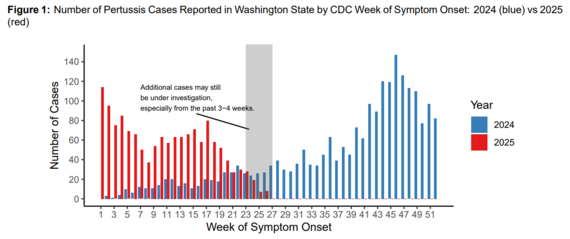
As of June 28 in Washington, 1,434 pertussis cases – 101 of those were infants – have been reported this year, according to the state Department of Health. By this time last year, there were 420. By the end of 2024, the state had seen almost 26 times as many cases as the year before, and a child in Spokane County died from the disease.
Less vaccine coverage is likely behind the recent pertussis spike in Washington, as well as more awareness about the disease, better testing, and genetic changes to bacteria could also be contributing to more cases. There is “some kind of cyclical nature” to pertussis cases increasing as immunity from vaccines wane over time. Washington previously faced a pertussis epidemic in 2012. This is a really important reminder as to why everyone needs to get vaccinated. Vaccines remain the best way to protect against whooping cough, according to the CDC.
Learn More:
On June 18, 2025, the Department of Health published an updated data dashboard on school immunization reporting. Each year, countless school and state staff work to provide the information for the health of Washington state.
School-level immunization data are available for download by state, county, district, and school building. Following our small-numbers guidance, we suppress school-level vaccination data for school cohorts with 10 or fewer kids.
Overall, school immunization rates for the 2024-25 school year have remained flat compared to the 2023-24 school year. There are still significant vaccination gaps in different parts of the state. It remains important for families to keep their children up to date on vaccinations as they prepare for the next school year and as the county continues to deal with disease outbreaks that vaccines can prevent.
If you have questions about the updated dashboard, please email the data request inbox at WAIISDataRequests@doh.wa.gov.
Thank you!
Office of Immunization
Washington State Department of Health
|