|
|
Welcome to the Vaccines for Respiratory Illnesses Newsletter! Here you'll find the latest news and information on respiratory illness vaccine related topics.
- Latest News
- Clinical Updates
- Training and Events
- Resources
|
|
|
November is National Diabetes Awareness Month. Flu can increase the risk of diabetic ketoacidosis (DKA), and people with Type 1 diabetes are at an increased risk of flu-related complications, so they should make receiving an annual flu vaccine a priority each year to decrease these risks.
People around family members with Type 1 diabetes should also be vaccinated to help protect their loved ones. Just ask Lyndall Hauver. Her son Will was a college athlete and Type 1 diabetic, and he lost his life when his flu illness progressed to DKA. Lyndall encourages people with Type 1 diabetes to seek medical treatment immediately if they fall ill with flu; every minute counts when it comes to saving a life.
|
|
|
A: Pneumonia used to be mainly in older people, but we're now seeing it in middle-aged Americans. Because of the increase in incidence of pneumonia, the CDC lowered the adult age recommendation for pneumococcal vaccination from age 65 and older down to age 50.
- The age was lowered to help address existing disparities in disease burden, which were most pronounced in this newly included age group.
- Lowering the age should also improve vaccination coverage among adults 50 through 64 years of age, including those with risk conditions.
- Black adults tend to develop pneumococcal disease at younger ages compared to non-Black adults, which raises important health equity concerns. Lowering the vaccination age can help protect adults during these years when their disease rates are proportionally higher.
The pneumococcal vaccine is recommended for all children younger than 5 years old and children 5 through 18 with certain risk conditions. It’s also recommended for all adults 50 years or older and those who are 19 through 49 with certain risk conditions.
|
|
|
The Washington State Department of Health (DOH) sent a Provider Alert regarding an increase in pertussis (whooping cough) cases on November 6, 2024. Healthcare providers should:
- Remain alert for patients with symptoms of pertussis.
- Test patients who may have pertussis and treat patients strongly suspected of having pertussis.
- Ensure patients are up-to-date with DTaP or Tdap vaccines.
This is an update to the Provider Alert sent in May 2024.
Current Pertussis Situation in Washington
There has been a total of 1,193 confirmed and probable cases of pertussis reported statewide during 2024 through 11/02/2024, compared to 51 cases reported by the same week in 2023. This represents a 21-fold increase in pertussis cases over the previous year. 31 of 39 counties have reported pertussis activity during 2024; however, the Centers for Disease Control and Prevention (CDC) estimates that only approximately 10% of pertussis infections are identified and reported to public health.
Current information about pertussis in Washington state can be found in the DOH Weekly Pertussis Update. This report is updated every Friday.
Please contact vpd-cde@doh.wa.gov with any questions related to Pertussis cases or investigations; Contact immunenurses@doh.wa.gov with any questions regarding vaccination.
|
|
|
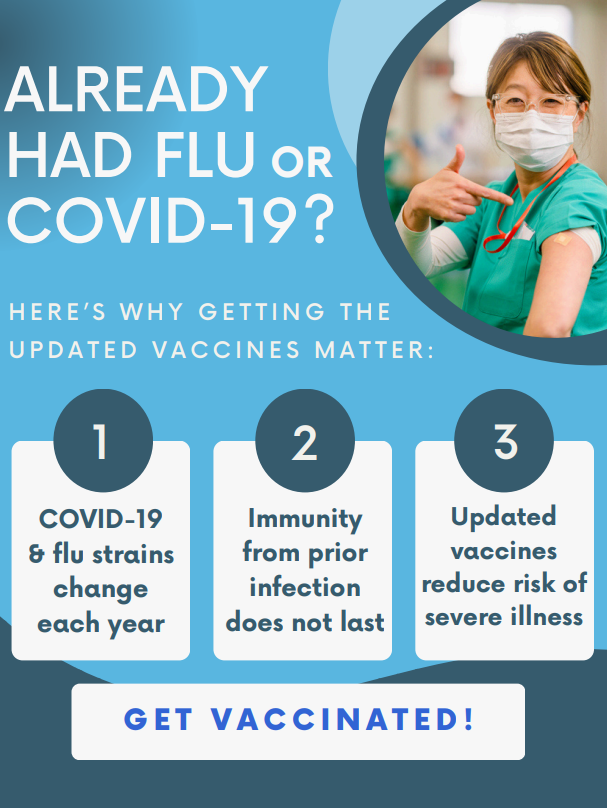
UCI Health Infection Prevention and Epidemiology offers free downloadable posters through the Educational Materials to Bring Resilience Against Contagious Events (EMBRACE) project, an initiative funded by the CDC. This series of 12 posters provides evidence-based information to encourage the uptake of COVID-19 and influenza vaccinations. The posters cover essential topics such as vaccine effectiveness, safety, and common myths.
|
|
|
The Advisory Committee on Immunization Practices (ACIP) met on October 23–24 and voted to approve the below recommendations. These recommendations were adopted by the CDC Director and are now official. ACIP recommendations will be published in CDC’s Morbidity and Mortality Weekly Report in the future.
- Routine use of pneumococcal conjugate vaccines (PCV) for all adults 50 years and older who have not previously received PCV vaccine.
- A 6-month dosing interval (previously 1-month) for the 2-dose Bexsero in healthy adolescents and young adults 16 through 23 years based on shared clinical decision-making and for a 3-dose series (0, 1–2, 6 months) for people at increased risk. This new schedule for Bexsero is the same as for Trumenba. However, the two MenB vaccines are still not interchangeable. The same vaccine brand must be used for all doses.
During the meeting, ACIP also reviewed a new RSV preventive antibody, clesrovimab, currently under review by FDA. Clesrovimab is intended to be used similar to Beyfortus (nirsevimab). ACIP will make recommendations after the FDA licensure decision.
|
|
|
On Monday, November 18, 2024, from 11 AM-12 PM PST, National Academies is hosting a webinar. Join to learn strategies from the social and behavioral sciences to support routine childhood immunizations. In September 2024, the Societal Experts Action Network (SEAN) released Guidance on Routine Childhood Immunizations. This Rapid Expert Consultation explored multifaceted approaches that incorporate systems-level changes and strategic partnerships to support effective interventions at the clinical practice, individual, and family levels. Learn more about this event.
|
|
|
The Vaccine Education Center (VEC) at Children's Hospital of Philadelphia (CHOP) will present a 1-hour webinar titled Preventing the Next Pandemic: Why It Is Important to Know the Origin of SARS-CoV-2 at 9 AM PST on December 4, 2024. Part of its Current Issues in Vaccines series, the webinar will feature Paul Offit, MD, director of the VEC. Free continuing education credits (CME, CEU, and CPE) will be available for both the live and archived events.
Educational objectives:
- Interpret and employ new or updated vaccine information.
- Discuss vaccine-related information with patients and their families.
- Provide science-based resources to patients and their families who are seeking additional information.
- Discuss the origins of SARS-CoV-2.
|
|
|
|
FOR SCHOOLS AND CHILD CARE FACILITIES
FOR LONG-TERM CARE FACILITIES
|
|
|
|
|
|
|
If you aren't already signed up for Vaccines for Respiratory Illnesses Newsletter, please visit the Department of Health's email subscribers page here. Once you enter your email, on the next page expand the Immunization topic, select Vaccines for Respiratory Illnesses Newsletter, and click submit.
|
|
This newsletter summarizes content beginning the week of November 3, 2024 and was sent out on November 15, 2024. |
|
|
|
|