|
|
Smiling children, reading a book, featuring the Washington State Department of Health logo and the text Children and Youth with Special Health Care Needs.
Welcome to the Washington Department of Health Children and Youth with Special Health Care Needs (CYSHCN) Communication Network Newsletter! Below are updates, resources, and events! We plan to continue this newsletter quarterly to share updates from the CYSHCN Program and partners. If you would like to be added to list, please sign up: through the Washington State Department of Health (govdelivery.com) page.
|
|
General Updates:
The DOH Maternal Child Health program has been working hard on our 5-year Maternal Child Health Needs Assessment. The Surveillance and Evaluation team has analyzed results from the Discovery Survey, facilitated discussions, and key informant interviews collected earlier this year and reviewed data, and other needs assessments related to maternal child health. Below are some key themes identified for CYSHCN.
The most common CYSHCN-focused topics that came up in the community-based Discovery Survey include access to healthcare and mental/behavioral health services, community building and belonging, access to financial assistance and income subsidies, caregiver availability, and special education services in schools.
- Comments on access to physical, mental, and behavioral health services highlighted shortages for support, respite care, and personal care hours for CYSHCN parents.
- There is a felt need for services for children with complex medical conditions without developmental concerns, as well as therapies for CYSHCN with other disabilities that affect daily life.
- Access to healthcare comments included provider shortages for primary care, mental health, and dental care where providers are well-versed in understanding and accommodating CYSHCN.
- Affordable, accessible, quality, and CYSHCN-friendly caregiver availability was a top theme.
- Childcare is essentially non-existent for CYSHCN ages 11-17, as these children are too old for daycare and too young for adult care.
- There was a major concern and felt need for financial assistance and/or payments for caregiving for CYSHCN families.
- Comments on community building and feeling of belonging for CYSHCN and their families, including the availability of sensory-friendly, ADA accessible, and CYSHCN-friendly events and/or recreational spaces.
- The desire for special education services to be funded in school systems.
- The need to increase access to local resources (e.g., transportation) for rural CYSHCN families.
The next step is identifying 1 or 2 broad CYSHCN priorities based on these themes to focus on for the next 5 years. Then we will develop an action plan based on those priorities. We have conducted a few priority identification sessions with CYSHCN families and partners and will have a new prioritization focused survey and data brief coming out soon.
|
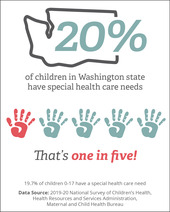 19.7% of children 0-17 have a special health care need Data Source: 2019-20 National Survey of Children's Health, Health Resources and Services Administration Maternal and Child Health Bureau
|
|
Child Health Intake Form (CHIF):
- CHIF Office Hours- 4th Wednesday of the month. Please email amanda.simon@doh.wa.gov if you need the meeting invite.
- Be on the lookout for CHIF orientation and guidance materials!
- Please continue to submit all CHIF data via MFT.
- If you run into any issues with the MFT tickets need to be submitted via survey monkey, if you cannot access the survey monkey, please email amanda.simon@doh.wa.gov.
|
|
Early Childhood & Communication
|
|
Family Engagement
- Supported the CYSHCN Family Advisory Council meeting in September focused on the Maternal Child Health (MCH) Needs Assessment results and prioritization process.
- Supported facilitated discussions with the Youth Advisory Council’s with Special Health Care Needs subcommittee regarding the MCH Needs Assessment.
- Promoting Family Engagement in Systems Assessment Tool (FESAT) use within DOH programs through a FESAT Community of Practice.
- Newly elected as a Family Representative to the Association of Maternal and Child Health Programs (AMCHP) Board of Directors.
|
|
Behavioral and Adolescent Health
SAFES (Supporting Adolescents and Families Experiencing Suicidality)
Washington State Department of Health (DOH), Seattle Children’s Hospital - Partnership Access Line (PAL) and Frontier Behavioral Health have partnered together to create the SAFES program to provide rapid access to suicide-specific psychotherapy in a brief 4 session model. The program is based on the Behavioral Health Crisis Care Clinic model developed at Seattle Children’s.
Patient Eligibility Criteria:
- Must live in an eligible county in Washington state: Adams, Chelan, Douglas, Ferry, Grant, Lincoln, Okanogan, Pend Oreille, Spokane, Stevens
- Age 10-18
- Patient’s primary care provider determines patient has active concerns of suicidality, but is not severe enough to need an ED visit today
- Patient should not be engaged in other mental health services unless current therapist or provider feels additional supports are needed
-
Currently no insurance restrictions
How to Refer a Patient: Primary care providers and behavioral health clinicians embedded in primary care offices can call PAL at 866-599-7257
For more information visit our website or email us at: SAFES@seattlechildrens.org
Washington’s Mental Health Referral Service for Children and Teens
Our Referral Specialists connects patients and families with evidence-supported outpatient mental health services in their community. This free, telephone-based referral service is funded by Washington Healthcare Authority and operated by Seattle Children’s. The Mental Health Referral Service will provide thorough mental health referrals for children and teens 17 and younger from across Washington.
How do families access this service?
- Families can call 833-303-5437 Monday to Friday, 8 a.m. to 5 p.m.
- Or submit an online request form
What can patients and families expect?
- After matches are found, a referral specialist will call and email the family to access providers or agencies in real-time.
- A few weeks after providing the referrals, a referral specialist will contact the family to see if they were able to make an appointment and ask if additional resources are needed.
- If no appointment has been made, we will address any barriers or link the family to another provider.
For more information, please visit our website or call 1-833-303-5437.
Mental Health Hospital Consultation Service:
Seattle Children's Psychiatry and Behavioral Medicine Clinic has launched a new service that provides consultation and resource assistance to colleagues at Washington hospitals in need of support for their youth mental health boarders. This service is for clinicians whose patients are boarding in the Emergency Department or on medical floors with a primary presentation of mental health concerns. Call 206-987-0999 or email mentalhealthconsult@seattlechildrens.org.
|
|
 Young child in a cooking hat making pizza. Image from unknown source
|
|
Blueprint for Change for CYSHCN:
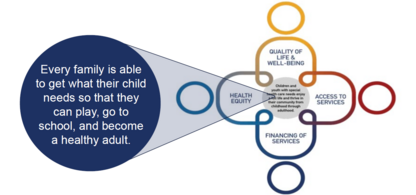
Blueprint graphic plain language: Every family is able to get what their child needs so that they can play, go to school, and become a healthy adult
The Blueprint for Change for CYSHCN is the federal vision to advance the system of services for CYSHCN over the next 15 years.
Blueprint goal in plain language: Every child gets the services they need, so that they can play, go to school, and grow up to become a healthy adult. (And so, grown-ups and siblings can thrive too.)
The Department of Health CYSHCN Team and family and community partners are currently working with the National Center for Services for CYSHCN on developing Blueprint Implementation Projects.
Our focus is on strengthening family-centered, interdisciplinary care coordination including a shared plan of care and a peer support component. We will be implementing projects over the next year to support this goal.
Priority Strategies:
- Care Coordination System Mapping
- Providing input to Health Care Authority as they develop state plan amendment for Ace Kids Act Health Homes
- Looking at models of integrated peer support for CYSHCN
American Academy of Pediatrics: Dedicated To The Health Of All Chrildren Logo
The National Center for a System of Services for CYSHCN is hosting a series of virtual cafés, especially crafted for Title V CYSHCN programs. Each café provides information about a topic of interest/need for CYSHCN programs related to advancing the Blueprint for Change. These virtual cafés will provide an interactive space to foster collaboration and facilitate meaningful conversations. Dive deep into discussions, share insights and connect with fellow Title V CYSHCN programs and professionals.
Registration is now open for the upcoming virtual cafés. Virtual café registration is open to Title V CYSHCN programs and their staff. Café content is designed specifically for this audience and cafés are used as a space for these programs to connect, learn, and share with each other. Register now!
|
|
Upcoming Events:
University of Washington Haring Center for Inclusive Education- College of Education Logo
The University of Washington (UW) Haring Center is hosting free, remote trainings this fall for early childhood providers! (trainings are offered in Spanish, English and Somali). See attached flyers and info below. Please feel free to pass along!
DCYF Complex Needs Training Series- Fall Quarter 2024
The Washington State Department of Children, Youth and Families (DCYF) is offering trainings to support childcare workers who care for young children with complex needs. These trainings will be facilitated by the UW Haring Center and focus on deepening the provider's knowledge in several areas related to individualizing instruction and supporting social-emotional learning. All attendees will receive an Inclusion Kit with laminated visuals they can use in their program!
All trainings are FREE, and will be held remotely via zoom. In-Service STARS credit will be offered for ALL trainings. This is not eligible for clock hours.
Target Audience: Early Childhood Providers: Infant and Toddler Providers (Ages Birth-3 years) and Preschool Providers (ages 3-5 years) – see attached flyer for the focus of each training. Training Dates - See the attached flyer for topics and dates. Please note: All times listed are in Pacific Standard Time (PST).
Training Languages: Trainings are offered in English, Spanish and Somali.
You can register for trainings through the DCYF online form. English and Spanish options are available in the same form
You can register for trainings in SOMALI through the DCYF Online Form
Please email Phoebe Yeung (pcyeung@uw.edu) if you have any questions!
Department of Social and Health Services Brand Logo
Developmental Disabilities Administration
Training Opportunity: House Bill 2008 - Intake and Eligibility Changes
Are you interested in hearing about the changes to Intake & Eligibility due to House Bill 2008, and other related WAC changes? Come join us for one of these information sessions! We will cover the removal of IQ from eligibility criteria, age requirements and other exciting changes.
We are offering an opportunity for you to come and learn. ASL interpreters will be available.
|
|
|
|
Family-Lead Academic Grand Rounds (Flag) Logo
Family Led Academic Grand "FLAG" Rounds
Join the University of Wisconsin-Madison and Bluebird Way Foundation for their upcoming virtual series of Family Led Academic Grand "FLAG" Rounds. This series is focused on ableism in the care of children with disabilities and medical complexity. Family faculty will present a “case” in story form, followed by strategies to build knowledge, skills, and abilities to dismantle ableism and enhance collaboration in the care of children with disability and/or medical complexity. State Title V programs are encouraged to participate and share this opportunity with providers in their states and territories to support workforce development and help inform equity initiatives in alignment with the Blueprint for Change. Register now! View the flyer for more details.
Supporting Families of Children with Developmental Differences, 5 Mondays between Sept. 9-Dec. 16, 12-1 p.m. See registration for more information. Parenting While Rising to Child Developmental Challenges
|
|
Resources:
Housing Assessment Opportunity
The Arc of Washington is excited to share our partnership with Partners4Housing with you! They are working with us to help our families plan for the future.
The Dan Thompson Memorial Fund funded Partners4Housing to provide Benefits and Housing Reviews to up to 5,000 families in WA. This free service (typically $500) will end in July 2025. Time is running out!
This is a great opportunity!
Click here to learn more. https://arcwa.org/programs/partners4housing/
|
New! AMCHP MCH Bridges episode. Episode 21 - Navigating Prenatal Diagnoses: Fostering Equity & Reducing Harm for Parents of Children with Down Syndrome Listen to our latest episode where guest host and Lettercase Program Director Dr. Stephanie Meredith reviews some of the findings from her recent study focused on the experiences of parents receiving a prenatal diagnosis of Down syndrome. Dr. Meredith approaches her research as the mother of a 24-year-old son with Down syndrome. Additionally, listeners will gain insight from a recent project aimed at improving support for Black and Hispanic new and expectant parents of children with Down syndrome. Episode #21: Navigating Prenatal Diagnoses: Fostering Equity & Reducing Harm for Parents of Children with Down Syndrome
AAP News Article on New Centers for Medicare & Medicaid Services Guidance to Improve Health Care for Children Enrolled in Medicaid and the Children’s Health Insurance Program
In a recently published American Academy of Pediatrics (AAP) News article, AAP applauds the Centers for Medicare & Medicaid Services (CMS) in their effort to improve comprehensive healthcare for children in Medicaid and Children’s Health Insurance Program (CHIP). The new guidance from CMS focuses on key areas such as promoting Early and Periodic Screening, Diagnostic, and Treatment (EPSDT) awareness, increasing pediatric provider participation, and enhancing care for children with specialized needs, including those with mental health conditions, disabilities, and complex health needs. This guidance holds significant implications for children with disabilities and is closely linked to the financing of services domain of the Blueprint for Change.
Supporting Families of Children with Developmental Differences, 5 Mondays between Sept. 9-Dec. 16, 12-1 p.m. See registration for more information. Parenting While Rising to Child Developmental Challenges
Release of 2022-2023 Annual Data from the National Survey for Children’s Health
The Data Resource Center for Child and Adolescent Health (DRC), a project of the Child and Adolescent Health Measurement Initiative (CAHMI) recently released the National Performance Measures (NPMs), National Outcome Measures (NOMs) and Standardized Measures (SMs) data findings from the 2022-2023 National Survey of Children’s Health (NSCH). This dataset, which includes data from 109,265 children ages 0-17 years, offers national and state-level insights on key health indicators. Visit the Data Resource Center to access these valuable findings.
Tools from the Center for Health Care Strategies Child Health Transformation Resource Center
The Center for Health Care Strategies (CHCS) Child Health Transformation Resource Center offers a number of tools designed for healthcare professionals, policymakers, and payers. These resources support the transformation of pediatric care and provide insights on leveraging financing and accountability measures. Visit their website to access these valuable tools.
|
|
|
|
|