|
|
Welcome to the Vaccines for Respiratory Illnesses Newsletter! Here you'll find the latest news and information on respiratory illness vaccine related topics.
- Latest News
- Clinical Updates
- Training and Events
- Resources
|
|
|
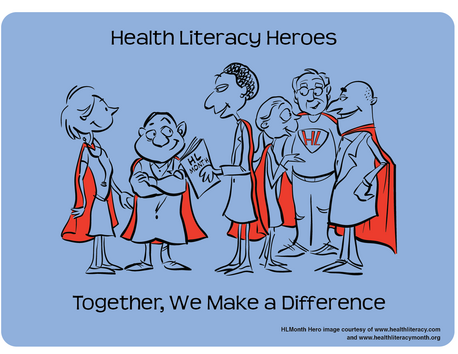
October is Health Literacy Month! During Health Literacy Month, we take time to recognize the importance of making health information easy to understand and the health care system easier to navigate. We invite our respiratory health partners to join us in recognizing health literacy as an important part of improving health.
What is Health Literacy?
Health literacy is the degree to which individuals can find, understand, and use information and services to inform health-related decisions and actions for themselves and others.
Why is health literacy important?
Health literacy is essential for everyone because at some point in our lives we all need to find, understand, and use health information and services. It's not just something we do when we visit the doctor or go to a hospital; it's part of our everyday life.
Get Involved!
- Follow Washington’s Plain Talk guidelines when writing for the public and other partners. Use our Plain Talk 1-pager or 2-pager as a reference.
- Talk with your team about how you can apply health literacy principles in your work.
- Share respiratory health resources that are clear and easy to understand. You can find resources that follow health literacy and plain talk best practices at:
|
|
|
A: The Centers for Disease Control and Prevention (CDC) reported 200 pediatric flu-related deaths for the 2023-2024 season across the U.S. This surpasses the previous high of 199 flu-related deaths in children during a regular flu season set during 2019-2020. About 80 percent of children who were eligible for flu vaccination and for whom vaccination status was known were not fully vaccinated against flu. Washington had two pediatric flu-related deaths for 2023-2024, which is lower than past seasons.
September and October are the best times for most children to receive flu vaccine. CDC recommends everyone 6 months and older get an annual flu vaccine, especially children at higher risk for serious flu complications.
|
|
|
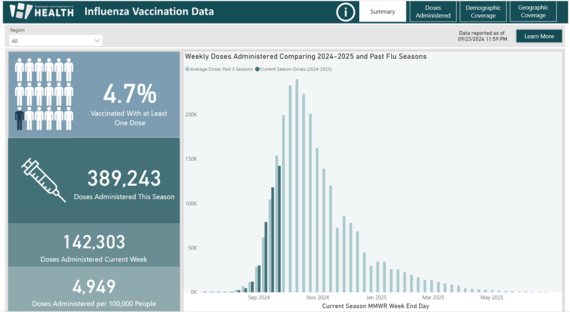
Welcome to the Washington State Department of Health Influenza Vaccination Dashboard. This dashboard describes the number of flu vaccines being administered in Washington, as well as estimates of the percentage of Washingtonians who have received a flu shot this year. The data on this dashboard will be updated weekly September 1- April 30.
For more information about the flu and flu vaccination, please visit the Influenza (Flu) Overview page. Additional respiratory illness data is available on the Respiratory Illness Data Dashboard.
|
|

Every U.S. household is eligible to order 4 free at-home tests from COVIDTests.gov. The COVID-19 tests will detect current COVID-19 variants and can be used through the end of the year. Your order of COVID-19 tests is completely free, you won’t even pay for shipping! USPS started shipping tests the week of September 30. You can also find a list of no-cost COVID-19 testing sites on CDC’s website: No-Cost COVID-19 Testing (cdc.gov).
Tests (both for COVID-19 and the flu) are also provided through Washington State DOH testing kiosks are free: Testing Kiosks | Washington State Department of Health. Some of the kiosks are stocked with other free health care supplies including naloxone, pregnancy tests, tests for sexually transmitted infections and fentanyl test strips.
Medicaid insurance still covers at-home COVID tests. Other insurance providers are no longer required by federal law to cover COVID-19 testing but check with your independent health plan as coverage may vary.
|
|
|
Immunize.org has recently updated their standing order template for administering RSV vaccine to adults 60 and older. They addressed the updated limited residential status in nursing homes, provided more illustrations on deciding who under 74 is eligible for RSV vaccine added a clause stating the importance of not denying someone vaccination due to self-reported risk factor.
|
|
|
A new study looking at about 45,000 pregnant people over 14 years was published in the Journal of the American Medical Association (JAMA) Open Network. It found no increased risk of negative health outcomes for the birthing person or baby among pregnant people who got flu vaccines during successive pregnancies. That was true regardless of how far apart the pregnancies were spaced.
|
|
|
On September 20, 2024, the FDA approved the first self-administered flu vaccine. This provides a new option for receiving a safe and effective seasonal flu vaccine with greater convenience, flexibility, and accessibility. Adults will be able to administer FluMist, a nasal spray vaccine, at home without a health care provider present. This option may help address the decline in flu vaccination rates, which fell below 50% during the 2022-2023 season.
FluMist is available for those aged 2 to 49 and provides a convenient alternative to traditional flu shots. However, individuals must still obtain a prescription, and vaccines will be delivered directly to homes. This innovation could enhance public health efforts by improving access to seasonal flu prevention.
While the option to receive FluMist is already available in a clinical setting, the option to administer at home will not be available until next flu season.
|
|
|
The Washington State Department of Health's Power of Providers (POP) initiative invites you to participate in an upcoming webinar, Preparing for the 2024-2025 Respiratory Virus Season. The webinar is scheduled for Wednesday, October 16, from 12 to 1 PM PT and features Eric J. Chow, MD, MS, MPH, an infectious disease expert.
Dr. Chow will discuss the epidemiology of influenza (flu), respiratory syncytial virus (RSV), and COVID-19 and summarize measures of community burden. He will review important mitigation strategies, vaccine recommendations, and respiratory illness guidance as we head into the 2024-2025 respiratory virus season.
The webinar will be recorded and include live ASL interpretation. Continuing education is available for allopathic physicians (MDs), osteopathic physicians (DOs), physician assistants, naturopathic physicians (NDs), nurses (RNs, LPNs, ARNPs), medical assistants, pharmacists and pharmacy technicians.
|
|
|
Registration is open for What’s Up Doc: VAXcess to Care: It Takes a Village, on Thursday, October 17, 2024 from noon-1:15pm PT. Pierce County Immunization Coalition and Washington Vaccine Association present an engaging panel of speakers to discuss access to vaccines in children and adults. The speakers will share perspectives from pharmacies, pediatrics, school-based health centers, and adult care. Discussion topics will cover data, vaccine access barriers, and creative solutions to increase vaccine access.
|
|
|
|
FOR SCHOOLS AND CHILD CARE FACILITIES
FOR LONG-TERM CARE FACILITIES
|
|
|
|
|
|
|
If you aren't already signed up for Vaccines for Respiratory Illnesses Newsletter, please visit the Department of Health's email subscribers page here. Once you enter your email, on the next page expand the Immunization topic, select Vaccines for Respiratory Illnesses Newsletter, and click submit.
|
|
This newsletter summarizes content beginning the week of September 22, 2024 and was sent out on October 4, 2024. |
|
|
|
|