|
|
Welcome to the Vaccines for Respiratory Illnesses Newsletter! Here you'll find the latest news and information on respiratory illness vaccine related topics.
- Latest News
- Clinical Updates
- Training and Events
- Resources
|
|
|
September is National Preparedness Month: an observance “to raise awareness about the importance of preparing for disasters and emergencies that could happen at any time.” Disability inclusion and accessibility is the theme for the Centers for Disease Control and Prevention’s (CDC) 2024 National Preparedness Month. CDC is raising awareness about preparing the whole community by integrating disability inclusion and accessibility in all phases of emergency preparedness and response.
There are many kinds of emergencies, such as natural disasters, human-caused disasters, and disease outbreaks. Disease outbreaks can include flu, respiratory syncytial virus (RSV), COVID-19, and mpox. Preparing and responding to disease outbreaks often involves vaccines. There are many steps involved from development of the vaccine itself to large scale distribution. Check out the CDC Museum COVID-19 Timeline to learn about select moments in the COVID-19 pandemic in the United States and around the world beginning from its known origins to today.
|
|
|
A: For most people who only need one dose of influenza vaccine, vaccination should ideally be offered in September and October. For people not vaccinated by the end of October, vaccination efforts should continue as long as influenza viruses are circulating and unexpired vaccine is available.
Children younger than age nine years who need two doses of vaccine this season should receive their first dose as soon as possible so that they can get their second dose before the end of October.
|
|
|
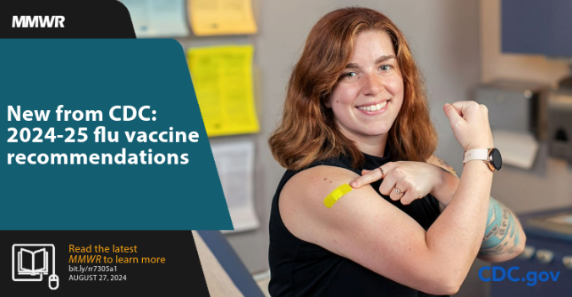
Guidance for the use of flu vaccines for the upcoming season has officially published. For the 2024-2025 flu season, ACIP recommends annual flu vaccination for everyone 6 months and older. All U.S. flu vaccines this season will be trivalent (three virus) vaccines and were updated from last season’s vaccines to provide optimal protection. More information is available from CDC’s flu website.
- It is preferred for adults 65 years and older to get the high dose or adjuvanted flu vaccine, if available.
- Solid organ transplant recipients can get the high dose or adjuvanted flu vaccine.
- If higher dose or adjuvanted vaccines are not available, use any other age-appropriate flu vaccine. Do not miss an opportunity to vaccinate!
|
|
|
On August 30, 2024, the Food and Drug Administration (FDA) amended the emergency use authorization (EUA) of Novavax COVID-19 Vaccine, Adjuvanted to include the updated 2024-2025 formula. The 2024-2025 Novavax COVID-19 vaccine includes a monovalent (single) component that corresponds to the Omicron variant JN.1 strain of SARS-CoV-2.
Novavax COVID-19 Vaccine, Adjuvanted (updated 2024–2025 Formula) is authorized for use in individuals 12 years of age and older as follows:
- Individuals 12 years of age and older who have never been vaccinated with any COVID-19 vaccine are eligible to receive two doses of this updated vaccine, 3 weeks apart.
- Individuals who have been vaccinated only with one dose of any Novavax COVID-19 vaccine are eligible to receive one dose of the updated Novavax COVID-19 vaccine at least 3 weeks after the previous dose.
- Those who have been vaccinated with a prior formula of a COVID-19 vaccine from another manufacturer or with two or more doses of a prior formula of the Novavax COVID-19 vaccine are eligible to receive a single dose of the updated Novavax COVID-19 vaccine at least 2 months after the last dose of a COVID-19 vaccine.
- Immunocompromised individuals: An additional dose of Novavax COVID-19 Vaccine may be administered at least 2 months following the last dose of a COVID-19 vaccine (2024-2025 Formula). Additional doses of Novavax COVID-19 Vaccine may be administered at the discretion of the health care provider, taking into consideration the individual’s clinical circumstances. The timing of the additional doses may be based on the individual’s clinical circumstances.
With this regulatory action, the formerly available Novavax COVID-19 Vaccine, Adjuvanted (2023-2024 Formula) is no longer authorized for use in the United States. Immediate action for remaining inventories: 2023-2024 Novavax COVID-19 vaccine should not be administered. To minimize risk of vaccine administration error, providers should:
- Remove any/all 2023-2024 Novavax COVID-19vaccines remaining from storage units immediately.
- Once all inventory is fully accounted for, delete 2023-2024 Novavax COVID-19 vaccine listings from the available vaccine inventory in your Immunization Information System, as applicable.
- Return all unused 2023-2024 Novavax COVID-19 vaccines to CDC's centralized distributor using the normal process for returning spoiled/expired vaccines.
- Providers must use the category "Spoiled" and the reason "Expired BUD" to reconcile and submit the return of these vaccines in the IIS. Please do not use the "Recall" category.
Preparation/next steps for ordering 2024-2025 COVID-19 vaccine:
It may take a few weeks before Novavax ordering becomes available. Until that time, ordering is now available for the updated 2024-2025 mRNA COVID-19 vaccine. Please remember:
- It can take up to two weeks from the approval date to receive your shipment.
- All respiratory products can be ordered at any time. You do not need to wait for your assigned ordering window to place an order for these products.
- Place smaller orders more frequently, rather than large orders.
- Orders may be reduced to meet allocation and product availability. The goal is to ensure all providers receive some product.
- Providers are required to carry and offer all Advisory Committee on Immunization Practices (ACIP) recommended vaccines for the population they serve.
Thank you for your continued partnership in providing COVID-19 vaccines to children, adolescents, and adults in Washington state. Please reach out to us at with any questions you have.
|
|
|
As the 2024 Southern Hemisphere flu season nears its end, data shows activity was similar to previous seasons. Flu activity in the Southern Hemisphere generally extends from April to September, continuing sometimes into October or November. While this year's season was consistent with trends from 2017‒2019 and 2022‒2023, some countries saw higher or earlier activity.
- Data from this year’s Southern Hemisphere flu season show that seasonal flu continues to pose a significant threat, causing many illnesses, hospitalizations, and deaths across the globe.
- Two countries in South America and Southern Africa experienced very high influenza virus detection levels, and three South American countries experienced earlier activity compared with before the COVID-19 pandemic.
- Vaccination remains the best defense against flu and even if vaccination does not prevent the risk of flu entirely, it can help reduce the severity of flu illness in people who get flu despite being vaccinated.
|
|
|
As part of FDA’s actions, the 2023–2024 Moderna and Pfizer-BioNTech COVID-19 vaccines are no longer authorized for use in the United States. To minimize the risk of vaccine administration errors, providers should:
- Remove all 2023–2024 mRNA COVID-19 vaccines from storage units immediately, even if they are not expired.
- Return all unused 2023–2024 mRNA COVID-19 vaccines using the normal process for returning spoiled/expired vaccines in the IIS.
2023-2024 Moderna vaccines ordered prior to the authorization of the 2024-2025 vaccines and that are currently in transit may reach providers over the next 1-2 days. Providers should accept COVID-19 vaccine orders if they receive them post-FDA action. Providers should return these vaccines using the normal process for returning spoiled/expired vaccines in the Immunization Information System (IIS).
|
|
|
FluView is a weekly influenza surveillance report prepared by the influenza division. View current FluView reports each week. For regional and state level data and age group distribution, please visit FluView Interactive.
|
|
|
The Washington State Department of Health (DOH) will host a webinar on Tuesday, September 17, 2024 from 12 – 1 pm PDT to discuss influenza, COVID-19, and RSV epidemiology, vaccine recommendations, and vaccine ordering and distribution. The webinar will be recorded, and continuing education credits (CE) will be available for nurses, and medical assistants. We are in the process of applying for CE for pharmacists/pharmacy techs.
|
|
|
Join the National Foundation for Infectious Diseases (NFID) on Tuesday, September 10, 2024 from 10 – 11 am PDT for a webinar discussing the importance of adult immunization and strategies to increase vaccination rates among U.S. adults. The webinar will feature a panel discussion addressing the burden of vaccine-preventable diseases among U.S. adults and recommendations at the health care system, provider, patient, and legislative/public policy levels.
|
|

Join CDC, Department of Education, National Association of School Nurses, and Alliance for a Healthier Generation on Wednesday, September 25, 2024 from 12 –1:30 pm PDT for a webinar titled “Vaccinations for School-Age Children: Opportunities for Health Promotion, Collaboration, and Family Engagement!”
This webinar will provide attendees an overview of current trends in national kindergarten vaccination coverage, Advisory Committee on Immunization Practices (ACIP) vaccination recommendations for K-12 students, evidence-based strategies and promising practices for strengthening vaccination coverage, and the role of the school nurse as a community leader in health promotion.
|
|
|
Join the Association of Immunization Managers (AIM) for the upcoming "Understanding Clinician and Pharmacist Attitudes Toward Pediatric COVID-19 Vaccination" webinar on Friday, September 13, 2024 from 12 – 1 pm PDT.
This webinar will review the findings of a study conducted by AIM and Mathematics between June and September 2023. This review will cover:
- Clinicians’ and pharmacists’ experiences and perspectives on offering pediatric COVID-19 vaccines and participating in the Vaccines For Children (VFC) program.
- How the commercialization of COVID-19 vaccines may impact decisions to offer pediatric COVID-19 vaccines and VFC participation.
|
|
|
The Washington Department of Health (DOH) hosted a webinar on Thursday, August 29, 2024. Department of Health staff discussed current COVID-19 vaccine recommendations, vaccine ordering, and storage and handling guidelines. Continuing education is available for nurses and medical assistants.
|
|
|
|
FOR SCHOOLS AND CHILD CARE FACILITIES
FOR LONG-TERM CARE FACILITIES
|
|
|
|
|
|
|
If you aren't already signed up for Vaccines for Respiratory Illnesses Newsletter, please visit the Department of Health's email subscribers page here. Once you enter your email, on the next page expand the Immunization topic, select Vaccines for Respiratory Illnesses Newsletter, and click submit.
|
|
This newsletter summarizes content beginning the week of August 25, 2024 and was sent out on September 6, 2024. |
|
|
|
|