
The Washington State Department of Health is issuing a Provider Alert for doxy PEP to prevent bacterial sexually transmitted infections.
The full provider alert includes easy to access CDCs doxy PEP guidelines and considerations for ancillary clinical services.
New resources are now available online.
July 15, 2024
Dear Colleagues,
Please join me and our health care colleagues across the state in using doxycycline for postexposure prophylaxis to prevent bacterial STI infections. On June 4, 2024, CDC released The Guidelines for the Use of Doxycycline Postexposure Prophylaxis for Bacterial Sexually Transmitted Infection (STI)
Prevention. Use of doxycycline for PEP, known as doxy PEP, has been reported as tolerated and to significantly reduced the acquisition of chlamydia (CT), gonorrhea (GC), and syphilis when taken within 72 hours after condomless oral, anal, or vaginal sex. Please review and adopt CDCs recommendation
and considerations for doxy PEP and consider the best practices and additional local resources from WA DOH included in this letter
Dosing and Prescribing Key Points
|
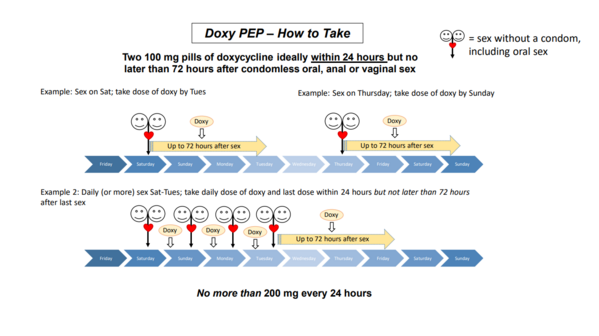
- 200 mg of doxycycline should be taken ideally within 24 hours but no later than 72 hours after condomless oral, anal, or vaginal sex. (Regimen graphic displayed below).
- Doxycycline can be taken as often as every day, depending on frequency of sexual activity, but individuals should not take more than 200 mg within a 24-hour period.
- Take doxycycline with fluids and remain upright for 30 minutes after the dose. Taking doxycycline with food may increase tolerability.
- Either doxycycline hyclate OR doxycycline monohydrate immediate release 100 mg tabs (2 tabs taken simultaneously) are acceptable.
- Do not take concurrently with polyvalent cations such as iron and calcium carbonate. Take doxycycline at least 1 hour before or 2 hours after antacids, calcium or iron containing products.
- No laboratory monitoring is needed with doxy PEP.
Regimen Graphic courtesy of
1. Health Equity Considerations for doxy PEP: Lessons learned from the introduction of PrEP for HIV and Jynneos as the Mpox vaccine demonstrate that an effective introduction of doxycycline as STI PEP will require careful attention to health equity:
- During the 2022 Mpox Outbreak, public health officials learned that excessive vaccine restrictions based on sexual behavior deterred some people from getting the mpox vaccine. Remember that patients may not be willing to divulge sensitive information about sexual behavior because of stigma.
- Doxycycline as STI PEP is a new prevention intervention. Some patients may have heard about it in the news while others may not know about it. Proactively informing patients rather than waiting for them to request it can facilitate more equitable distribution of doxycycline as STI PEP.
2. Inform and consult patients on doxy PEP. Doxy PEP may be effective for all people who have oral and anal sex with people with a penis regardless of gender identity and sex assigned at birth. It may be particularly indicated for those who have recent or frequent exposure to STIs, particularly syphilis.
3. Offer doxy PEP using shared decision-making to all non-pregnant individuals and those not wishing to become pregnant at increased risk for bacterial STIs and to those requesting doxy PEP, even if these individuals have not been previously diagnosed with an STI or have not disclosed their risk status.
4. Assess for the need of HIV PEP, HIV treatment, and consult for HIV PrEP. As appropriate, initiate HIV PEP within 72-hours to prevent infection and rapid start treatment regimens. Coordinate with your local health department, Emergency Department, or Prevention Services Partner to ensure prompt and comprehensive prevention measures are taken.
5. Partner with the DOH to help remove and reduce financial barriers. Become a contacted provider with Client Services for Early Intervention Program (EIP) and the PrEP Drug Assistance Program (PrEP DAP).
6. ICD-10 diagnosis code, Z20.2, is recommended (Contact with and [suspected] exposure to infections with a predominantly sexual mode of transmission).
Access the latest information and resources from the University of Washington STD Prevention Training Center's New STI Video Library!
|