|
|
Welcome to the COVID-19 Vaccine Partner Newsletter! Here you'll find the latest news and information on COVID-19 vaccine related topics.
|
|
Q: WILL THERE BE A COVID-19 VACCINE BOOSTER THIS SPRING?
A: The Centers for Disease Control and Prevention (CDC) is deciding whether to recommend another dose of COVID-19 vaccine this spring. The expectation is this dose would be for vulnerable groups such as older adults and people with weakened immune systems, and would be the same vaccine that was approved last fall (updated 2023-2024 formula).
The CDC’s Advisory Committee on Immunization Practices (ACIP) is expected to meet this Wednesday, February 28, 2024, in order to vote on the whether another dose this spring is recommended. Advisory committees in Canada and the United Kingdom have already recommended spring COVID-19 vaccines for seniors, people in long-term care facilities, and people over 6 months old who have weakened immune systems.
Tune in to the ACIP meeting this Wednesday to hear the final decision. The meeting will begin at 5:30AM PT, with votes regarding COVID-19 vaccines starting at 10:55AM PT. View the full meeting agenda here.
|
|
STAY TUNED...
You may notice some changes in future editions of this newsletter. Beginning with our next edition coming out on March 8, 2024, we will be moving forward as the COVID-19 and other Respiratory Illness Vaccines: A Partner Newsletter. This newsletter will still provide you with the same COVID-19 vaccine content you know and love, now improved with bonus resources and information! As we transition from COVID-19 response to recovery and begin to incorporate COVID-19 with other respiratory illnesses, such as flu and RSV, it is important that we provide our partners with resources and information pertaining to all respiratory illness vaccines.
Keep tuning in every other Friday for the latest news, clinical updates, and upcoming trainings covering all of the respiratory illness vaccines! Do you have partners that work with respiratory illnesses outside of COVID-19? Have them subscribe today!
|
|
RECOGNIZING BLACK PUBLIC HEALTH HEROES
In celebration of Black History Month, faculty at the Johns Hopkins Bloomberg School of Public Health identified Black public health icons who influenced the work they do and the field overall. From historical firsts to today’s changemakers, these are a few of the many individuals who have broken barriers, saved lives, and propelled public health to new heights:
James McCune Smith, MD: In 1837, James McCune Smith became the first African American to earn a medical degree, at the University of Glasgow, after being denied admission to U.S. universities due to his race. He returned to the U.S., where he became the first African American physician in the U.S., opened the country’s first Black-owned pharmacy, and was the first African American to publish peer-reviewed articles in medical journals.
Robert D. Bullard, Ph.D.: The founding director of the Bullard Center for Environmental and Climate Justice and distinguished professor of urban planning and environmental policy at Texas Southern University. Bullard was the first scientist to publish research showing how pollution in a person’s surroundings could impact their health—in this case, how it was affecting predominantly Black neighborhoods in Houston. Bullard received a Lifetime Achievement award from the UN Environment Programme in 2020.
Ruth E. Moore, Ph.D.: In 1933, Ruth E. Moore became both the first Black woman to be awarded a PhD in the natural sciences and the first Black scientist of any gender to be awarded a PhD in bacteriology. A few years later, in 1936, she also became the first Black member of the American Society for Microbiology. Her PhD dissertation focused on the isolation and detection of the tuberculosis-causing microbe Mycobacterium tuberculosis—at a time when tuberculosis was the second-leading cause of death in the U.S.—and would be referenced in work that helped scientists understand and control the disease. She went on to become the chair of Microbiology at Howard University School of Medicine.
Loretta Sweet Jemmott, Ph.D., MSN, RN, FAAN: Loretta Sweet Jemmott serves as Drexel University’s vice president of Health and Health Equity and is a professor at its College of Nursing and Health Professions. She is one of the U.S.’s most prominent researchers in the field of HIV/AIDS prevention, with a particular focus on African American adolescents and adults. By prioritizing understanding a community’s culture, issues, values, and needs, Jemmott has built effective community-based strategies to reduce STI risk and incidence.
Learn more about these and other important figures in public health, as nominated by the Bloomberg School’s faculty: Black Public Health Heroes Who Made—And Are Making—History.
|
|
NEW MyIR MOBILE RESOURCE TO DISPLAY
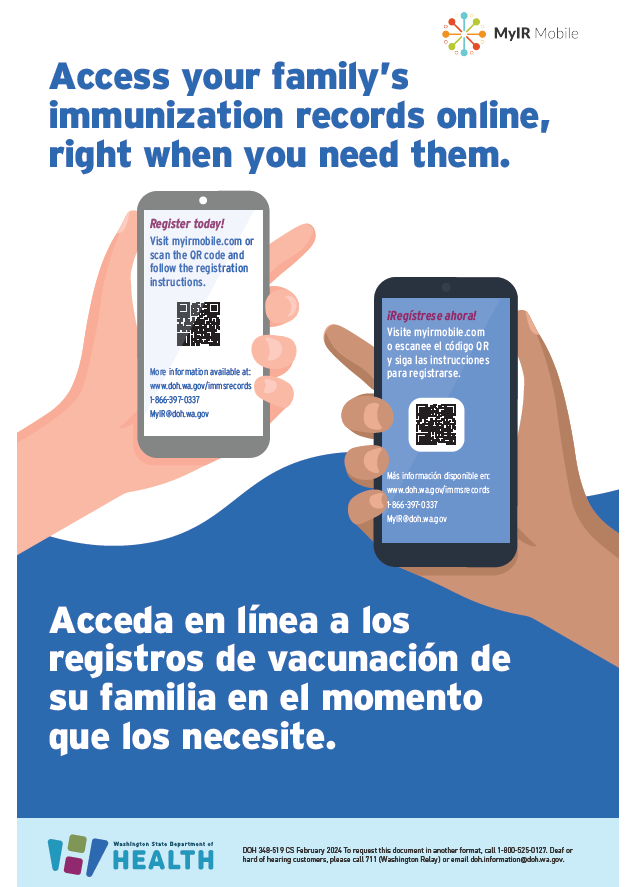
A new resource has been created to display in clinics and other offices for the general public. The poster offers information in both English and Spanish on access to immunization records for the whole family through MyIR Mobile, as well as a simple QR code to register.
MyIR Mobile accounts can now be viewed in Spanish. To change to Spanish, users can click on the dropdown menu in the upper right-hand corner and select Español. The language in the user’s account will automatically update.
If you have questions, contact MyIR@doh.wa.gov.
Print some for your office today! MyIR Mobile Poster
|
|
GOT AN UPDATED 2023-2024 COVID-19 VACCINE? REGISTER IN V-SAFE
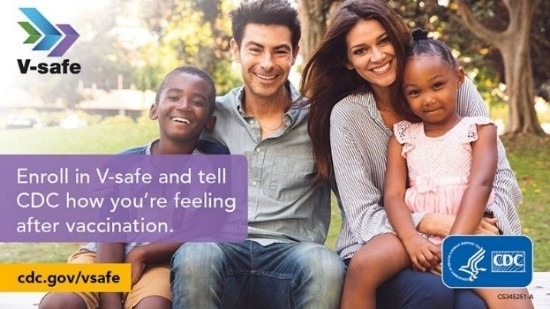
Vaccine safety monitoring is a top priority at CDC. V-safe is one of several systems CDC uses to closely monitor the safety of vaccines in the United States. V-safe registration is now open to anyone who gets an updated 2023-2024 COVID-19 vaccine or an RSV vaccine. Participants who enroll in V-safe within 6 weeks of vaccination will receive confidential health check-ins via text message or email to share how they feel after vaccination.
You can sign up for V-safe using your smartphone, tablet, or computer at vsafe.cdc.gov.
|
|
COVID-19 VACCINES AND COVID-19-RELATED THROMBOEMBOLIC EVENTS
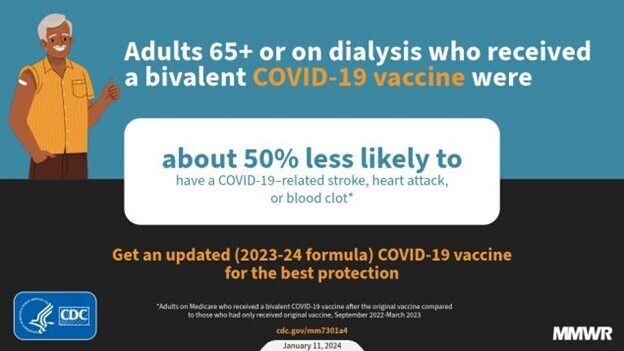
A recent study shows COVID-19 vaccines helped provide protection against COVID-19–related thromboembolic events. Thromboembolism is when a blood clot (thrombus) that forms in a blood vessel breaks loose, is carried by the bloodstream, and blocks another blood vessel. Adults 65 years of age or older and adults receiving dialysis are less likely to have a COVID-19-related stroke, heart attack, or blood clot when they had COVID-19 if they had received the bivalent mRNA COVID-19 vaccine.
To prevent COVID-19–related complications, including thromboembolic events, adults should stay up to date with recommended COVID-19 vaccination.
|
|
|
Creator: Evgeniia Ardashnikova | Credit: Getty Images
ADULT COVID-19 VACCINE ORDERING
We would like to remind providers that updated 2023-2024 COVID-19 vaccines are available to order through the Adult Vaccine Program (AVP) for adults 19 years and older.
COVID-19 vaccines ordered through AVP can be administered to individuals who are either uninsured or underinsured—all other AVP vaccines can only be administered to uninsured individuals.
Orders for AVP COVID-19 vaccines are placed via the Washington IIS. There are currently three COVID-19 vaccines available to order:
-
Pfizer prefilled syringes (fridge)
-
Moderna single-dose vials (freezer, or a fridge for up to 30 days)
-
Novavax multi-dose vials (5 doses/vial, fridge)
The minimum order quantity for all three products is 10 doses.
To enroll in the Adult Vaccine Program, begin by filling out this REDCap Provider Enrollment Form.
|
|
|
Creator: Tashatuvango | Credit: tashatuvango - stock.adobe.com
UPDATED GUIDELINES FOR COVID-19 VACCINATION
Earlier this month the Interim Clinical Considerations for Use of COVID-19 Vaccines CDC page was updated. The following is a summary of the updates:
- Information on post-vaccination reaction was updated in the pre-vaccination counseling section. Safety considerations for use of COVID-19 vaccines was updated to better align with information provided in fact sheets and package inserts.
- The availability of V-Safe for COVID-19 vaccines was added to the adverse event reporting section of the guideline.
|
|
ARE YOU STORING PFIZER COVID-19 VACCINE CORRECTLY?
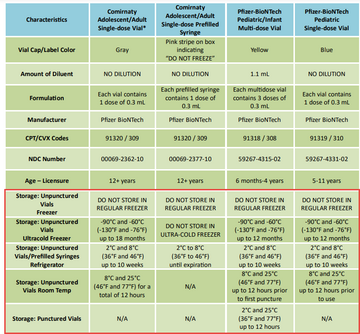
Recently, we have identified providers who are storing Pfizer COVID-19 vaccine incorrectly. If your clinic orders Pfizer COVID-19 vaccine products, please check to make sure you are storing it correctly according to the COVID Vaccine At-A-Glance Guide.
-
Never store any Pfizer COVID-19 vaccine products in a regular freezer (i.e. where you store other frozen vaccines like Varicella, MMRV, and Moderna COVID-19 vaccine).
- The new Pfizer COVID-19 vaccine 12+ pre-filled syringes must be stored in the fridge.
- Single dose vials and multi-dose vials of all Pfizer COVID-19 vaccine products must be stored in an ultracold freezer or the fridge. Vaccine can only be used for up to 10 weeks once placed in the fridge.
- Use Beyond-Use-Date labels:
- When storing single or multi-dose vials in the fridge to indicate the shortened expiration date.
- After puncturing a multi-dose vial to indicate the vaccine can only be used for up to 12 hours after puncture.
- See additional guidance below for BUDs when storing single or multi-dose vials at room temperature.
|
|
ARTS-FOCUSED APPROACH TO PUBLIC HEALTH COMMUNICATIONS
Thursday, February 29, 2024 from 9:30-11:00AM PT
Join the Public Health Communications Collaborative for their next webinar, Arts-Focused Approaches to Public Health Communications. Researchers, practitioners, and artists who use the arts to shift views and build healthier communities will discuss:
- Art as a tool for successful and meaningful public health communications and storytelling
- Best practices for initiating collaborations with artists
- Respectful portrayal of members of population groups
- A real-world campaign that used art to communicate about public health
|
|
2024 UPDATES TO THE CHILD/ADOLESCENT & ADULT IMMUNIZATION SCHEDULES
Wednesday, March 6, 2024 from 9:00-10:00AM PT
The CDC is hosting a webinar on 2024 updates to the child/adolescent and adult immunization schedules. You can find more event details at the following link:
Current Issues in Immunization Webinars
No registration is required, although participation is capped at 1500. The webinar will be recorded. Direct access at the time of the event is at the following link:
Webinar Login
|
|
STORYTELLING WITH DATA WEBINAR
The state Department of Health is excited to partner with IBM on this special training called Storytelling with Data. The three-part series includes lectures plus hands-on, practical activities designed for epidemiologists, data analysts, communicators, and anyone else who wants to learn more about how to frame public health data for better understanding and action.
The series is held over three consecutive Tuesdays in March 2024. Attendees will receive a certificate of completion at the end of the course.
Register for all three sessions today.
-
Week 1: Tuesday, March 5 from 11:30AM to 1:00PM PT
-
Week 2: Tuesday, March 12 from 11:30AM to 1:00PM PT
-
Week 3: Tuesday, March 19 from 11:30AM to 1:00PM PT
A recording of each webinar will be available at the Public Health Data Learning Center website.
Questions about these events? Email us at DataModFeedback@doh.wa.gov.
|
|
|
FOR SCHOOLS AND CHILD CARE FACILITIES
FOR LONG-TERM CARE FACILITIES
|
|
SIGN UP FOR THIS NEWSLETTER!
If you aren't already signed up for the COVID-19 Vaccine Partner Newsletter, please visit the Department of Health's email subscribers page here. Once you enter your email, on the next page expand the Immunization topic, select the COVID-19 Vaccine Partner Newsletter, and click submit.
|
|
This newsletter summarizes content beginning the week of February 11, 2024 and was sent out on February 23, 2024. |
|
|
|
|