|
|
Welcome to the COVID-19 Vaccine Partner Newsletter! Here you'll find the latest news and information on COVID-19 vaccine related topics.
|
|
Q: HOW CAN I PROTECT MYSELF/MY COMMUNITY FROM RESPIRATORY ILLNESS?
A: There are many things you can do to reduce your chances of getting or spreading respiratory illnesses like flu, RSV, or COVID-19. Some of the most important and effective measures are:
-
Get vaccinated and stay up-to-date with vaccinations. Everyone ages 6 months and older can get vaccinated against flu and receive an updated COVID-19 vaccine. RSV vaccines can also prevent severe RSV-related illness for older adults and pregnant people. You can get these vaccines all at the same time! And it’s not too late to benefit from additional protection this season.
-
Wear a mask. Masks aren't just for pandemics. Wearing a high-quality, well-fitting mask is an effective way to reduce the spread of respiratory illnesses. Wearing a high-quality mask prevents the spread of the virus to others and protects the mask-wearer.
-
Stay home and isolate if you’re sick. Stay home and isolate from others when feeling sick. You can take at-home tests; while there isn’t an at-home test for RSV, at-home rapid antigen COVID-19 and flu tests are effective and reliable when used properly.
-
Wash and sanitize your hands. Washing and sanitizing your hands is a simple and important way to prevent the spread of viruses like RSV, flu, and COVID-19.
View Washington State Department of Health's newest resource, a Respiratory Illness Prevention Toolkit, below for more resources to keep your community healthy!
|
|
NEW! RESPIRATORY ILLNESS PREVENTION CO-BRANDABLE TOOLKIT
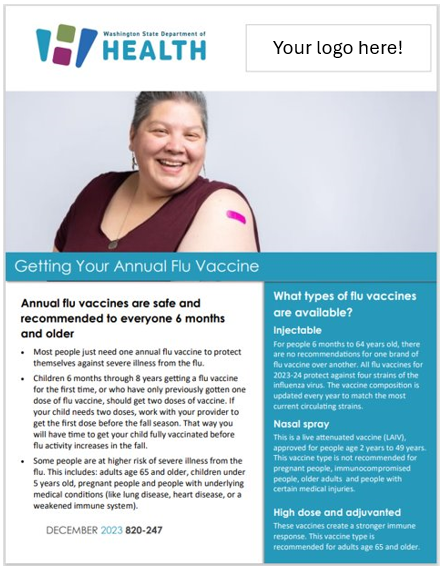
DOH has created an extensive Respiratory Illness Prevention Toolkit, now available to local health jurisdictions (LHJs) and Tribal partners. This toolkit was created to aid Washington state LHJs in educating their communities on a range of respiratory disease related topics. This toolkit primarily focuses on general respiratory disease prevention and vaccine promotion for COVID-19, flu, and respiratory syncytial virus (RSV). Specific messaging for high-risk groups, including children, older adults and pregnant people is included. There are ready-to-use materials covering COVID-19 and flu, as well as adaptable material (sample social media posts and talking points for LHJ/Tribal communications) covering COVID-19, flu and RSV. The ready-to-use materials within this toolkit are co-brandable, allowing space for LHJs and Tribes to include their own logos! Many of the materials are offered in English and Spanish currently, with more languages coming soon. There is DOH staff contact information located on the toolkit page if there are questions or additional needs.
Respiratory illness activity is rapidly increasing across the United States, yet vaccination rates for COVID-19, influenza, and RSV remain low. Low vaccination rates mean more people with more severe disease. Getting vaccinated now can help prevent hospitalizations, decrease strain on the health care system, and save lives.
CDC has urged health care providers and clinicians to recommend all patients receive all respiratory immunizations they are eligible for. On December 14, 2023, CDC issued a Health Alert Network (HAN) advisory to raise awareness about respiratory illness activity and urge action. To increase vaccination coverage, COVID-19 vaccines are available at no cost to adults who are uninsured or underinsured through the Bridge Access Program.
Use DOH materials within your own communities and help increase respiratory illness vaccinations locally with this toolkit.
|
|
NEW INSURANCE COVERAGE RESOURCE
The COVID-19 vaccine is available at no-cost for:
-
Publicly and privately insured individuals who access the vaccine through an in-network provider.
-
Uninsured adults who seek vaccination through the Bridge Access Program.
-
Underinsured adults, including those who are covered under grandfathered health insurance policies, can also seek vaccination through the Bridge Program.
-
Grandfathered plans were sold through insurance companies, agents, or brokers. These plans were purchased on or before the Affordable Care Act (ACA) was signed on March 23, 2010.
This informative two-page handout explains how insurance covers COVID-19 vaccines for adults and children. Developed by the COVID-19 Vaccine Education and Equity Project, the handout includes brief healthcare coverage requirements for adults, children, and people enrolled in Medicaid, Medicare, TRICARE, and private insurance.
|
|
MORE RESOURCES FROM DOH
The DOH COVID-19 Vaccine Health Education Team continues to update and create materials for your use. Please ensure that the materials and information you're using are the most recent version by checking the creation date on the document or webpage. Discard/remove any out-of-date material you're using.
Now available!
|
|
CARE-A-VAN OFFERINGS
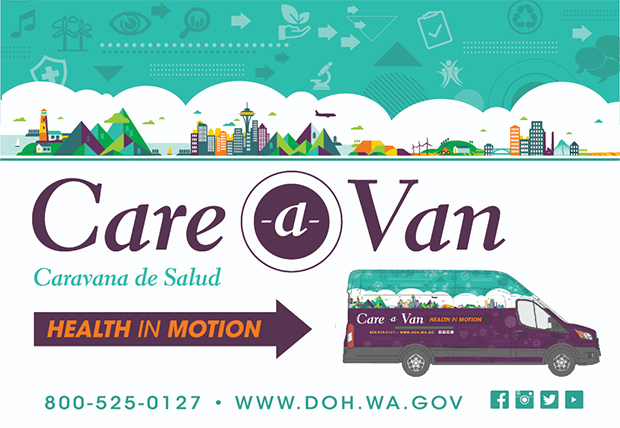
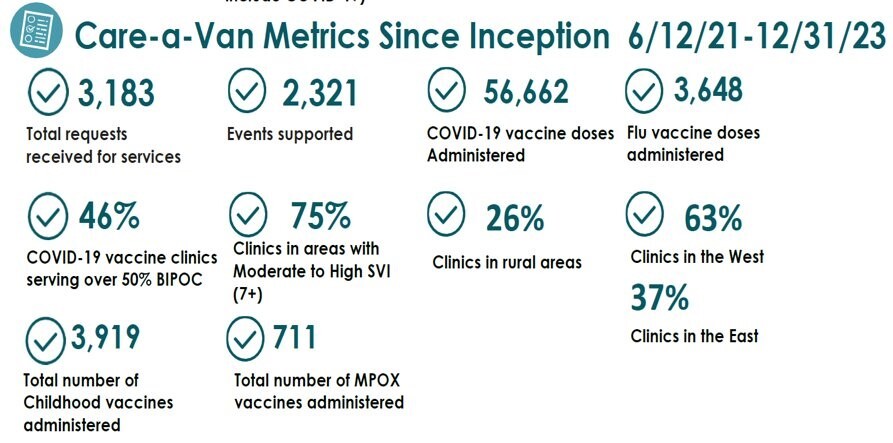
The Care-a-Van mobile health clinic program offers COVID-19, flu, Mpox, and childhood vaccines as well as blood pressure and blood glucose screenings, and naloxone distribution. Care-a-Van provides vaccinations for all children at no cost up to 19 years of age, as well as for adults (19 years and older) who are insured, uninsured and under-insured.
If you would like to request a clinic, please use the following link: Care-a-Van Request Form (smartsheet.com). Care-a-Van is currently booked out through January.
Care-a-Van has reduced to 30 clinics per month from 1/1/24 through 3/31/24 and plans to reduce to 20 clinics per month 4/1/24 thru 6/30/24.
|
|
UPDATED AUDIO RECORDINGS FOR ON-HOLD MESSAGING
Updated mp3 on-hold message recordings in English and Spanish are now available on the Power of Providers member website.
Add these recordings to your waiting room playlists and on-hold phone messages to encourage everyone to get up to date on COVID-19 vaccines.
|
|
CDC 2024 RECOMMENDED IMMUNIZATION SCHEDULE
The 2024 Advisory Committee on Immunization Practices Recommended Immunization Schedules were recently posted by the Centers for Disease Control and Prevention (CDC). The schedules summarize final recommendations that were previously adopted and made official by the CDC director.
Schedule changes are reflected in CDC’s health care provider web content as well as on the Immunization Schedule App.
The new schedules include updated recommendations for the following vaccines:
|
|
VACCINES.GOV INVENTORY REPORTING
The Bridge Access Program does not require inventory reporting on Vaccines.gov. However, providers must be visible on Vaccines.gov to participate in the program and must therefore indicate their COVID-19 vaccine availability.
If your organization does not report inventory electronically via SFTP, follow these steps to manually indicate vaccine availability:
- Navigate to the Vaccines.gov provider portal.
- Ensure you are on the "COVID-19 Vaccine Inventory" tab.
- Select "Log Manually."
- Select "Edit" on the top right of the page (below the large blue COVID-19 Vaccine Inventory rectangle).
- Directly to the right of the location name is a gray box with the text "Display to the Public." Select the "Yes" option within that section for each location you intend to show as available.
- Select the "Yes" option in the "In Stock" column for each vaccine you intend to show as available.
- If there is a number in the "PREVIOUS DOSES" column, you must enter a number in the "CURRENT DOSES" column in order to change your "IN STOCK" status to "Yes."
The number of doses does not need to be accurate, but there must be a number in the field for the location to be visible to the public. For flu vaccines, repeat steps 3-5 on the "Other Vaccines" tab.
Please note that to keep a location visible in Vaccines.gov, a provider portal account user for that location must interact with a record on the "COVID-19 Vaccine Inventory" page at least every 29 days. Because the number of doses listed does not need to be accurate, the easiest way to do this is to change the number in the “DOSES” field and save the change.
More information about displaying location and vaccine availability can be found on the Vaccines.gov Provider Resources website, which includes the following:
For Vaccines.gov technical assistance, please submit a Vaccines.gov New Service Request or reach out to the COVID-19 Administration Reporting Systems (CARS) Help Desk:
Email: CARS_HelpDesk@cdc.gov
Phone: 1-833-748-1979
|
|
PREPARE NOW FOR PROVIDER AGREEMENT RENEWALS
Now is a good time to ensure your clinic is prepared for the upcoming Childhood Vaccine Program provider agreement renewal period which occurs between March and April this year. To help your agreement renewal go smoothly please ensure:
- All thermometer calibrations are up to date.
- Gather your practice profile data for the calendar year 1/1/23-12/31/23.
- Your primary and backup vaccine coordinators have completed You Call the Shots training modules in 2024. Starting this year, the trainings must be completed in CDC TRAIN. The links below include instructions for accessing the courses via TRAIN:
|
|
MyIR UPDATES
|
COVID-19 vaccine certificates will no longer be available on MyIR Mobile. Immunization records can still be accessed via MyIR Mobile while COVID-19 vaccination records are also available through WA Verify.
|
|
|
EXPECT SHIPPING DELAYS
Inclement weather across the country is causing shipping delays this week. The distributor is holding all childhood vaccine program orders for the state of Washington due to extreme weather conditions for shipments that were due to be delivered on January 10, 2024.
We will provide more information as we get updates. Thank you for your understanding. For more information on this update or to subscribe to Vaccine Blurbs, email the Vaccine Management team at WAChildhoodVaccines@doh.wa.gov.
|
|
PFIZER 12+ PRE-FILLED SYRINGES
The CDC has changed the CVP 12y–18y Pfizer vaccine and the AVP 19y+ Pfizer vaccine from single-dose vials (NDC 00069-2362-10) to pre-filled syringes (NDC 00069-2377-10). The storage requirements for pre-filled syringes are different than for single-dose vials:
-
Pre-filled syringes must be stored between 2°C and 8°C. Do not store them in an ultra-cold or a standard freezer.
-
Pre-filled syringes can be used through the expiration date on the carton. The 10-week beyond-use date (BUD) does not apply to them.
Please continue to use any remaining single-dose vial Pfizer until it is consumed, expired, or passed the BUD. WAIIS will still allow for administration of single-dose vials even though they can no longer be ordered.
|
|
NEW MCKESSON TEMPTERATURE MONITOR
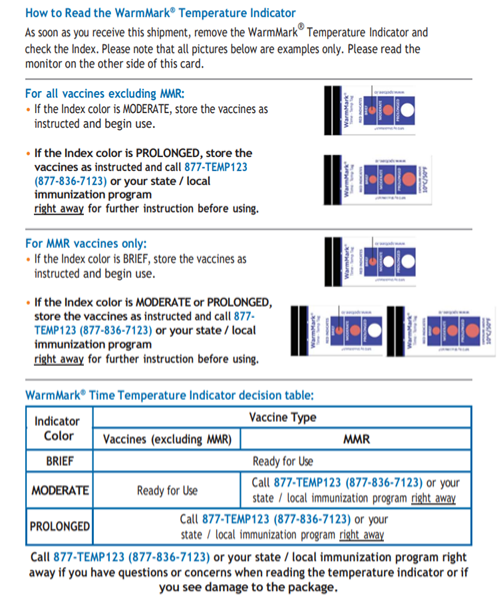
Starting on January 8, 2024, McKesson began using a new temperature monitor in addition to the old 3M monitor. Providers will now receive either the 3M or the new SpotSee (WarmMark) temperature monitor in their shipments. This is a temporary change, anticipated to remain until the beginning of February.
|
|
CDC EMPHASIZES NEED FOR VACCINATIONS AND THERAPEUTICS DURING RESPIRATORY VIRUS SEASON
Last month the CDC reported numbers as high as a 200% increase in influenza cases as well as stark increases in numbers of RSV and COVID-19 infections throughout the country. With these alarming elevations in respiratory illness counts the CDC issued a Health Alert Network Report providing recommendations in response to this situation. In this report the CDC urges providers to encourage vaccinations for the patients they serve as well as provide therapeutics such as antivirals and monoclonal antibodies for eligible patients. Furthermore, the CDC highlights the importance of reviewing other preventive measures with their patients such as frequent handwashing, covering coughs/sneezes, staying at home when sick, improving ventilation at home or work, and washing hands to protect themselves and others against spread of respiratory illnesses.
You can find the full publication at the following link: Health Alert Network (HAN) - 00503
|
|
WEBINAR TODAY: POST-COVID-19 CONDITIONS - DIAGNOSIS AND MANAGEMENT OPTIONS
Today, January 12th from 12:00PM-1:00PM PT
The Power of Providers Initiative from the Washington State Department of Health is hosting a 'Long COVID' webinar. Dr. Anita Chopra & Dr. Janna Friedly from the University of Washington Post-COVID Rehabilitation and Recovery Clinic will discuss clinical presentations of Long COVID, commonly utilized diagnostic techniques, available treatment management options, and developing management options.
The Department of Health will record the webinar. Physicians (MDs, DOs), Physician Assistants (PA), Nurses, and Medical Assistants will have continuing education credit opportunities.
|
|
IMMUNITY ACTION COALITION OF WASHINGTON UPCOMING MEETINGS
The next Immunity Action Coalition of Washington (IACW) meeting will take place virtually on February 14, 2024 from 12:00-2:00PM PT. The agenda and more details are to come. Registration is required; see the link below.
Did you miss the last one? Check out the meeting recording and presentation slides from November 8th here. Do you have feedback on what you would like to see presented at future meetings? Send an email with your suggestions, comments, or questions to ic@withinreachwa.org.
The Respiratory Season Subcommittee held their second meeting on December 19, 2023 and will meet next on January 23, 2024. The subcommittee discussed how COVID-19, RSV, and flu (view the DOH Respiratory Illness Dashboard here) are on the rise as well as objectives/activities for 2024. If interested please send an email to be added to the invites.
|
|
REDCap REFRESHER- JOIN CVP PROVIDER TRAINING SERIES
Thursday, January 18, 2024 at 12:00PM PT
Please join us January 18, 2024 for the next session in the CVP Training Series. The topic will be a repeat of the November 16th session for anyone who missed it. Please tune in to learn about or get a refresher on submitting temperature logs and reporting temperature excursions in REDCap which is now required every month for every provider enrolled in the Childhood Vaccine Program (CVP) and the Adult Vaccine Program (AVP).
Note: There will be some changes to the REDCap Office Hours due to no attendance at the past couple sessions. The January 10 and January 17 Office Hour sessions will be canceled and substituted with the CVP training session mentioned above.
|
|
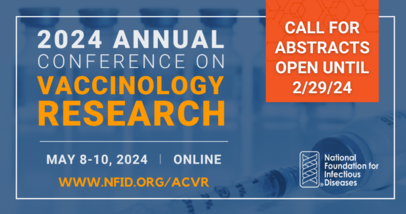
2023 ANNUAL CONFERENCE ON VACCINOLOGY RESEARCH NOW ACCEPTING ABSTRACTS
The National Foundation for Infectious Diseases (NFID) invites abstract submissions of original research in the field of vaccinology. Abstracts are peer-reviewed for quality of research, educational, and scientific content. Accepted abstracts will be scheduled as either poster or oral presentations at the 2024 Annual Conference on Vaccinology Research scheduled as an online event on May 8-10, 2024. Abstract notifications will be sent in March 2024.
Abstract submission topics include:
- Combatting Antimicrobial Resistance
- Epidemiology and Burden of Diseases
- Implementation Challenges and Solutions
- Innovation in Immunization
- Vaccine Disparities and Health Equity
- Vaccine Policy and Regulatory Pathways
- Vaccine Research, Development, Production, and Delivery
- Vaccine Safety, Monitoring, and Evaluation
- Vaccines Against Emerging and Re-Emerging Infectious Diseases
- Vaccines for Special Populations (Maternal Immunization,
- Immunocompromised, and High-Risk Groups)
|
|
|
FOR SCHOOLS AND CHILD CARE FACILITIES
FOR LONG-TERM CARE FACILITIES
|
|
SIGN UP FOR THIS NEWSLETTER!
If you aren't already signed up for the COVID-19 Vaccine Partner Newsletter, please visit the Department of Health's email subscribers page here. Once you enter your email, on the next page expand the Immunization topic, select the COVID-19 Vaccine Partner Newsletter, and click submit.
|
|
This newsletter summarizes content beginning the week of December 17, 2023 and was sent out on January 12, 2024. |
|
|
|
|