|

UPCOMING WEBINARS AND
TRAINING OPPORTUNITIES
Healthcare Guidance Update
The WA State Department of Health (DOH) has updated the Interim Recommendations for SARS-CoV-2 Infection Prevention and Control in Healthcare Settings. Updates can be found at the COVID-19 Infection Prevention in Health Care Settings web page.
Please tune in on Thursday April 20, 2023, from 10:00 -11:30 AM for a follow-up to the April 6th webinar to review Frequently Asked Questions and additional subject matter expert presentations related to the updated guidance. Contact HAI-COVID@doh.wa.gov with any additional questions.
April 20th, 10 AM PST • Register
DOH Staffing Chat: How do we keep you in long-term care?"
The Healthcare-Associated Infections and Antimicrobial Resistance Section is conducting “Staffing Chat: How do we keep you in long-term care?” focus groups to address the turnover rate in long-term care (LTC) staffing. Turnover in LTC staff has been shown to impact the burden of healthcare-associated infections. This will be a 45-minute online focus group for direct patient care staff (CNA, Home Care Aide, LPN, RN, and more) working in Washington state LTC facilities, with the goal to provide suggestions for facilities to improve staff retention.
HAI Staffing Chat Flyer
April 19th, 4 PM PST • RSVP
April 26th, 10 AM PST • RSVP
Navigating Infection Control Training Requirements in Long-Term Care
This Comagine Health webinar will refer to requirements in Centers for Medicare & Medicaid Services (CMS) State Operations Manual Appendix PP and the survey investigative pathways to provide an overview of staff training requirements for infection prevention and control.
April 25th - 11 AM PST • Register
Strategies to Increase Immunization Rates
The Washington Department of Health (DOH) will be hosting a webinar to discuss proven strategies to increase immunization rates, ways medical assistants can effectively promote immunizations and increase immunization rates in a clinic, and using tools in the Washington State Immunization Information System to raise immunization rates.
The webinar will be recorded, and continuing education is available for physicians, nurses, medical assistants, and pharmacists/pharmacy techs.
April 19th - 12 PM PST • Register
|
|
 Marburg Virus Disease Outbreaks in Equatorial Guinea and Tanzania
Division of Healthcare Quality Promotion would like to highlight a Health Advisory Network (HAN) release which was published April 6th due to ongoing outbreaks of Marburg virus disease (MVD) in Equatorial Guinea and Tanzania. The HAN includes recommendations for clinicians, public health departments, clinical laboratory biosafety, and the public. The following infection prevention and control measures are included in the HAN:
Infection Prevention and Control Measures In hospitals, CDC recommends a combination of infection prevention and control measures to prevent transmission of MVD. These infection prevention and control measures include personal protective equipment (PPE), patient placement, and patient care considerations. If MVD is suspected, patients should be isolated in a private room with a private bathroom or covered bedside toilet. Healthcare personnel should follow the same infection prevention and control measures as recommended for Ebola disease, including using recommended personal protective equipment (PPE) and limiting the number of personnel who enter the room for clinical evaluation and management.
Healthcare personnel can be exposed through contact with a patient’s body fluids, contaminated medical supplies and equipment, or contaminated environmental surfaces. Splashes to unprotected mucous membranes (e.g., the eyes, nose, or mouth) are particularly hazardous. Procedures that can increase environmental contamination with infectious material, involve handling of potentially contaminated needles or other sharps, or create aerosols should be minimized. Separate PPE guidance is available for managing clinically stable and clinically unstable patients.
The following infection prevention resources are also available in the HAN:
The 2022 Annual ICAR Report
During 2022, the Washington State Department of Healthcare Associated Infection and Antimicrobial Resistance Section (HAI/AR) worked alongside Local Health Jurisdictions (LHJs) to conduct 831 Infection Control Assessment and Response (ICAR) consultations in healthcare facilities, the majority were in Long-term Care (LTC) settings. In addition to LTC, we supported hospitals, supported living services, behavioral health, and outpatient clinics with their infection prevention and control (IPC) needs.
The primary focus was to promote long-term relationship building between public health and LTC, and support sustained healthcare IPC practices.
- Conducted a facility-level engagement survey to gain a stronger understanding of which IPC topics are most helpful during the consultations.
- Facility-level feedback was vital as it allowed us to incorporate feedback and suggestions into future ICAR consultations.
- Continued to maintain additional efforts towards the importance of onsite consultations.
- Continuing on-site ICARs allowed us to take a hands-on approach alongside the LHJs to offer resources and support to facilities.
|
|
 Clinical Pearls:
Penicillin Allergy Article
- There are data showing that penicillin and other beta-lactam allergies are associated with several unwanted effects, including increased odds of C. difficile infection & increased odds of methicillin-resistant Staphylococcus aureus (MRSA) colonization or infection.
- This article written by the Antimicrobial Stewardship Team contains more statistics & information on this important patient safety topic, as well as links to resources to support facilities in their penicillin allergy delabeling journey.
- Read more.
Medical Providers’ Frequently Asked Questions About Urinary Tract Infections (UTI): Evidence for Safe Management of Suspected UTIs
- This is a document designed to provide an evidence-based perspective on some common concerns that factor into antibiotic prescribing for asymptomatic bacteriuria.
- This is one of many support strategies that we are working on to support stewardship in the state of WA. We hope that you will find this resource valuable.
- Read more.
Study: Antibiotics don't reduce risk of death from viral respiratory infections
- This study included 2,111 adult patients who tested positive on admission for respiratory syncytial virus (RSV), influenza, and COVID-19. Nearly 2/3rds received antibiotics but did not appear to benefit from them. Read more.
Educational Opportunities:
Skilled Nursing Facility Antimicrobial Stewardship Collaborative
- The Washington State Department of Health is hosting an antimicrobial stewardship collaborative that will start in June and last for 1 year. The goal of this collaborative is to assist facilities in progressing towards meeting the Centers for Medicare and Medicaid mandates and Centers for Disease Control's Core Elements of Antibiotic Stewardship for Nursing Homes. Participation in the collaborative is voluntary, but participating facilities can earn an incentive of up to $5,000 by completing specific activities. Learn more & Register.
Reminders:
NHSN Antibiotic Use and Resistance (AUR) Module Reporting Requirement for Hospitals
- CDC's National Healthcare Safety Network (NHSN) Antimicrobial Use and Resistance (AUR) Module is the primary surveillance system for tracking antimicrobial use in all US hospitals. All hospitals will be required by Centers for Medicare and Medicaid Services (CMS) to be in “Active Engagement” in NHSN AUR module starting in 2024. We put together a Frequently Asked Questions document to help you get started.
NHSN Antimicrobial Use (AU) Module Reporting Funding Opportunity for Hospitals
- To help offset the cost of implementing reporting to the NHSN-AU module, the Department of Health is offering $5,000 financial reimbursement to hospitals that start reporting to the NHSN-AUR module between August 1st, 2022, and March 1st, 2024. Learn more and apply for funding.
  Project Firstline is a nationwide project supported by the CDC and the Washington State Department of Health to provide frontline healthcare workers with infection prevention and control education.
Reduce the Spread of Infection - Become an Infection Control Superhero with the Washington State Project Firstline Learning Modules
|
Washington Project Firstline has a series of online, interactive training modules on basic infection prevention and control practices. The educational, informative, and fun modules take approximately 20-minutes each to complete. Staff who complete all six modules will earn two contact-hours of continuing education credits through WA DSHS and Continuing Nursing Education at the University of Washington School of Nursing.
|
|
|
|
The six-module series is based on CDC Project Firstline contend and focuses on the following:
- Infection Control
- How Germs Can Spread on Surfaces
- How Germs Can Spread via Respiratory Droplets
|
- Proper Hand Hygiene
- Proper Use of Personal Protective Equipment (PPE)
- Cleaning and Disinfection
|
Modules are available at firstline.nwcphp.org.
We encourage you to print the attached flyer and post it in your breakroom for your staff.
Washington Project Firstline Promotional Flyer
Facility Program: Frontline Infection Prevention Champion
 |
|
Become a Frontline Infection Prevention Champion Facility!
Steps:
- Request a Facility Code
- Have your staff members enter Facility Code in user profile.
- Notify staff to complete all six modules – they will receive 2 (free) contact hours of CEs/CNEs.
- Once 90% of your staff complete all 6 training modules, you will be recognized as a Frontline Infection Prevention Champion facility.
|
Are you unsure how close you are to 90%? Email Project Firstline to verify.
You will receive a certificate and recognition on Washington Project Firstline webpage. Most importantly, your staff will be trained in infection prevention!

*NEW* Spanish Interactive Resources
Check out the Spanish Resources on the Project Firstline website for some new interactive resources on the following pages:
Sobre el Proyecto Firstline
Acceda a los materials educativos sobre el control de infecciones

 |
|
| |
The Project Firstline Podcast, hosted by the Washington State Department of Health, is geared toward frontline healthcare workers to bring awareness to infection prevention and public health practices. We identify the importance and impact of infection prevention on our lives and on the lives of our community.
|
|


|
|
|
NEW Episode:
Catch up on previous episodes:
|
|
 What is a Respiratory Protection Program?
A Respiratory Protection Program (RPP) is a set of rules and regulations enforced by the Washington State Department of Labor and Industries (L&I). These rules and regulations are in place to keep workers from becoming sick or injured because of workplace exposures to hazards. One significant hazard comes from viruses that spread through the air when a sick or contagious person coughs, talks or sneezes. Spreading viruses through the air is a respiratory hazard. Read more.

The DOH Occupational Health Team is hosting monthly 30-minute, Lunch & Learn sessions on specific respiratory protection topics. Bring your topic questions to the session or email them ahead of time to HAI-FitTest@doh.wa.gov.
|
Sessions start promptly at 12:00 PM
- April 19th – Who should be in the Respiratory Protection Program?
- May 17th – Estimating what shape N95 likely to work for people’s faces
- June 21st – Tips for the Respirator Program Administrator
- July 19th – Tips for the employee respirator training
For more information contact Stella Daniels, Occupational Health Team Supervisor.
Learn how to conduct your own fit test.
Join us for a 1-hour review of the fit test equipment and see how a valid fit test is done. Visit our website for detailed information.
- Monday, April 24th, 3 PM
- Tuesday, May 9th, 1 PM
- Thursday, May 25th, 11 AM
- Wednesday, June 7th, 3 PM
- Monday, June 26th, 11 AM
- Monday, July 10th, 11 AM
- Wednesday, July 26th,1 PM
Quarterly NHSN User Group for Hospitals
*Calls are facilitated through TEAMS*
Please contact Sandy Ng for a TEAMS invitation
All sessions are from 10:30 - 11:30 AM
July 11, 2023
October 10, 2023
This is monthly forum for NHSN skilled nursing facilities (SNFs) to share and collaborate, improve reporting accuracy, and increase user knowledge.
Please contact Paula Parsons for more information
Calls scheduled 2nd Thursday of the month, 11:00 AM - 12:00 PM
Upcoming dates:
May 11, 2023
June 8, 2023
July 13, 2023
August 10, 2023
September 14, 2023
|
|

Outbreaks of SARS-CoV-2 Infections in Nursing Homes during Periods of Delta and Omicron Predominance, United States, July 2021–March 2022
SARS-CoV-2 infections among vaccinated nursing home residents increased after the Omicron variant emerged. Data on booster dose effectiveness in this population are limited. During July 2021–March 2022, nursing home outbreaks in 11 US jurisdictions involving >3 infections within 14 days among residents who had received at least the primary COVID-19 vaccine(s) were monitored. Among 2,188 nursing homes, 1,247 outbreaks were reported in the periods of Delta (n = 356, 29%), mixed Delta/Omicron (n = 354, 28%), and Omicron (n = 536, 43%) predominance. During the Omicron-predominant period, the risk for infection within 14 days of an outbreak start was lower among boosted residents than among residents who had received the primary vaccine series alone (risk ratio [RR] 0.25, 95% CI 0.19–0.33). Once infected, boosted residents were at lower risk for all-cause hospitalization (RR 0.48, 95% CI 0.40–0.49) and death (RR 0.45, 95% CI 0.34–0.59) than primary vaccine–only residents. Read more.
Lori Nerbonne, of New England Patient Voices, discusses how patients and families can improve patient safety
To help celebrate Patient Safety Awareness Week, CDC has published a new patient safety blog. Lori Nerbonne, cofounder of New England Patient Voices, shares her experience as a patient safety advocate, which began after the death of her mother in 2004. She discusses the importance of patient engagement and shares patient safety tips and tools from infection preventionist Marie Moss. Read more.
How U.S. officials cracked mystery of eyedrops that blinded people across country
Experts marvel at how disease detectives pieced together the case: Patients were scattered across the country. The illnesses occurred over the span of months. The infections were found in different parts of the body — in the blood of some patients, in the lungs of others. Read more.
Extending outbreak investigation with machine learning and graph theory: Benefits of new tools with application to a nosocomial outbreak of a multidrug-resistant organism
From January 1, 2018, until July 31, 2020, a hospital network in Switzerland experienced an outbreak of vancomycin-resistant enterococci (VRE). The goal of their study was to improve existing processes by applying machine-learning and graph-theoretical methods to a nosocomial outbreak investigation. Risk factors for being a VRE carrier were identified, along with 3 important links with VRE (healthcare personnel, medical devices, patient rooms). The author concludes that data science is likely to provide a better understanding of outbreaks, but interpretations require data maturity, and potential confounding factors must be considered. Infection Control & Hospital Epidemiology, March 7, 2023. Read more.
|
|
 Request for Special Pathogens Preparedness Assistance
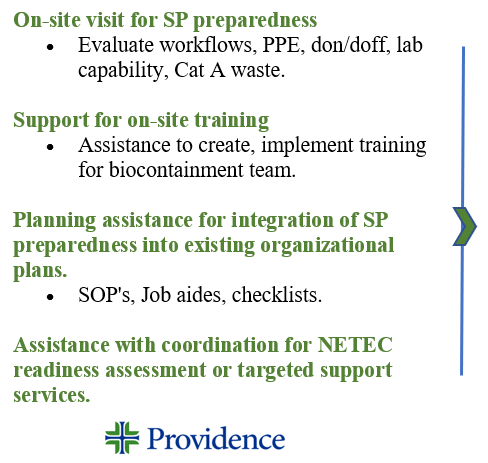
If your organization would like to request support, please follow this process:
- Determine education and/or training needs.
- Send a brief outline of identified needs and potential timeline to christina.arguinchona@providence.org
- Christa to schedule a 30-minute virtual meeting to discuss next steps.
|
SHEA/IDSA/APIC Practice Recommendation: Strategies to prevent healthcare-associated infections through hand hygiene: 2022 Update
The purpose of this document is to highlight practical recommendations to assist acute-care hospitals in prioritization and implementation of strategies to prevent healthcare-associated infections through hand hygiene. This document updates the Strategies to Prevent Healthcare-Associated Infections in Acute Care Hospitals through Hand Hygiene, published in 2014. Read more.
WA One Health Conference – Save the Date & Call for Abstracts
This year’s Washington One Health Conference will be held on August 16th at Central Washington University in Ellensburg. This all-day event will feature topics at the human, animal, and environmental interface. While in-person participation is encouraged, we will also have a virtual option for attendance.
We are currently accepting abstracts for consideration for this conference. If you are interested to present, please submit your abstract by 5/12/2023. Your abstract must be 400 words or less and be pertinent to our One Health theme. All presenters should plan to attend in-person.
Additional information regarding the conference will be posted on the conference webpage. We will send an additional notification when registration is opened. For more information, or if you are interested in joining the planning committee, reach out to Lauren Sarkissian.
CDC Safe Healthcare Blog | Patient Engagement in Infection Prevention
This blog is a part of a series that CDC launched to highlight the importance of patient safety by providing educational information and simple ways to help people stay informed on public safety topics. Visit the webpage to read the latest blog authored by Lori Nerbonne and Marie K. Moss about the importance of patient engagement in infection prevention.
 Information required for continuation of Nurse Aide Waiver
If you completed this survey last month, please complete this survey again. We are required to compile this information and send it to CMS on a monthly basis.
*ATTENTION NURSING HOMES*
To remain in compliance with the Nurse Aide 1135 waiver, Washington State is required to provide CMS monthly reports. As a part of the report process the state needs to compile information from each CMS certified nursing home on a monthly basis. Please assist in this process by completing the 3 question survey. If we are unable to provide the requested information to CMS, Washington state may lose this critically important 1135 waiver and the ability to allow NARs to continue working in a nursing home beyond 4 months while they complete the certification process.
CMS Memo: Strengthened Enhanced Enforcement for Infection Control Deficiencies and QI Activities in LTPACs
The revised guidance strengthens enforcement efforts for noncompliance with infection control deficiencies, particularly those that result in actual harm or immediate jeopardy to residents. Read more.
A letter to Providers/Administrators/Superintendents regarding the following topic is now available online:
A letter to NH Administrators regarding the following topics are now available online:
A letter to ALF Administrators regarding the following topic is now available online:
You are subscribed to Healthcare-Associated Infections and Antimicrobial Resistance (HAI&AR) Newsletter for Washington State Department of Health. This information has recently been updated, and is now available.
 If you aren't already signed up for the Healthcare Associated Infections and Antibiotic Resistance newsletter, please visit the Department of Health's email subscribers page here.
|
|
|
|
|