|
|
Welcome to the COVID-19 Vaccine Partner Newsletter! Here you'll find the latest news and information on COVID-19 vaccine related topics.
|
|

Q: ARE THE UPDATED BIVALENT BOOSTER VACCINES EFFECTIVE?
A: Data released by Centers for Disease Control and Prevention in December 2022 highlights the importance of the updated bivalent booster for everyone eligible. The updated bivalent booster protects against the original strain of the virus and the currently circulating Omicron BA.4 and BA.5-related lineages and sublineages. The report found that the bivalent booster provides additional protection from COVID-19 illness in people who previously received two or more doses of an original (monovalent) mRNA vaccine. Getting the updated bivalent booster restored protection that had decreased over time since receiving the last vaccine dose.
The CDC has also produced data in December via their COVID Data Tracker which showed that people ages 12 years and older who got an updated bivalent booster were 15 times less likely to die from COVID-19 compared with people who were not vaccinated. CDC will continue to evaluate the effectiveness of the updated bivalent booster.
The updated bivalent booster is recommended to all those who are eligible in order to prevent serious illness, hospitalization and death due to COVID-19. Talk to your patients, families and loved ones about the importance of updated boosters today.
|
|
TWO YEARS OF COVID-19 VACCINATION
As of December 2022, it has officially been two years since the first COVID-19 vaccine was administered here in the United States. These vaccines have helped to prevent millions of hospitalizations and saved millions of lives.
Staying up to date on your vaccines, including recommended boosters, and encouraging others to do the same can help protect yourselves, your loved ones, and your community against COVID-19.
You can now get an updated bivalent booster at least 2 months after completing your primary series or last monovalent booster dose. Stay informed on COVID-19 booster information and find resources by visiting the Washington State Department of Health's Vaccine Booster Doses webpage.
|
|
TOOLS AVAILABLE FOR TRACKING COVID-19 VACCINATION DATA
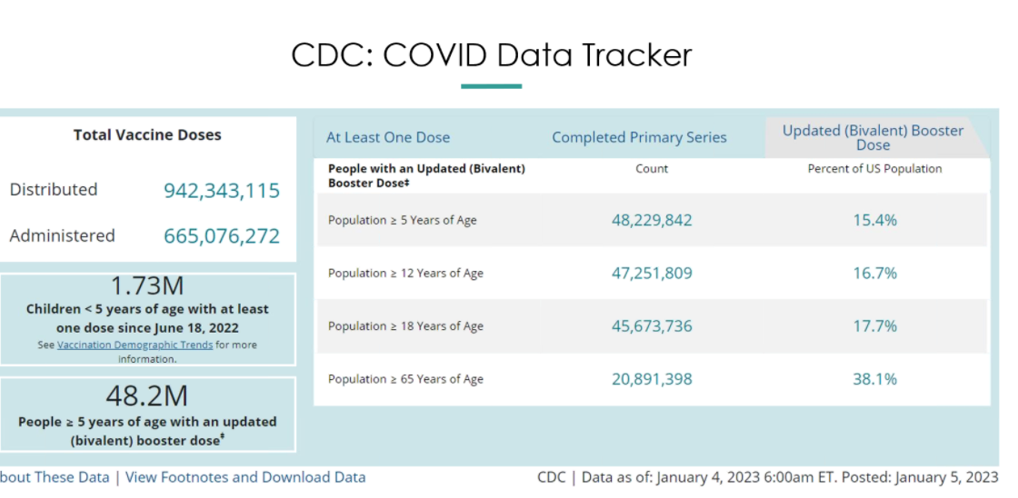
Per the Centers for Disease Control and Prevention (CDC), as of January 4, 2023, 665.1 million vaccine doses have been administered in the United States. Overall, about 229.3 million people, or 69.1% of the total U.S. population, have completed a primary series. More than 48.2 million people, or 15.4% of the U.S. population ages 5 years and older, have received an updated (bivalent) booster dose. The CDC has a Vaccination Data page, updated weekly, that provides you with the trends in number of COVID-19 vaccinations in the US.
 |
Additionally, the Washington State Department of Health has a COVID-19 Data Dashboard which includes a 'vaccination' section where you can find state and local vaccination data. Learn about where and when vaccinations are being given, how many people are getting vaccinated, and who is getting vaccinated in Washington state. You can even view the data based on those who have initiated vaccination versus completed, as well as by type of booster (any versus updated bivalent booster).
|
|
TELEHEALTH PROGRAM IN WASHINGTON ENDED DECEMBER 31, 2022
On December 31, 2022 DOH ended its COVID-19 Telehealth program operated by Bird's Eye Medical and Color Health. COVID-19 medications are still readily available through doctors, local pharmacies, and health clinics at over 1,000 locations throughout the state.
If you have COVID-19 symptoms and test positive, do not wait to get treated. You must begin taking oral COVID-19 medication within five days of your first COVID-19 symptoms. Use this tool to find a location that is right for you.
Visit DOH’s COVID-19 Treatments webpage for more information on antiviral and other COVID treatments. The Washington State COVID-19 Hotline (1-800-525-0127) is also available to assist callers seeking information and resources related to COVID-19 therapeutics.
DOH will continue to monitor the supply of current and new COVID-19 therapeutics, including antivirals and monoclonal antibodies, to advance Washington’s ongoing strategy for preventing and treating COVID-19. We will ensure all Washingtonians have access to the therapeutics shown to be effective against current and emerging variants based on the latest science and availability of FDA-authorized therapeutics, and that healthcare providers have the knowledge and resources to prescribe them effectively.
DOH's COVID-19 Therapeutics Program assisted over 4,600 Washingtonians from July 28th to November 30, 2022.
|
|
TALKING POINTS ON COVID-19 VACCINE SAFETY AND EFFECTIVENESS
With an uptick of COVID-19 cases this winter, the emergence of a new Omicron subvariant XBB.1.5, and the persistent spread of COVID-19 misinformation on social media, the best way to counter false and misleading information is by continuing to share science-based facts. The data shows that vaccines have saved tens of millions of lives, are safe, and continue to be effective at preventing severe illness.
In addition to their Misinformation Alert tracking tool, PHCC has updated their Talking Points on Vaccine Safety and Effectiveness to help you address vaccination misinformation in your community and underscore the importance of staying up-to-date on COVID-19 vaccination.
|
|
DOH SEEKS GUIDANCE FROM PROFESSIONAL PARTNERS ON NEW CAMPAIGN
The Washington State Department of Health (DOH) is developing a campaign in 2023 to encourage families to catch up on immunizations. As part of this effort, we are seeking guidance on what materials and resources may support you in promoting immunizations to families. We are interested in hearing from different types of professionals, including health care providers, school and child care staff, and others who play any part in promoting immunizations.
If you are interested, please fill out this short 10 question survey. The survey should take 5 minutes or less, and we will use the aggregated feedback to determine what materials are most helpful to different professionals.
If you have any questions or comments about this survey, please email OICPschools@doh.wa.gov with the subject line: Imms Campaign Survey. The survey will close on January 20, 2023.
|
|
VACCINE INVENTORY REMINDER AND USEFUL INFORMATION
Shelf-Life Extension Reminder
Pfizer received shelf-life extensions of all TRIS products (i.e., all mRNA COVID-19 vaccines, including both monovalent and bivalent vaccines). Expiry is now 18 months from the date of manufacture (stored ULT frozen). Please use the Pfizer-BioNTech COVID-19 Vaccine Expiry tool to check expiration dates.
Moderna received shelf-life extensions of all wave 1 and wave 2 monovalent COVID-19 vaccines (complete list below). Some of the lots below are MOD 10 (ages 12+) and some are MOD 5 (ages 6-11). All Moderna lots that have received shelf-life extensions are for primary series use only. Please use the Moderna Vial Expiration Checker tool to check expiration dates.
If you would like a copy of the lot numbers with a new Expiry date, please contact Brandi Wilcox at brandi.wilcox@doh.wa.gov
Expiration Dates: BUD vs Expiry
Pfizer-BioNTech COVID-19 Vaccine Expiration Date Extension and Beyond-Use Dates (BUD)
Recently the Food and Drug Administration (FDA) extended the expiration date for Pfizer-BioNTech COVID-19 vaccine (monovalent and bivalent) from 12 to 18 months from manufacturer date. Before discarding any vaccine, providers should check the expiration date using Pfizer-BioNTech's expiration date tool at Pfizer-BioNTech COVID-19 Lot Expiry (cvdvaccine.com). NOTE: This expiration date extension applies to both vaccine vials currently stored at ultra-cold temperatures (-90°C and -60°C [-130°F and -76°F]) and at refrigerated temperatures (2°C and 8°C [36°F and 46°F])–even if these vials were moved to refrigerated temperatures prior to the extension.
For example, if a vaccine (original expiration date = 12/20/2022) was removed from ultra-cold storage and placed in a refrigerator on 12/4/2022. Pfizer-BioNTech COVID-19 vaccine stored in a refrigerator must be used within 10 weeks (beyond-use date [BUD]). Based on the date the vaccine was placed in the refrigerator, the vaccine’s BUD is 2/12/2023. Without the expiration date extension, this vaccine could only be used up to the expiration date (12/20/2022)–not the full 10 weeks. HOWEVER, with this extension, the expiration date is now AFTER the BUD. The vaccine can be used for the full 10 weeks.
For more information go to: Storage and Handling of Pfizer-BioNTech COVID-19 Vaccines | CDC
Moderna COVID-19 Vaccine Expiration Date Extension and Beyond-Use Dates (BUD)
Recently the Food and Drug Administration (FDA) extended the expiration date for select lots of Moderna COVID-19 vaccine (monovalent). This extension includes some lots of Moderna COVID-19 Vaccine (ages 12+ and 6-11). Before discarding any vaccine, providers should check the expiration date using Moderna’s expiration date tool at Moderna Vial Expiration Checker. NOTE: This expiration date extension applies to both vaccine vials currently stored at both frozen temperatures between (-50°C and -15°C [-58°F and 5°F]) and refrigerated temperatures (2°C and 8°C [36°F and 46°F])–even if these vials were moved to refrigerated temperatures prior to the extension.
For example, if a vaccine (original expiration date = 12/20/2022) was removed from frozen storage and placed in a refrigerator on 12/4/2022. Moderna COVID-19 Vaccine stored in a refrigerator must be used within 30 days (beyond-use date [BUD]). Based on the date the vaccine was place in the refrigerator, the vaccine’s BUD is 1/03/2023. Without the expiration date extension, this vaccine could only be used up to the expiration date (12/20/2022)–not the full 30 days. HOWEVER, with this extension, the expiration date is now AFTER the BUD. The vaccine can be used for the full 30 days.
For more information go to: Storage and Handling of Moderna COVID-19 Vaccines | CDC
|
|
ENSURING COVID-19 VACCINE SAFETY
To make sure that COVID-19 vaccines are safe, CDC expanded and strengthened the country’s ability to monitor vaccine safety. CDC created new web-based platforms to gather information and give CDC scientists information about the safety of COVID-19 vaccines in real time.
As a result, vaccine safety experts can monitor and detect issues that may not have been seen during the COVID-19 vaccine clinical trials. If any vaccine safety issues—also called adverse events— are reported, CDC scientists can quickly study them and determine if there is a safety concern with a particular vaccine.
|
|
ADULT VACCINE PROGRAM VACCINE PREFERENCE SURVEY
The Washington State Adult Vaccine Program (AVP) provides vaccine for adults 19 years of age and older who are uninsured or underinsured.
For all current AVP providers, please take this short survey to let us know which vaccines you would like to have available to order through the program for the upcoming year (July 2023 – June 2024). At this time, we do not anticipate the ability to provide every vaccine type without receiving an increase to our funding. Your feedback is very important to us. The survey will close on Friday, January 20th.
As a reminder, this vaccine preference survey is not an order. Completing this survey does not guarantee the future availability of these vaccines in AVP. For those providers who are not yet enrolled in the Adult Vaccine Program, DOH is finalizing a survey and resources for all COVID-19 providers to better understand enrollment pathways for both the Adult Vaccine Program and Childhood Vaccine Program. If you have any questions, please email WAAdultVaccines@doh.wa.gov.
|
|
INCLEMENT WEATHER REMINDER AND RESOURCES FOR PROVIDERS
Planning for Inclement Weather & Power Outages
When inclement weather is expected, power outages and shipping delays are also possible. It's always a good time to remember the resources and processes in place to safeguard the publicly funded vaccines at clinics around Washington and ensure your vaccine management plan is up to date.
As a provider in the Washington State COVID-19 Vaccine Program, please ensure vaccines maintain stable temperatures. If you experience a power outage, please refer to the COVID-19 Temperature Excursion Guide.
If vaccines need to be moved to an alternative location, please remember emergency transport does not require prior approval. If vaccines are transported, ensure that a digital data logger is used to record vaccine temperatures while in transit.
Report all temperature excursions to COVID.vaccine@doh.wa.gov and remember that when a temperature excursion occurs, no matter how brief, the manufacturers of each vaccine involved in the excursion should be contacted to verify vaccine viability. Please refer to the additional resources below for more information.
Resources:
Vaccine Temperature Excursion Guide
Vaccine Transport Guidelines
DOH Storage and Handling Webpage
|
|
PHWINS FOR THE FUTURE: UNDERSTANDING THE STRENGTHS AND NEEDS OF RURAL PUBLIC HEALTH
Monday, January 23, 2023 - 12:00pm PST
Explore the differences between rural and urban public health practitioners and consider recommendations for strengthening the capacity of the rural public health workforce.
The January session of Hot Topics in Practice will examine findings from the 2021 Public Health Workforce Interest and Needs Survey. This study took place during a time of great challenge for public health, as rural health departments struggled to support high needs populations with inadequate resources. These existing challenges were compounded by the COVID-19 pandemic, which has had lasting and severe impacts on both rural and urban public health practitioners.
During this hour-long webinar, Paula Kett and Betty Bekemeier will present an overview of research findings from this survey. Paula, a research scientist at the University of Washington’s Center for Health Workforce Studies, and Betty, Director of the Northwest Center for Public Health Practice, will discuss the implications of their study findings for the public health workforce and policy makers. The presentation will examine how training, education and support may need to be tailored differently for rural practitioners and consider policies that could help build and strengthen the workforce.
|
|
JOIN CDC AND CALIFORNIA DEPARTMENT OF PUBLIC HEALTH FOR JOINT COVID-19 NARRATIVE BRIEFINGS
The Centers for Disease Control and Prevention (CDC) and California Department of Public Health (CDPH) have made it a priority to enhance insight into the causes of vaccine hesitancy and to share strategies that reduce the harmful impacts of misinformation about the COVID-19 vaccines. Our partners are key to increasing public confidence in COVID-19 vaccines and slowing the spread of misinformation by empowering individuals to make informed decisions about COVID-19 vaccination.
Joint COVID-19 Narrative Briefings
To provide greater insights into the root causes of vaccine hesitancy and to mitigate the harmful impacts of COVID-19 vaccine misinformation to public health, CDC and CDPH have teamed up to host a series of Joint COVID-19 Narrative Briefings. These briefings are intended to provide public health organizations with a baseline understanding of some of the English and Spanish online narratives that may undermine confidence in COVID-19 vaccines, as well as tactics to counter them. During the briefings, we will share insights into COVID-19 vaccine hesitancy, highlight prominent current rumors and inaccurate information about the COVID-19 vaccines with high levels of online engagement, and provide proven strategies, trusted information, and resources about the COVID-19 vaccines.
Our next session will be held on Tuesday, January 24 at 4:00 PM ET /3:00 PM CT/ 2:00 PM MT, and 1:00 PM PT via Zoom. Subsequent sessions will take place monthly.
|
|
|
FOR SCHOOLS AND CHILD CARE FACILITIES
FOR LONG-TERM CARE FACILITIES
|
|
SIGN UP FOR THIS NEWSLETTER!
If you aren't already signed up for the COVID-19 Vaccine Partner Newsletter, please visit the Department of Health's email subscribers page here. Once you enter your email, on the next page expand the Immunization topic, select the COVID-19 Vaccine Partner Newsletter, and click submit.
|
|
This newsletter summarizes content from the week of January 2, 2023 and was sent out on January 13, 2023. |
|
|
|
|