|
|
Welcome to the COVID-19 Vaccine Partner Newsletter! Here you'll find the latest news and information on COVID-19 vaccine related topics.
|
|

Q: WHAT BRAND OF COVID-19 VACCINE CAN CHILDREN UNDER 5 RECEIVE?
A: The updated bivalent COVID-19 vaccine booster has recently been expanded to include children down to 6 months of age. The recent age expansion has brought about a fair amount of confusion as various COVID-19 vaccine brands have different guidelines for use. So, what exactly are the new guidelines for the 6 month - 5 year old population by brand?
Children 6 months-4 years old should receive an updated bivalent dose that is the same brand as their primary series; no mix-and-matching.
Moderna
- Children 6 months-5 years who received the original monovalent Moderna COVID-19 vaccine are now eligible to receive an updated bivalent booster two months after completing the primary series.
- Children 5 years old (not younger or older) who received Moderna may receive an updated Moderna or Pfizer bivalent booster.
Pfizer
- The Pfizer COVID-19 vaccine primary series for children 6 months-4 years will now include two monovalent Pfizer doses and one bivalent Pfizer dose.
- Children 6 months-4 years who have not yet begun the 3-dose Pfizer primary series or who have not received the third dose of their primary series will now receive the updated Pfizer series
- Children 6 months-4 years who have already completed the 3-dose Pfizer primary series will not be eligible for additional doses or boosters at this time
- Children 5 years old who completed the Pfizer primary series should only receive an updated bivalent Pfizer booster.
Novavax and Johnson & Johson are not authorized for this age group at this time.
Washington State Department of Health has got you covered with plenty of updated materials that can assist both you and those you work with in understanding and communicating this new information.
Stay up to date with booster information via our Vaccine Booster Doses, Vaccinating Youth, About the COVID-19 Vaccines, and Clinical Information for COVID-19 Vaccine Providers pages!
|
|
UPDATED BIVALENT COVID-19 VACCINES FOR CHILDREN DOWN TO 6 MONTHS OF AGE
COVID-19 vaccine providers are now able to offer omicron variant-targeted bivalent booster doses of COVID-19 vaccines to children ages 6 months and older. This follows the guidance and recommendations released last week from the U.S. Food and Drug Administration (FDA) and the Centers for Disease Control and Prevention (CDC).
Updated COVID-19 vaccines are formulated to protect against COVID-19 caused by the omicron variant. Most importantly, COVID-19 vaccines are critical to providing ongoing protection as immunity wanes and the virus continues to mutate.
The benefits of vaccinating children far outweigh the risks. The potential for a serious side effect or reaction to the vaccine is far less than the risk of serious outcomes or death from COVID-19 disease. The vast majority of children in this age group have not received any doses of a COVID-19 vaccine. CDC is working to increase parent and provider confidence in COVID-19 vaccines and improve uptake among the 95% of children who are not vaccinated or who have not completed the COVID-19 vaccine primary series. Parents should talk to their child’s health care provider to ensure their child is up to date on their COVID-19 and other vaccines.
|
|
NEW DOH RESOURCE OFFERS CLARITY TO PUBLIC ON "UPDATED BIVALENT" COVID-19 VACCINES
Questions on the differences between Monovalent COVID-19 vaccines and Bivalent COVID-19 vaccines?
Check out this new document highlighting the differences between the two types of vaccines, and the importance of staying up to date with a bivalent booster as soon as you are eligible. This resource is available now in English and Spanish and will be available soon in additional languages.
COVID-19 Vaccines - Monovalent VS Bivalent (wa.gov)
COVID-19 Vaccines - Monovalent VS Bivalent (wa.gov) (Spanish)
|
|
NEW DOH TOOLKIT IS A COMPREHENSIVE RESOURCE FOR COVID-19 VACCINE PROVIDERS
A new training toolkit, Preparing for COVID-19 Vaccine Administration, is now available for pediatric vaccine providers. This toolkit is designed to increase clinics' confidence and capacity to offer COVID-19 vaccines to patients in the office setting. The toolkit offers an array of staff training materials, details incorporating COVID-19 vaccines into daily workflow, and numerous updated resources for providers and staff, patients and families.
View the toolkit here.
For more resources like this visit our provider Toolkit and Resources page!
|
|
NEW RESOURCE ON PROTECTING YOURSELF AGAINST RESPIRATORY ILLNESSES
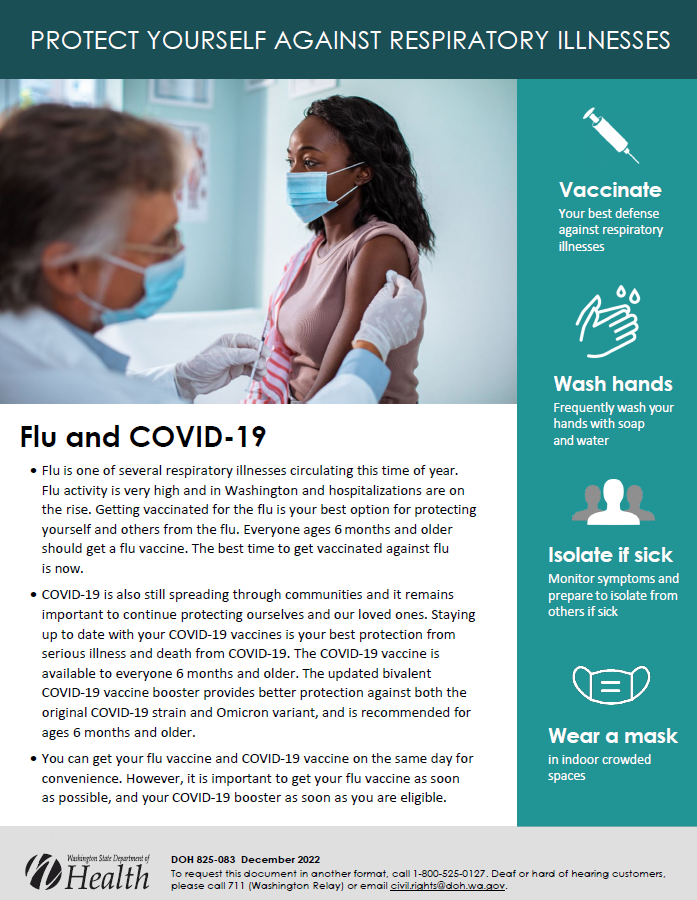
Several respiratory illnesses are circulating Washington communities right now. We have created a new Protect Yourself Against Respiratory Illnesses resource to highlight the importance of protecting against respiratory illnesses through vaccination and other health behaviors. This document also highlights guidance around co-administering COVID-19 and flu vaccines. This resource can be given to patients and displayed in health care settings including vaccine clinics.
|
|
NEW EDUCATIONAL VIDEO ON HOW VACCINE RECOMMENDATIONS ARE MADE
The authorization of COVID-19 vaccines in the United States heightened awareness of the Advisory Committee on Immunization Practices (ACIP), which develops clinical recommendations on the use of vaccines in the U.S. Longstanding misconceptions and misunderstandings around vaccines and their safety and efficacy continue to impact vaccine confidence and vaccination rates nationally.
To support communities and individuals in better understanding vaccines and the recommendations behind them, the Public Health Foundation (PHF) and the Centers for Disease Control and Prevention (CDC) developed an educational video, Understanding the ACIP and How Vaccine Recommendations are Made in the US. This short video sheds light on the process, science, and safety behind vaccine recommendations, equipping healthcare and public health professionals with information to help them confidently incorporate ACIP recommendations as standards of care in their practice.
|
|
WASHINGTON STATE DOH HAS UPDATED ITS TESTING GUIDANCE
The Washington State Department of Health (DOH) has updated its testing guidance as of December 5th to allow the use of at-home rapid antigen testing for children under 2 years of age. At this time, the US Food and Drug Administration (FDA) has not approved or authorized any at-home COVID-19 rapid antigen test for use in children under 2 years of age. However, at-home tests can be safely use for children under 2 years of age after being exposed, while in isolation, and if a child is experiencing symptoms or to identify a COVID-19 infection and begin isolation. We recommend that parents or guardians that choose to test children under 2 years of age administer the at-home tests themselves and to follow the instructions for use that come with the test for specific directions on testing children. Using at-home tests will help relieve the demand for testing in primary care, urgent care, and emergency departments settings which are currently overwhelmed, especially the pediatric health care system.
|
|
FINAL WESTERN STATES SCIENTIFIC SAFETY REVIEW WORKGROUP MEETING
There will be a final Western States Scientific Safety Review Workgroup meeting on Monday, December 19 at 5:00pm to have a short discussion about the recent emergency use authorization (EUA) approval for the COVID-19 updated bivalent vaccine booster for children 5 years and under. This meeting will also be an opportunity to acknowledge and thank the many hours of work contributed by the committee members.
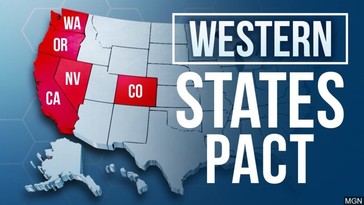
Washington, Oregon, California, Colorado, and Nevada joined together in fighting COVID-19 through the Western States Pact, a collective recovery plan, beginning in April of 2020. While each state built a state-specific plan, they agreed to the follow a set of principles based on working together in order to flatten the COVID-19 curve, mitigate harm to citizens and control the virus throughout the pandemic. These states have successfully worked together over the last more than two years, however with the COVID-19 emergency orders rolling back as of October 2022, the need for regular collaboration has decreased. The Western States workgroup will hold their final meeting Monday, December 19th.
|
|
BABY BIVALENT FINALLY APPROVED
Last week the Centers for Disease Control and Prevention (CDC) published their recommendations for the use of Moderna and Pfizer mRNA Bivalent COVID-19 vaccinations for children 6 months-4 years old. More details on these vaccinations can be found in the Latest News and Question of the Week sections above, and at the following link: Use of COVID-19 Vaccines in the United States Interim Clinical Considerations
- With this action, the monovalent Pfizer COVID-19 vaccine is no longer authorized for use as the third dose of the three-dose primary series in children 6 months through 4 years of age.
- Do not get rid of monovalent stock as that vaccine is still needed for primary series doses.
- Make sure that correct doses of the correct vaccine brands are administered by checking cap color and vaccination records carefully.
- The bivalent vaccines, also known as omicron boosters, contain two strains: one component of the original strain of SARS-CoV-2 and a second component from the BA.4 and BA.5 lineages of the omicron variant. The monovalent COVID-19 vaccines previously administered since December 2020 only contain the original strain.
- You can give any COVID-19 vaccine at the same time as most vaccines, such as a flu shot or other recommended childhood vaccines.
- Variations and/or updates to an already tested and authorized vaccine can be authorized by the FDA similar to how they approve updated flu vaccines every year.
- Find more information about providing COVID-19 vaccine and vaccinating youth, at doh.wa.gov/Covid19VaccineProvider.
As we approach the two-year anniversary of COVID-19 vaccines being available, the COVID-19 Vaccine Program thanks you for everything you’ve done to protect people in Washington from this serious and deadly disease. Your efforts have saved lives and kept families healthy.
|
|
HOW TO OPT-OUT OF ADULT ANCILLARY KITS
Please note: The opt-out option is not currently available for pediatric COVID-19 vaccine as Pfizer pediatric ancillary kits contain the diluent necessary to administer the vaccine.
To opt out of the COVID-19 ancillary kit, the provider must:
- Include a comment in the comments section of the order screen within the Immunization Information System (IIS) as seen below and submit the order as normal.
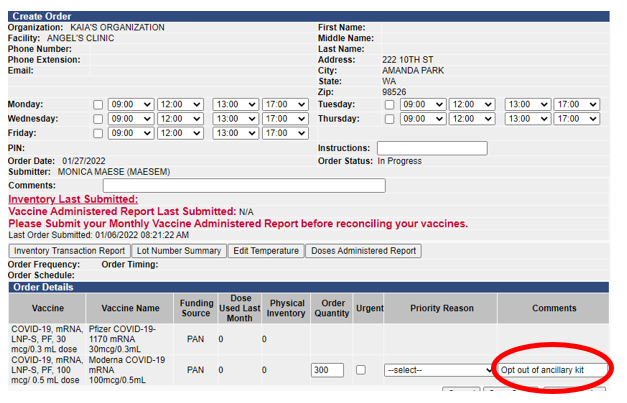
- The comment applied to the order will not continue to roll over to the following orders placed by the provider within the IIS so providers must opt out of the ancillary kit with each order that is placed.
As a reminder, COVID-19 Vaccine orders are approved on Mondays and Thursdays. To limit the chance of error, requests for opting out of the ancillary kits are being limited to what is received within the IIS. Please do not email opt out requests.
Once the order is submitted to CDC, ancillary kits cannot be returned to the distributor. Please do not return the kits to the distributor. Attempting to return extra kits may result in ordering permissions being revoked.
Please send any questions or concerns to COVID.vaccine@doh.wa.gov.
|
|
NEW SHELF LIFE EXTENSIONS
-PFIZER
Pfizer has received shelf-life extensions of all TRIS products (i.e., all mRNA COVID-19 vaccines, including both monovalent and bivalent vaccines).
Expiry is now 18 months from the date of manufacture (stored ULT frozen).
Please use the Pfizer-BioNTech COVID-19 Vaccine Expiry tool to check expiration dates.
-MODERNA
Additional monovalent Moderna products have received shelf-life extensions. Moderna has verified the new expiry dates below and updated the Moderna Vial Expiration Checker.
|
|
ORDERING UPDATES
EUA
As of December 8,2022, the U.S. Food and Drug Administration amended the emergency use authorizations (EUAs) of the updated (bivalent) Moderna and Pfizer-BioNTech COVID-19 vaccines to include use in children down to 6 months of age.
Following this announcement, ordering for both products was turned on in the Immunization Information System (IIS) and orders will be approved on Mondays and Thursdays. Minimum order quantities for both vaccines are 100 doses. Both products are multi-dose vials—Moderna contains 2 doses per vial and Pfizer contains 10 doses per vial.
As a reminder, providers should continue to review the vaccine advertisement page in the IIS for vaccine that is available for transfer.
Spikevax Ordering Update
Spikevax will be turned off for vaccine ordering on the evening of Thursday, December 15, 2022. The Moderna BLA-labeled product is now within 30 days of expiry and will only be made available by exception.
Pfizer 1170 (purple cap)
As of October 2022, Pfizer 1170 (purple cap) expired. Any vaccine that remains in your inventory should be reconciled in the Immunization Information System (IIS) and disposed of in accordance with clinic protocol for waste. This vaccine will be inactivated within the Immunization Information System (IIS) in the upcoming week, and this will limit edits that providers can make to the product. However, providers will still be able to reconcile inventory for this product. If you have any questions or concerns, please send to COVID.vaccine@doh.wa.gov.
|
|
CENTERS FOR DISEASE CONTROL AND PREVENTION (CDC) TRACKS COVID-19 VACCINATION DATA
As of December 7, 2022, 657.9 million vaccine doses have been administered in the United States. Overall, about 228.6 million people, or 68.9% of the total U.S. population, have completed a primary series. More than 42.0 million people, or 13.5% of the U.S. population ages 5 years and older, have received an updated (bivalent) booster dose.
You can follow along with this data regularly via the CDC'S Trends in Number of COVID-19 Vaccinations in the US page. Through the CDC you can also find:
- COVID Data Tracker’s Rates of COVID-19 Cases and Deaths by Vaccination Status now displays early data on updated (bivalent) booster doses for select jurisdictions.
- COVID Data Tracker’s Vaccination Among Pregnant People tab now displays the percentage of pregnant people ages 18–49 years who received an updated (bivalent) booster dose before or during pregnancy overall, by race and ethnicity, and by week.
- COVID Data Tracker’s County View page now displays updated (bivalent) booster dose data for all age groups at the county level.
|
|
REMINDER: STORAGE UNIT POLICY UPDATE
Vaccine storage unit requirements are changing to no longer allow the use of household combination refrigerator/freezer units. Any enrolled sites using the fridge or freezer section of a household combination unit is required to upgrade to pharmaceutical or stand-alone units by January 2023. This change only affects sites who are still using household combination units to store publicly supplied vaccine. We are implementing this change to help prevent vaccine loss that results in waste of public funds and to help ensure patients receive viable and effective vaccines.
If you have not yet upgraded, we encourage you to order a pharmaceutical or stand-alone storage unit as soon as possible. Please note, due to supply chain issues some providers are encountering shipping delays so be sure to plan ahead.
For additional information, please review our updated Vaccine Storage Unit Guide.
If you have any questions, contact WAChildhoodVaccines@doh.wa.gov.
|
|
FAILED DIGITAL DATA LOGGERS FIXED
West coast states have experienced failed Digital Data Loggers (DDLs) in vaccine shipping containers when they froze or shut down during transit. Single use shipping containers now have thicker lids to provide more insulation to the DDL unit.
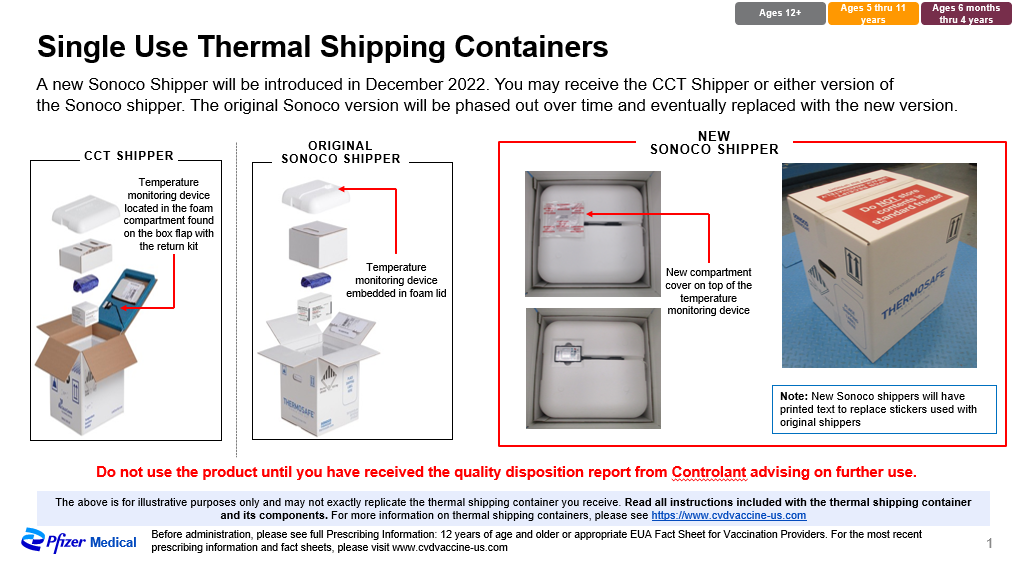 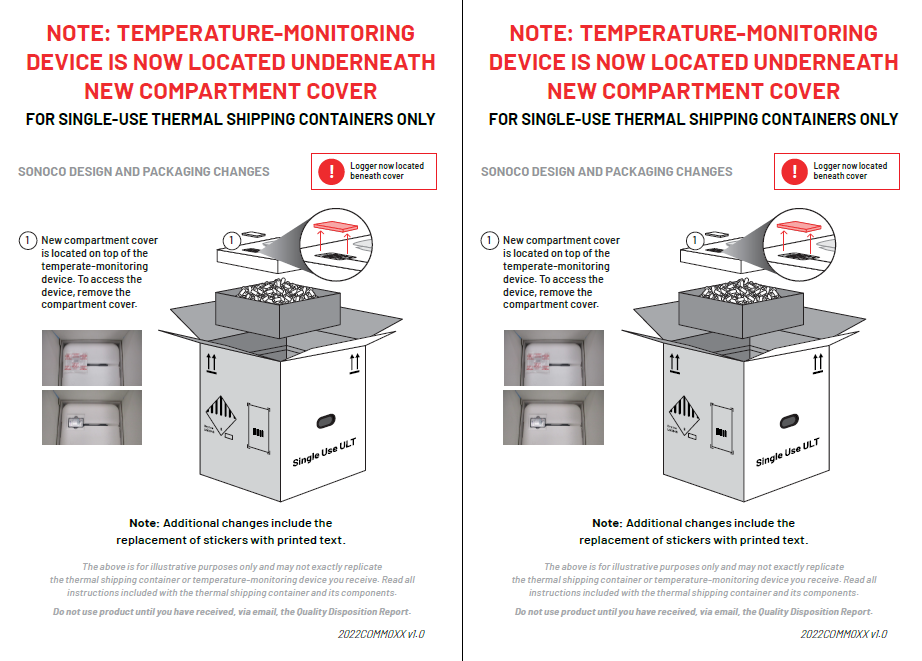
The above is for illustrative purposes only and may not exactly replicate the thermal shipping container you receive. Read all instructions included with the thermal shipping container and its components. For more information on thermal shipping containers, please see https://www.cvdvaccine-us.com
|
|
INCLEMENT WEATHER REMINDER AND RESOURCES FOR PROVIDERS
Planning for Inclement Weather & Power outages
When inclement weather is expected, power outages and shipping delays are also possible. It's always a good time to remember the resources and processes in place to safeguard the publicly funded vaccines at clinics around Washington and ensure your vaccine management plan is up to date.
As a provider in the Washington State COVID-19 Vaccine Program, please ensure vaccines maintain stable temperatures. If you experience a power outage, please refer to the COVID-19 Temperature Excursion Guide.
If vaccines need to be moved to an alternative location, please remember emergency transport does not require prior approval. If vaccines are transported, ensure that a digital data logger is used to record vaccine temperatures while in transit.
Report all temperature excursions to COVID.vaccine@doh.wa.gov and remember that when a temperature excursion occurs, no matter how brief, the manufacturers of each vaccine involved in the excursion should be contacted to verify vaccine viability. Please refer to the additional resources below for more information.
Resources:
Vaccine Temperature Excursion Guide
Vaccine Transport Guidelines
DOH Storage and Handling Webpage
|
|
WEBINAR: LESSONS LEARNED FROM COVID-19 DRIVE-THROUGH CLINICS
Monday, December 19, 2022 - 12:00PM-1:00PM PST
The Washington State Department of Health will host a Lessons Learned from COVID-19 Drive-Through Immunization Clinics Webinar on Monday, December 19, 2022, from 12pm to 1pm PT.
The webinar will include multiple speakers who will discuss the details of their previous immunization clinics, including their:
- Vaccination model used
- Clinical tools used
- Communication and education efforts
- Lessons learned
- Helpful clinical resources
The webinar will be recorded and continuing education is available for nurses and pharmacists/pharmacy techs.
|
|
UPCOMING POWER OF PROVIDERS (POP) WEBINARS
Please register for upcoming POP webinars, and share with your colleagues:
|
|
SHEA SPRING 2023 CONFERENCE
The SHEA Spring Conference will be held on April 11-14, 2023 in Seattle, WA and will include topics on healthcare epidemiology, antibiotic stewardship, long-term care, research methods, clinical microbiology, patient safety and quality, implementation science, and COVID-19. The call for abstracts is open and the deadline is January 11, 2023. Scholarship opportunities to attend the conference are available, and applications are due on December 31, 2022.
|
|
|
FOR SCHOOLS AND CHILD CARE FACILITIES
FOR LONG-TERM CARE FACILITIES
|
|
SIGN UP FOR THIS NEWSLETTER!
If you aren't already signed up for the COVID-19 Vaccine Partner Newsletter, please visit the Department of Health's email subscribers page here. Once you enter your email, on the next page expand the Immunization topic, select the COVID-19 Vaccine Partner Newsletter, and click submit.
|
|
This newsletter summarizes content from the week of December 4, 2022 and was sent out on December 16, 2022. |
|
|
|
|