|
|
This weekly newsletter provides summarized content on COVID-19 vaccine related topics. This broad level of information is tailored towards health care professionals, partners, and the general public.
WASHINGTON COVID-19 VACCINATION STATUS: ALL AGES 5 AND UP
|
|
COVID-19 BOOSTER RECOMMENDATION EXPANDS TO EVERYONE AGE 12 AND OLDER
Youth ages 12 to 17 should receive a booster dose of the Pfizer-BioNTech COVID-19 vaccine at least 5 months after completing their primary vaccination series. The Washington State Department of Health (DOH) has expanded booster dose eligibility to include everyone 12 and older following guidance and recommendations from the U.S. Food and Drug Administration, the Centers for Disease Control and Prevention’s (CDC) Advisory Committee on Immunizations Practices, and the Western States Scientific Safety Review Workgroup.
Everyone 12 and older should get a booster dose at least:
- Five months after completing the Pfizer primary vaccination series,
- Five months after completing the Moderna primary vaccination series (see FDA's Jan. 7 news release), or
- Two months after receiving the single-dose Johnson & Johnson vaccine.
Across the state, nearly 2 million people have received an additional dose, which includes both boosters and third doses. Boosters can be mixed and matched, which means adults can get any mRNA COVID-19 vaccine available. Pfizer is currently the only COVID-19 vaccine authorized for people ages 17 and younger.
Read the news release here.
|
|
NEW REPORT TRACKS RISK OF COVID-19 REINFECTION IN WASHINGTON STATE
Washington State Department of Health (DOH) has published a new, weekly report that provides an insight into COVID-19 reinfections. This report includes information on hospitalizations and deaths, demographics, trends over time, and vaccination status of people with a reinfection where DOH has information about both infection events.
Reinfection means a person was infected once with the virus that causes COVID-19, recovered, and then later became infected again. A person with a reinfection could be fully vaccinated, partially vaccinated, or unvaccinated. This report is located on the COVID-19 Data Dashboard :: Washington State Department of Health and is updated weekly.
“We are still learning about COVID-19 and the duration and strength of immunity following infection with this virus,” said Scott Lindquist, MD, MPH, state epidemiologist for communicable diseases. “Based on what we know from similar respiratory viruses, we expect some COVID-19 reinfections to occur.”
The first report indicates that from September 1 through December 26, 2021, in Washington state:
- A total of 4,404 people had a reinfection out of a total of 264,520 cases.
- 223 (5.1%) people with a reported reinfection were hospitalized.
- 22 (0.9%) people with a reported reinfection died.
- 2,640 (59.9%) of people with a reinfection were unvaccinated.
DOH can only identify people who have been reinfected if both their original infection and their second infection were diagnosed by a COVID-19 test and reported to the state. Since many COVID-19 infections are asymptomatic and not diagnosed by a test, DOH will not be able to classify those individuals as reinfected. As a result, the reported number of people reinfected or hospitalized or died from a reinfection is likely lower than the actual number of reinfection events.
Read the full news release here.
|
|
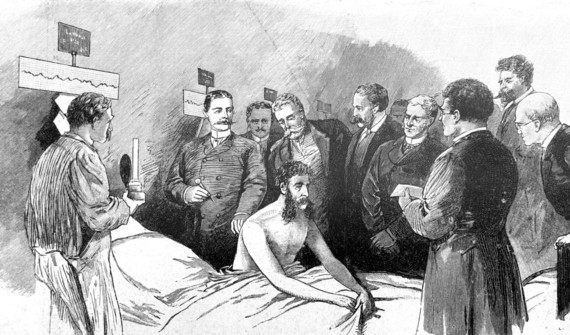 A DISCOVERY 225 YEARS AGO TRANSFORMED OUR HEALTH
LAS VACUNAS: UN DESCUBRIMIENTO QUE TRANSFORMÓ NUESTRA SALUD
|
|
|
The arrival of COVID-19 vaccines in December 2020 changed the course of COVID-19 in Washington — with many people getting vaccinated to protect themselves and their communities. Currently, about 75% of people 12 and older in Washington are fully vaccinated against COVID-19. As more people get vaccinated, we get closer to putting the pandemic behind us.
For more than 200 years, vaccines have helped keep us safe. In fact, vaccines have saved millions of lives against vaccine-preventable diseases for hundreds of years, reducing the burden of diseases like tetanus and measles by 92%-100%.
Let’s explore how vaccines helped stop the spread of severe illnesses in Washington.
See the full blog in English here.
|
|
La llegada de las vacunas contra el COVID-19 en el mes de diciembre de 2020 cambió la trayectoria del virus en Washington, y muchas personas se vacunaron para protegerse a sí mismas y a sus comunidades. En este momento, aproximadamente el 75% (solo en inglés) de las personas mayores de 12 años en Washington están completamente vacunadas contra el COVID-19. A medida que más personas se vacunan, nos acercamos a dejar atrás la pandemia.
Durante más de 200 años, las vacunas nos han ayudado a mantenernos a salvo de enfermedades. De hecho, las vacunas han salvado millones de vidas contra enfermedades prevenibles durante cientos de años, reduciendo la carga de enfermedades como el tétano y el sarampión entre un 92% a un 100% (solo en inglés).
Exploremos la historia de cómo las vacunas ayudaron a detener la propagación de enfermedades graves en nuestro estado de Washington.
Leer el artículo en español.
|
|
 TESTED POSITIVE FOR COVID-19?
Now that the winter holidays have ended and variants are spreading quickly, more people are testing positive for COVID-19 every day. And no one likes getting sick. Luckily, many people — especially those who are vaccinated — can recover at home.
First things first: If you have symptoms of COVID-19, get tested as soon as possible. You should also get tested if you’ve been in close contact with someone who may have COVID-19. In this case, get tested five days after your last contact with them, even if you don’t have symptoms. Visit our Testing Locator page to find testing sites near you, or consider buying an at-home test.
Test came back positive? You may be wondering what to do next. How should you care for yourself while you’re sick? How can you prevent spreading the virus to others? If you did test positive for COVID-19, the good news is there are steps you can take to help keep yourself and others safe.
Read the full blog for more details.
|
|
 AYUDE A DETENER LA PROPAGACIÓN DE COVID-19 CON SU TELÉFONO INTELIGENTE
Supongamos que usted no se sentía bien y se hizo una prueba casera de COVID-19 de venta libre y dio positiva. ¿Qué hacer si dio positivo? Además de aislarse e informar a contactos cercanos (solo en inglés), ahora puede usar fácilmente su teléfono inteligente para ayudar a detener la propagación del COVID-19. Si tiene un teléfono inteligente con WA Notify habilitado, puede solicitar un código de verificación para alertar a otros usuarios de WA Notify que puedan haber estado expuestos.
¿Qué es el WA Notify?
WA Notify es una herramienta gratuita de notificación de exposición que funciona en teléfonos inteligentes para alertar a los usuarios si pueden haber estado expuestos al COVID-19. Es una herramienta completamente privada; no se comparte información personal, incluyendo dónde o cuándo ocurrió la exposición al virus. WA Notify se lanzó hace un año y desde entonces, más de 2.6 millones de personas han habilitado esta herramienta en sus teléfonos.
Leer el artículo en español.
|
|
NOW AVAILABLE: COVID-19 VACCINE INFORMATION ONLINE IN 40 LANGUAGES
The Washington State Department of Health (DOH) now has COVID-19 vaccine information available online in 40 languages!
The new webpages include information on getting a COVID-19 vaccine, safety and effectiveness, vaccine requirements, school and child care, life after the vaccine, and vaccine booster and additional doses. The pages also include links to other in-language resources. DOH will review and update the webpages regularly. The pages are easy to navigate and include visual tiles for different topics.
You can check out the new in-languages pages by going to doh.wa.gov/Covid19VaccineLanguageName (for example, doh.wa.gov/Covid19VaccinePashto). A list of languages is below. Spanish is still available at VacunadeCovidWA.org. You can also find in-language content by selecting the language from the drop-down on CovidVaccineWA.org or doh.wa.gov (coming soon for Dari, Fijian, Pashto, and Tongan).
The webpages are available in the following languages:
Amharic, Arabic, Burmese, Chinese (traditional), Chinese (simplified), Chuukese, Dari, Farsi, Fijian, French, German, Hindi, Hmong, Japanese, Karen, Khmer (Cambodian), Korean, Lao, Marshallese, Mixteco Bajo, Nepali, Oromo, Pashto, Portuguese – Brazil, Punjabi, Romanian, Russian, Samoan, Somali, Spanish, Swahili, Tagalog, Tamil, Telugu, Thai, Tigrinya, Tongan, Ukrainian, Urdu, and Vietnamese.
|
|
COVID-19 VACCINE TRANSPORTATION RESOURCE
The Department of Health’s Equity and Social Justice team developed a COVID-19 Transportation Resource Document to support communities and partners with access barriers to vaccines and testing sites. This document will be updated with additional transportation resources on an ongoing basis.
If you would like to share additional transportation resources or have questions please send contributions and inquiries to equity@doh.wa.gov and include "Transportation Resource" in the subject line. Thanks.
|
|
|
Q: Should people vaccinated outside of the U.S. get a COVID-19 booster vaccine?
A: There has been a number of people that have received their COVID-19 primary doses outside the US. There are many different COVID-19 vaccines available throughout the world, a small selection have been recognized/authorized by the World Health Organization (WHO) and/or the Food and Drug Administration (FDA). Now that boosters have been recommended for everyone ages 18 years and older, this question will come up more frequently.
According to the Centers for Disease Control and Prevention (CDC), these people should get a single booster dose of Pfizer-BioNTech COVID-19 vaccine at least 6 months after completing their primary series:
- All people ages 18 years and older who completed all of the recommended doses of an WHO-EUL COVID-19 vaccine4.
- All people ages 18 years and older who completed a heterologous (mix and match) series composed of any combination of FDA-approved, FDA-authorized, or WHO-EUL COVID-19 vaccines.
Additionally, last month the CDC issued Emergency Use Instructions for the use of Pfizer Bio-NTech COVID-19 vaccine for those who received COVID-19 vaccinations outside the U.S. that are not FDA approved.
|
Name
|
FDA Approved
|
WHO EUL
|
|
Pfizer/ Comirnaty
|
Yes
|
Yes
|
|
Moderna
|
Yes
|
Yes
|
|
Janzen (J&J)
|
Yes
|
Yes
|
|
AstraZeneca
|
No
|
Yes
|
|
Covishield
|
No
|
Yes
|
|
SinoPharm
|
No
|
Yes
|
|
Covaxin
|
No
|
Yes
|
|
|
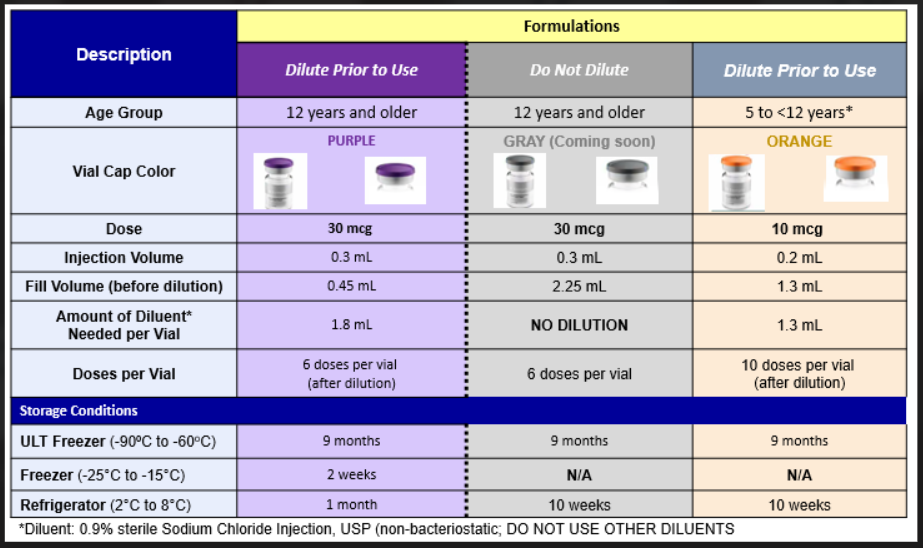 PFIZER COVID-19 VACCINE GRAY VIALS NOW AVAILABLE FOR ORDER
The Pfizer COVID-19 vaccine with purple cap vials has been replaced by Pfizer Gray Cap vials. The Gray Cap formulation should not be diluted. This chart above explains the differences between the 3 existing Pfizer products:
|
|
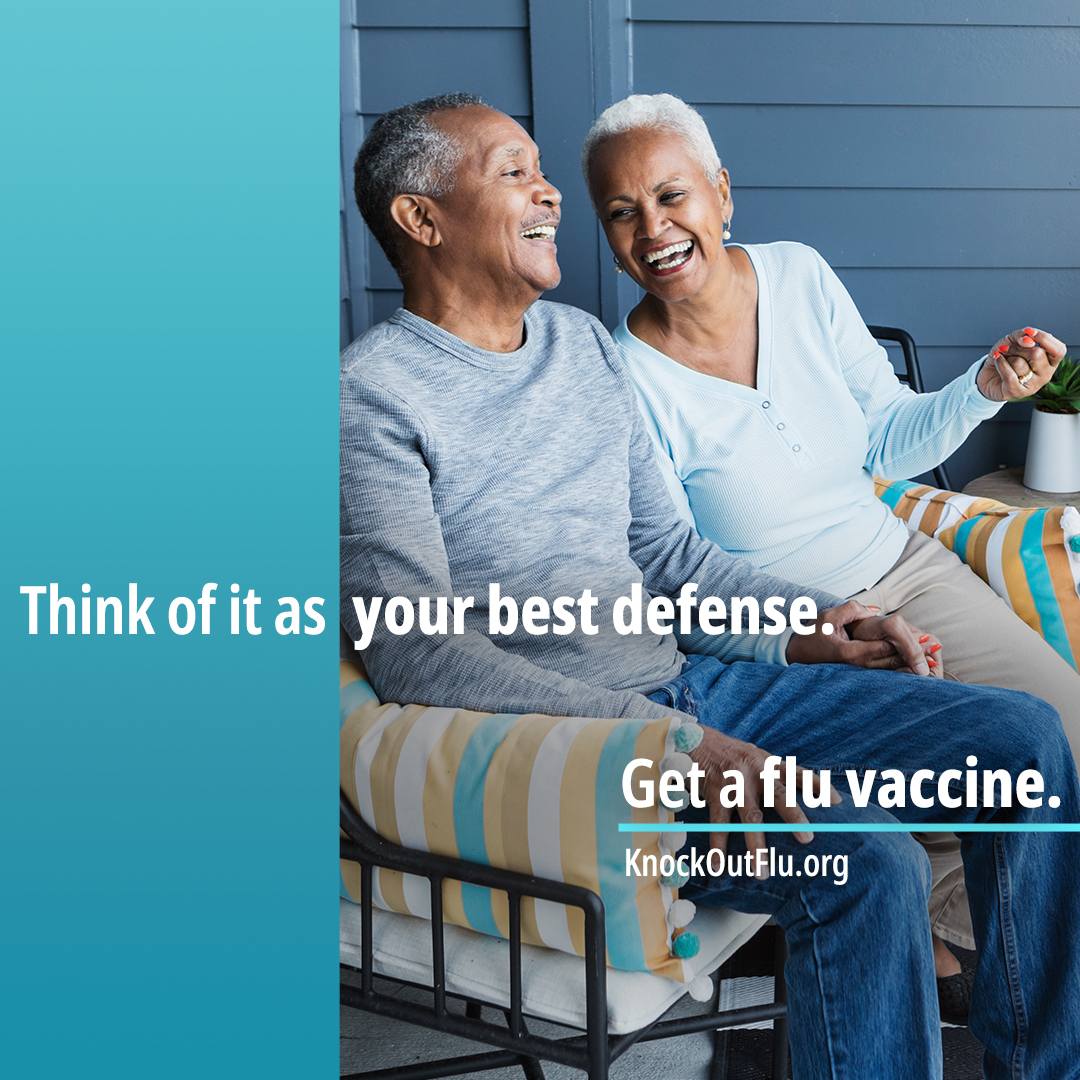 FLU ACTIVITY INCREASING IN WA: IT’S NOT TOO LATE TO GET VACCINATED
We are seeing an increase in flu activity across Washington and want to remind everyone that a flu vaccine is the best defense against illness and hospitalization. Please consider messaging your partners and patient populations that it isn’t too late to get a flu vaccine. As a reminder, flu vaccine may be safely received at the same time as COVID-19 vaccines. Consider using COVID-19 booster appointments to offer flu vaccine for patient convenience.
The Knock Out Flu partner toolkit is available to assist in your messaging and promotional efforts, including an updated infographic in dozens of languages which helps to identify the difference between COVID-19 & Flu symptoms. The toolkit also includes pre-drafted blog content for a variety of audiences, English and Spanish videos, social media and graphics in a variety of languages, on-hold messaging and more. Visit toolkits.knockoutflu.org to access all available toolkit material and partner resources.
|
|
MARTIN LUTHER KING HOLIDAY SHIPPING SCHEDULE
As a reminder COVID-19 vaccine orders are approved every Monday and Thursday. However, the Washington State Department of Health will be closed on Monday, January 17th in observance of the holiday. COVID-19 vaccine will continue to be shipped during the Martin Luther King Jr. Holiday on January 17, 2022. If a facility is unable to accept an order on Monday, January 17th, then the facility should place their order for COVID-19 vaccine after 12:00 P.M. on Thursday, January 13th for processing on Tuesday, January 18th.
|
|
PFIZER COVID VACCINE EXPIRATION DATES
The Food and Drug Administration (FDA) has extended the expiration date for Pfizer pediatric COVID-19 vaccine (orange cap vials) and the adult COVID-19 vaccine (gray cap vials) to 9 months while the vaccine is held at ultra low temperatures.
The updated expiry dates for both the orange cap and gray cap vials based on 9 months from the date of manufacture are provided below.
|
Printed Manufacturing Date
|
9-Month Expiry Date*
|
|
06/2021
|
Feb. 28, 2022
|
|
07/2021
|
Mar. 31, 2022
|
|
08/2021
|
Apr. 30, 2022
|
|
09/2021
|
May 31, 2022
|
|
10/2021
|
Jun. 30, 2022
|
|
11/2021
|
July. 31, 2022
|
|
12/2021
|
Aug. 31, 2022
|
|
01/2022
|
Sept. 30, 2022
|
|
02/2022
|
Oct. 31, 2022
|
*Date of expiration always falls on the last day of the month
As a reminder, the date printed on the Pfizer pediatric and adult/adolescent vaccine vials indicate the manufacture date and NOT the expiration date.
See the FDA fact sheets for more details.
Pfizer COVID-19 pediatric vaccine updated fact sheet
Pfizer COVID-19 adult vaccine updated fact sheet
|
|
COVID-19 VACCINE LOT LOOK UP REPORT
The COVID-19 Vaccine Lot Number & Expiration report is available from the Center for Disease Control and Prevention's (CDC's) Vaccine Code Set Management Service (VCSMS). This report includes COVID-19 vaccine lot numbers and expiration dates provided to the CDC by vaccine manufacturers. This report is used to support vaccine administration, inventory management, and jurisdiction Immunization Information Systems (IIS).
Correctly entered lot number and expiration date data improves the ability to monitor product safety, identify issues with lots, trace or decrement inventory, and identify expired products that were not administered.
To request access to this report, visit the CDC’s Vaccine Lot Number and Expiration Date webpage and complete the registration form.
|
|
NO MISSED VACCINE OPPORTUNITIES
The Centers for Disease Control and Prevention (CDC) supports health care providers taking every possible opportunity to vaccinate members of the public. Please ensure that no opportunity to administer a vaccine is missed, even if that means puncturing a vial for only one dose. Although this may lead to some vaccine being wasted, there is not a penalty for COVID-19 vaccine waste.
|
|
IIS PATIENT INFORMATION REMINDER
It is critical that providers enter and update patient information in the Immunization Information System (IIS). This is necessary in case patients need to be contacted after their vaccination. Ensure that you are reconciling vaccine inventory in the IIS and reviewing expiration dates. Information on how to search, add, reconcile and report inventory can be found here.
Visit the CDC’s Lot Number and Expiration date webpage for any expiry date extensions that may occur here.
|
|
INCLEMENT WEATHER AND RESOURCES FOR HEALTHCARE PROVIDERS
When inclement weather is expected, power outages and vaccine shipping delays are also possible.
Ways to prepare for inclement weather:
- Ensure your vaccine management plan is up to date.
- Ensure vaccines maintain stable temperatures. If you experience a power outage, please refer to the COVID-19 Temperature Excursion Guide.
- If vaccine must be moved due to an emergency, emergency transport does not require prior approval. If vaccines are transported, ensure that a digital data logger is used to record vaccine temperatures while in transit.
- Report all temperature excursions to 360-236-4223 or COVID.vaccine@doh.wa.gov, and call the manufacturers of each vaccine involved in the excursion to verify vaccine viability.
When conducting vaccination clinics prepare for a power outage by bringing paper copies of:
- Temperature logs.
- Hard copy of PrepMod registration.
- Paper to record vaccinations for data entry when system cannot be accessed.
- Vaccine Management Plan to identify if vaccines will need to be transferred to an alternate location if the facility storing the doses does not have power that will return before temperatures go out of range.
Also consider having the following items on hand incase of a power outage onsite at a clinic:
- Spare batteries
- Flashlights
Other Resources:
DOH Storage and Handling Webpage
CDC COVID-19 Vaccine Quick Reference Guide for Healthcare Professionals
|
|
|
FOR SCHOOLS AND CHILD CARES
-
COVID-19 Vaccines: Pediatric Vaccine Toolkit for Schools (PowerPoint) - This toolkit provides a variety of resources for schools, including parent handouts, backpack stuffers, and sample communication.
-
Symptom Decision Tree and Contact Tracing Checklist for K-12 Schools Updates include reference to updated quarantine recommendation, addition of contact tracing priority settings.
-
Contact Tracing Guide and FAQ for K-12 Schools Updates include updated quarantine recommendation, reference on contact tracing priority settings.
-
K-12 2021-2022 Requirements Updates include more details on contact tracing, requirements for quarantine and testing of close contacts, and requirements for performing arts performances and other school activities.
-
K-12 Schools 2021-2022 Supplemental Considerations to Mitigate COVID-19 Transmission. Updates include classroom and school closure criteria, contact tracing in high priority settings, timelines for close contact testing, and technical clarifications on antigen testing for Test to Stay programs and performing arts/sporting activities screening testing.
-
Secretary of Health’s Mask Order FAQ, to align with a technical update to the secretary’s order related to athletes and coaches at large outdoor gatherings.
School and child care guidance can be found on the Department of Health web page here.
|
|
FOR LONG TERM CARE FACILITIES
|
|
|
RESOURCES ON THE PFIZER COVID-19 VACCINE 12-15 AGE EXPANSION
In response to the authorized of Pfizer COVID-19 to children ages 12-15, the CDC has developed several useful tools for parents and clinicians to utilize.
Information for healthcare and vaccine providers provides basic information regarding the COVID-19 vaccine, consent and tools for communication to the community:
|
|
|
SIGN UP FOR THE NEWSLETTER
If you aren't already signed up for the COVID-19 Vaccine Partner Newsletter, please visit the Department of Health's email subscribers page here. Once you enter your email, on the next page expand the Immunization topic, select the COVID-19 Vaccine Partner Newsletter, and hit submit.
|
|
This newsletter summarizes content from the week of January 2, 2021 and was sent out on January 7, 2021. |
|
|
|
|