|
|
This weekly newsletter provides summarized content on COVID-19 vaccine related topics. This broad level of information is tailored towards health care professionals, partners, and the general public.
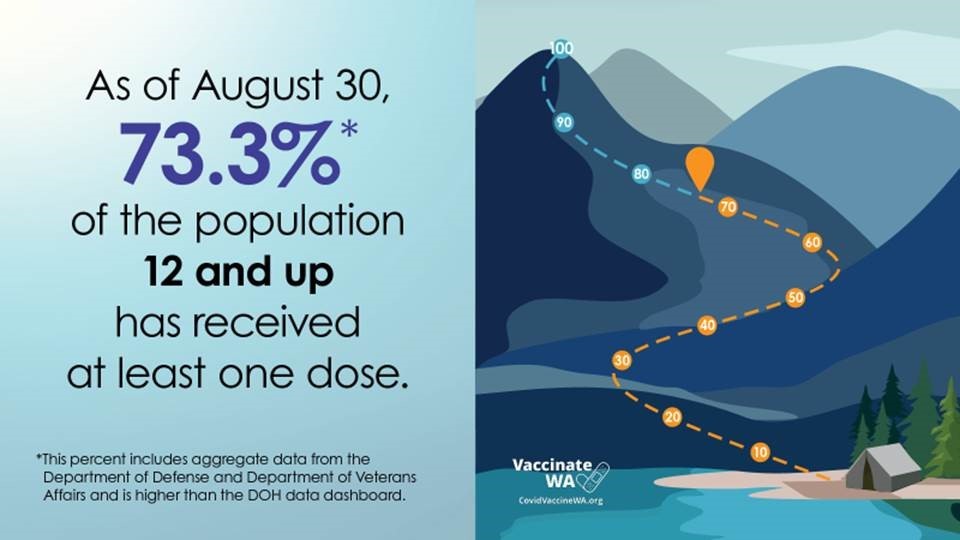
WASHINGTON COVID-19 VACCINATION STATUS: ALL AGES 12 AND UP
|
|
 WHAT TO KNOW ABOUT BREAKTHROUGH COVID-19 CASES
Chances are, you’ve recently heard some talk about breakthrough COVID-19 cases.
The delta variant is currently spreading through the US at an incredible rate. While it’s most contagious (and dangerous) among unvaccinated people, there are still a few fully vaccinated people testing positive for COVID-19.
We understand how discouraging this may sound, especially since a post-pandemic world felt so close a few weeks ago. Although this may be disappointing, it’s not necessarily unexpected. In fact, there are still reasons to feel encouraged.
Read the full blog post to learn ore about breakthrough cases.
|
|
TESTING PROGRAMS RAMP UP AS STUDENTS RETURN TO SCHOOLS
Soon schools across Washington will be teeming with students for the first time in more than a year. Supporting the effort to get students back into schools, and formulating plans to help keep our schools open, has been a priority for the Washington State Department of Health (DOH) for months.
This year, back-to-school occurs in the midst of a COVID-19 surge in all regions of the state. So, the strategy for a healthy return includes layered protections: encouraging vaccines for all eligible students, requiring staff to be vaccinated, near-universal masking, and regular COVID-19 testing at school.
Testing at schools is a crucial way to track and prevent disease spread, so DOH has partnered with the Health Commons Project to provide districts with end-to-end testing support, including a testing strategist to help develop the best strategy and tools.
Read the full news release in English.
|
|
 COVID-19 VACCINE AND NURSING YOUR BABY: WHAT YOU SHOULD KNOW
Every August, we celebrate those who promote and support lactation, breastfeeding, and chestfeeding. World Breastfeeding Week and National Breastfeeding Month remind us of the wealth of benefits that human milk has for the baby, parent, society, and environment.
Should I get the COVID-19 vaccine if I am nursing or plan to nurse my baby?
Yes! The CDC and the American College of Obstetricians and Gynecologists (ACOG) recommend that parents who are lactating or pregnant get a COVID-19 vaccine. COVID-19 vaccines are safe and effective. There’s no need to stop serving your milk if you get vaccinated against COVID-19. The vaccines can’t cause COVID-19 infections in anyone, including the parent and the baby. The vaccines will not change or alter anyone’s DNA, and there is no evidence that the vaccines impact fertility or cause miscarriages. The vaccines were developed based upon decades of scientific research using the most advanced technology in history. This allowed the scientists to develop the global lifesaving vaccines quicker than ever before.
In fact, getting the vaccine while nursing can provide some added benefits. Recent studies show nursing parents that received mRNA COVID-19 vaccines have antibodies in their produced milk. These antibodies made by your body may be passed through breastmilk and may help protect your child from the virus. So, receiving both doses of an mRNA COVID-19 vaccine (Moderna or Pfizer) actually boosts the protective properties in your milk and helps protect your child.
Read the full DOH blog post here.
|
|
FDA TO HOLD ADVISORY COMMITTEE MEETING TO DISCUSS PFIZER'S APPLICATION FOR COVID-19 BOOSTER
Today, the U.S. Food and Drug Administration announced a virtual meeting of its Vaccines and Related Biological Products Advisory Committee (VRBPAC) to discuss the matter of additional doses of COVID-19 vaccines and specifically to discuss the Pfizer-BioNTech supplemental Biologics License Application for administration of a “booster” dose of Comirnaty (COVID-19 Vaccine, mRNA) in individuals 16 years of age and older.
The meeting will be held on Sept. 17, 2021, from 8:30 a.m. to 3:45 p.m. EST. The FDA intends to livestream the VRBPAC meeting on the agency’s YouTube channel; the meeting will also be webcast from the FDA website.
The FDA intends to make background material available to the public, including the meeting agenda and committee roster, no later than two business days before the meeting.
Read the full news release in English.
|
|
 POP INITIATIVE RESOURCES AVAILABLE FOR PARTNERS AND PROVIDERS
The Department of Health has recently added some resources around the Power of Providers Initiative. The goal of the POP Initiative is to recognize the power all health care providers have in encouraging COVID-19 vaccination in the community.
To help promote the POP Initiative, the web page now has a fact sheet, a sample slide insert, and a sample newsletter article.
In addition, the department has a variety of other resources listed on the page, including provider discussion guides. talking points, and COVID-19 vaccination guidance.
|
|
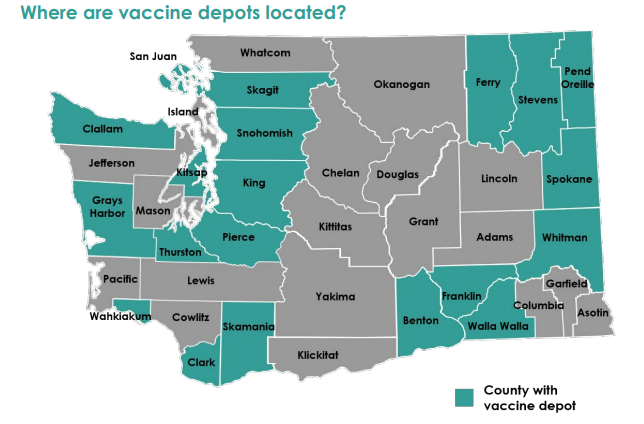 COVID-19 VACCINE DEPOT LOCATIONS ARE HERE
As a COVID-19 vaccine provider, are you wanting to order smaller amounts of COVID-19 vaccine? Here is your opportunity! Washington State now has 19 Vaccine Depots ready to transfer to you. Check out their locations below and visit the Vaccine Advertisement Page to review what is available. If you have questions about how to request COVID-19 vaccine from depots click here.
|
|
MAINTAINING VACCINE RECORD INTEGRITY
Healthcare and vaccine providers play an important role in entering and verifying COVID-19 immunization records into the Washington State Immunization Information System (WAIIS). With the number of mandates increasing providers may be under pressure to correct a patient’s vaccine history in their EHR or the IIS. There are situations when this is acceptable and many where it is not. When a patient can provide evidence of their vaccination (example: their record card), then a provider may modify their vaccination record. Without sufficient evidence that the patient was vaccinated it is not only unethical to modify their vaccination records, but could result in legal trouble for the provider or the patient depending on the circumstances.
At the state level, providers will be investigated by both the DOH and the Attorney General’s Office when fraud is reported. In addition, the FBI released a Public Service Announcement on March 30, 2021, saying fake vaccination cards are illegal and punishable by law. The FBI also states that “misrepresenting yourself as vaccinated when entering schools, mass transit, workplaces, gyms, or places of worship, you put yourself and others around you at risk of contracting COVID-19.”
Here is a guide that will help you in verifying COVID-19 vaccination record cards. If a patient presents a vaccine card that you think is fake, report it to the U.S. Department of Health and Human Services (HHS) Office of Inspector General by submitting a report online or calling 800-447-8477. The Washington State Office of the Attorney General (ATG) would also like to receive complaints about phony vaccination cards. Complaints can be filed through the normal complaint intake process, outlined on the ATG website here. Please also let the Department of Health know at Covid.Vaccine@doh.wa.gov.
|
|
COVID-19 VACCINE PROVIDER REDISTRIBUTION AGREEMENT
This is a reminder for COVID-19 vaccine providers to fill out a redistribution agreement so they may transfer vaccine. Fill out the agreement here.
Providers who fill out a redistribution agreement will be able to:
- Transfer vaccine at any time.
- Use the Vaccine Advertisement Page in the WAIIS to give or get vaccine doses.
- Get vaccine from depot locations in smaller package sizes.
If you have any questions, please email COVID.vaccine@doh.wa.gov.
|
|
COVID-19 VACCINE MANAGEMENT PLAN TEMPLATE NOW AVAILABLE TO PROVIDERS
A comprehensive COVID-19 vaccine management plan template that satisfies all CDC recommendations is now complete and available through the Washington State Department of Health (DOH). Covering both routine and emergency standard operating procedures, the template offers providers a clear, concise, and consolidated plan for managing their COVID-19 vaccines. The template includes guidance and fillable fields for the following:
- Contact information for current primary and backup vaccine coordinators
- Provider staff roles and responsibilities
- Documented training related to vaccine management
- Proper storage and handling practices, including how to handle a temperature excursion
- Procedures for vaccine ordering, receiving, inventory control, stock rotation, and handling vaccine waste/loss
- Procedures for monitoring expiration dates and beyond-use dates/times
- Procedures for emergency situations, including vaccine transport, equipment malfunction, power failure, and natural disaster
There are links to further resources throughout the document.
Find the template here: COVID-19 Vaccine Management Plan Template
|
|
THE CLINICAL IMMUNIZATION SAFETY ASSESSMENT PROJECT
There have been requests to clarify the new Centers for Disease Control and Prevention (CDC) recommendation of a 3rd dose of mRNA COVID-19 vaccine for those suffering from moderate to severe immunocompromising conditions. This recommendation came after studies found evidence of reduced immune response to a 2-dose primary mRNA COVID-19 vaccine series in some groups of immunocompromised people. Additionally, there was also some decreased vaccine effectiveness noted in immunocompromised people compared to participants who were not immunocompromised in a limited number of studies.
The CDC guidelines offer a list of the most common moderate to severe immunocompromising conditions, but also leave discretion to the patient and provider to ensure each case is reviewed based on individual needs. Because of those reasons, many patients and providers found the immunocompromised recommendation unclear.
Some health care providers may want further guidance and support after reading through the recommendations. CDC’s Clinical Immunization Safety Assessment (CISA) Project can assist providers in developing the best plan for their patients. If providers have questions about specific cases in relation to whether or not they should receive the vaccine or if their patient is possibility experiencing side-effects to the vaccine, they can consult CISA for clinical consultation.
|
|
WEBINAR ON ROUTINE CHILDHOOD IMMUNIZATIONS AND SCHOOL AND CHILD CARE REQUIREMENTS
The Washington State Department of Health is hosting an immunization webinar on September 15, 2021, from 12pm to 1pm. The webinar will cover strategies to catch up children and adolescents on routine immunizations, followed by updates to school and child care immunization requirements in the state of Washington.
The webinar is targeted towards health care providers, school and child care staff, local health jurisdictions, and anyone else who may be interested. Continuing education credit will be offered for attending the webinar and completing an evaluation. CE is available for nurses, medical assistants, pharmacists, and pharmacy technicians. The webinar will be recorded and made available within the coming weeks.
12:00pm - 1:00pm
September 15, 2021
Click here to register
If you have questions about the webinar, please contact Trang Kuss in the Office of Immunization.
|
|
CURRENT ISSUES IN VACCINES WEBINAR
The Vaccine Education Center (VEC) at Children’s Hospital of Philadelphia, together with the Pennsylvania chapter of the American Academy of Pediatrics and Nesbitt School of Pharmacy at Wilkes University, is pleased to offer a Vaccine Webinar Series for health care providers. The series is supported by the Thomas F. McNair Scott Endowed Research and Lectureship Fund.
The most recent webinar on September 22, 2021 will discuss COVID-19 Vaccine Myths and Misinformation. Free continuing education credits will be available (CME, CEU, CPE).
9:00 - 10:00am PT (12:00pm ET)
September 22, 2021
View registration page
|
|
FOR LONG TERM CARE FACILITIES
|
|
|
|
RESOURCES ON THE PFIZER COVID-19 VACCINE 12-15 AGE EXPANSION
In response to the authorized of Pfizer COVID-19 to children ages 12-15, the CDC has developed several useful tools for parents and clinicians to utilize.
Information for healthcare and vaccine providers provides basic information regarding the COVID-19 vaccine, consent and tools for communication to the community:
|
|
|
This newsletter summarizes content from the week of August 29, 2021 and was sent out on September 3, 2021. |
|
|
|
|