|
|
This weekly newsletter provides summarized content on COVID-19 vaccine related topics. This broad level of information is tailored towards health care professionals, partners, and the general public.
WASHINGTON COVID-19 VACCINATION STATUS: ALL PEOPLE 16 AND OVER
|
|
ELIGIBILITY EXPANDS TO EVERYONE 16 AND OLDER IN WASHINGTON STATE
Starting Thursday, April 15, 2021, everyone 16 and older who wants a COVID-19 vaccine can receive one in Washington. The eligibility expansion marks the four-month anniversary of vaccine rollout in our state. Since mid-December, nearly 4.3 million doses of COVID-19 vaccine have been administered across the state. More than 2.67 million people have received at least one dose and more than 23% of Washingtonians are fully vaccinated. Opening eligibility to everyone 16 and older will further protect our communities and help us get closer to crossing the finish line of this global pandemic.
The Washington State Department of Health’s (DOH) Vaccine Locator tool is a great resource to help you find a vaccine appointment in your area. Since launching the improved website, more than 1.6 million people have visited Vaccine Locator with 300,000 new users within the last week. More than 70% of people visiting the site click through to a provider’s scheduling website. We anticipate these numbers will spike today and we are prepared for increased traffic. If you need help making an appointment, please call the COVID-19 hotline at 1-800-525-0127, then press #. Language assistance is available.
Read the full news release in English.
|
|
WASHINGTON STATE PAUSING JOHNSON AND JOHNSON VACCINE
The Washington State Department of Health will pause the use of the Johnson & Johnson (J & J) vaccine statewide starting immediately, following the guidance of the FDA/CDC. Use of that vaccine will be put on hold until we receive further recommendations from our federal partners about how best to move forward. Safety is the highest priority when it comes to all COVID-19 vaccines.
This action is being taken out of an abundance of caution based on the appearance of a rare but serious side effect including serious brain blood clots (CVST) combined with low platelet counts in six patients, all women under 50. The CDC’s Advisory Committee on Immunization Practices (ACIP) will review these cases in the days ahead and will recommend guidance going forward.
For those who got the vaccine more than a month ago, the risk of this complication is very low at this time. People who have received the J & J vaccine who develop severe headache, abdominal pain, leg pain, or shortness of breath within three weeks after vaccination should contact their health care provider. It also demonstrates how well the robust vaccine safety monitoring systems work, since this potential safety concern was identified quickly and vaccines were paused to allow for further investigation.
DOH will continue to monitor the situation related to J & J vaccine and update on its use as the pause is reviewed and once it is lifted.
Read the full news release in English and in Spanish.
|
|
 COVID-19 VACCINE DISTRIBUTION UPDATE
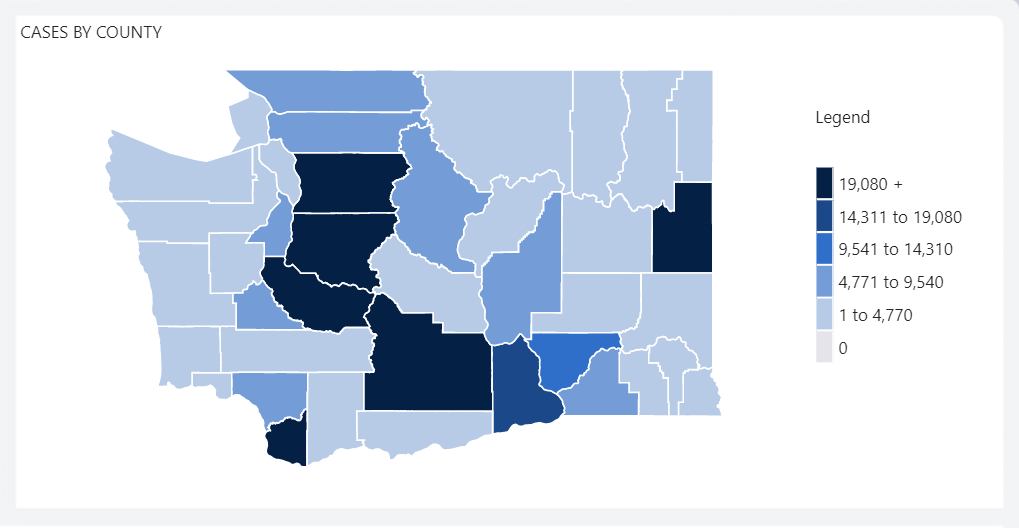
As of April 10, more than 4,189,884 doses of vaccine have been given across the state, which is more than 82% of the 5,094,380 doses that have been delivered to our providers and long-term care programs. Washington is currently averaging 57,577 vaccine doses given each day and more than 22% of people in Washington are fully vaccinated against COVID-19. This information can be found on the DOH data dashboard under the vaccines tab, which is updated three times per week.
Allocation update
Our three-week vaccine allocation forecast is an estimate that helps with planning at the state and local level. The numbers are subject to change as vaccine availability from the federal government may change.
- Week of April 18: 364,700 total doses
- This includes 210,600 doses of Pfizer and 154,100 doses of Moderna
- Week of April 25: 370,340 total doses
- This includes 212,940 doses of Pfizer and 157,400 doses of Moderna
- Week of May 2: 377,360 total doses
- This includes 219,960 doses of Pfizer and 157,400 doses of Moderna
In addition to Pfizer and Moderna, the forecast shows Washington will receive 4,300 doses of the Johnson & Johnson vaccine each week. We have reached out to our federal partners to see if these allocations will change following the decision to pause use of the Johnson & Johnson vaccine.
Read the full news release, including information on vaccine allocation, in English or in Spanish.
|
|
NEW COVID-19 RESOURCES FROM OUR PARTNERS
The Department of Health would like to share some new resources from our partners on COVID-19 vaccine, including content in Russian, Farsi, and for the disability community.
Kanon Magazine, which reaches Russian, Ukrainian, and Slavic communities, published a two-page Q&A spread in Russian addressing COVID-19-related vaccine topics and hesistancy. View the Russian Q&A in the April issue of Kanon Magazine here on pages 50-51. The Q&A, features responses from Andrey Shuvarikov, a trusted religious community leader and PhD candidate in Molecular and Cellular Biology at the University of Washington. Shuvarikov addresses community concerns about the COVID-19 vaccine, such as how the vaccine may affect those who have or have not had the virus, and myths about the vaccine.
Titre Avval, which reaches the Persian Community, published an article from a respected community member, Dr. Tara Jones, who answered important questions about the virus: the ways it is transmitted, who is at greatest risk and an update as to who is eligible for the vaccine at this point in time. Read and share the contributed article from Dr. Tara Jones in Farsi or in English.
The Center for Independence (CFI) created an accessible 2-minute video to share information with the disability community about CFI’s vaccine navigation support services. The video provides helpful tips for how individuals seeking support in getting vaccinated can prepare information about themselves prior to calling CFI. Access the video here. Planning a vaccine clinic? Also check out their Accessibility Checklist here.
|
|
 SAFER SPRING CLEANING FOR COVID-19 AND BEYOND
Most of us know we can prevent the spread of COVID-19 by wearing masks, washing our hands, keeping our distance, and staying home when we’re sick. But, can cleaning and disinfecting also protect your family from COVID-19? The good news is that your current cleaning routine may already be enough to keep you safe!
Read the Department of Health's blog post on cleaning to get some good tips about cleaning with COVID-19 in mind.
|
|
UPDATE ON VACCINE BREAKTHROUGH CASES IN WASHINGTON STATE
The Washington State Department of Health (DOH) is reporting a total of 217 COVID-19 vaccine breakthrough cases among vaccinated individuals in Washington state as of April 3, 2021. That is up from 102 since we first reported cases of breakthrough on March 30, 2021. Breakthrough cases have now been identified in 24 of Washington’s 39 counties.
Vaccine breakthrough occurs when a person tests positive for COVID-19 two weeks or more after receiving the full course of an approved COVID-19 vaccine. Large-scale clinical studies found that COVID-19 vaccines prevented most people from getting COVID-19 illness. However, the vaccines are not 100% effective. This means a very small number of fully vaccinated people will still get sick with COVID-19. Scientists note that breakthroughs are expected with any vaccine.
To date, more than 1.7 million people have been fully vaccinated in Washington state. The breakthrough cases represent a small portion, about .01 percent, of the fully vaccinated population.
DOH is investigating a total of five suspected deaths of individuals who experienced vaccine breakthrough. The people who died were between 67-94 years old and all had multiple underlying conditions. Four were residents of long-term care facilities.
Read the full news release on breakthrough cases in English or in Spanish.
|
|
COVID VACCINATION AND EXPOSURE
The Department of Health has received more calls from people who are inbetween COVID-19 vaccine doses and become inadvertently exposed to COVID-19. If you are identified as a close contact to a COVID case, please do not attend a vaccination clinic until you are cleared from quarantine. This is to protect the health and welfare of the staff running the clinic and those that may be getting vaccinated at the same time.
As a reminder, people have up to 42 days from the first vaccination to get the second dose of COVID-19 vaccine for the best protection. While it is optimal to maintain the recommended 28 day interval for Moderna or 21 day interval for Pfizer, the risk of infecting others requires being flexible with the vaccine interval within Centers for Disease Control and Prevention recommendations.
|
|
COVID-19 VACCINE ALLOCATIONS REMINDER
The Department of Health continues to allocate COVID-19 vaccine for Washington State. The Department of Health approves provider orders based on the feedback from local health jurisdictions. As such, COVID-19 Vaccine Program providers must coordinate with their local health jurisdiction to receive doses based off their capacity to administer COVID-19 vaccine. Providers will not receive notification of denied vaccine orders and must view the Immunization Information System to see the status of an order.
|
|
REQUEST FOR PROVIDERS TO ACTIVATE THEIR LOCATION IN VACCINE FINDER
As vaccine eligibility opens widely this week across Washington, the tools people use to find provider locations have become more important than ever. We are asking all active COVID-19 vaccine providers to activate their location to ‘display’ in VaccineFinder to be visible to the public. This will create better access and improve scheduling options.
All provider sites initially default to ‘not display’ to the public, so you will need to determine which site(s) to display publicly. Provider details updated before 4:00 a.m. PT will display on VaccineFinder.org the same day, so taking action now will quickly provide public access.
The CDC has put together a Public Display Checklist for providers using the COVID Locating Health Portal. Please review these quick tips to ensure your sites have the information they need to update their Locating Health Portal administration data.
Please remember to report on-hand inventories daily to the Centers for Disease Control and Prevention (CDC) via VaccineFinder. This is a requirement regardless of whether a provider site marks their location publicly visible. Thank you for your prompt attention in making VaccineFinder even better!
|
|
|
Q: How can I tell the difference between COVID-19 disease and COVID-19 vaccination side effects?
A: There are some overlap in symptoms between COVID-19 disease and COVID-19 vaccination side effects. We have a graphic that shows the differences and similarities between the two for your reference. COVID-19 vaccination does not cause COVID-19 disease.
If you think you may have been exposed to COVID-19, or show signs and symptoms of COVID-19 disease, you should get tested and quarantine for 14 days from the exposure date.
|
|
WASHINGTON STATE PREPMOD ADMINISTRATIVE TRAINING
The Washington State Department of Health is hosting another PrepMod training for health care providers wishing to learn more about PrepMod or use PrepMod for COVID vaccine scheduling, recording, and reporting.
PrepMod is a web-based software application that manages key aspects of mass vaccination efforts. It is designed specifically for agencies and organizations that do not have an existing electronic health record (EHR) interface to the Washington State Immunization Information System (IIS). To access PrepMod, you will need an approved COVID vaccine provider agreement.
9:00am - 10:15am
Wednesday, April 21, 2021
Register here.
If you have questions, please email the PrepMod inbox at prepmod@doh.wa.gov.
|
|
COVID-19 VACCINE PROVIDER OPEN DOOR SESSION
The Department of Health vaccine management team hosts bi-monthly COVID-19 provider open door sessions. The next session will cover the vaccine compliance process and will be at:
12:00 PM – 1:00 PM
Thursday, April 22, 2021
Click here to join the MS Teams meeting
Or call in (audio only)
+1 564-999-2000, 716052430#
Phone Conference ID: 716 052 430#
|
|
WEBINAR - DO YOUR PART TO PREVENT COVID-19 VACCINE ADMINISTRATION ERRORS
The Washington State Department of Health is hosting a webinar on Thursday, April 29, 2021 with Dr. Andrew Kroger, the Medical Officer of the CDC Immunization Services Division, Communication and Education Branch. COVID-19 vaccine administration and handling is complex, leading to the potential for errors. This webinar will identify common types of vaccination errors and highlight strategies for their prevention. Determination of additional dosing is a consideration to ensure a protective response occurs.
The webinar is for healthcare providers, school and child care nurses, and others interested in learning about preventing COVID-19 vaccine administration errors. The webinar will be recorded and continuing education is available for nurses, medical assistants, and pharmacists. View the webinar web page for more information.
12:00-1:00 PM
Thursday, April 29, 2021
Register here
|
|
 COVID-19 VACCINATION AND REACHING PEOPLE WITH DISABILITIES WEBINAR SERIES
The Association of University Centers on Disabilities, in conjunction with its partners, has a series of webinar recordings on how states are reaching people with disabilities. Click on each link to view the respective webinar page with the recording, slides, and transcript.
-
Webinar #1: Navigation: Promising practices for scheduling and transporting persons with disabilities to COVID-19 vaccination appointments
-
Webinar #2: Consideration: Promising practices for vaccinating family members of PWD and those who are homebound
-
Webinar #3: Communication: Promising practices for reducing COVID-19 vaccine hesitancy and disseminating accessible messages
-
Webinar #4: Prioritization: Promising practices for educating others about the importance of disability prioritizing in state vaccination plans
|
|
|
FOR THE GENERAL PUBLIC
FOR INDUSTRY
FOR HEALTH PARTNERS
|
|
This newsletter summarizes content from the week of April 11, 2021 and was sent out on April 16, 2021. |
|
|
|
|