|
You may notice that sometimes the lot number on the vial is different from the lot number on the box. Best practice is to use the lot number on the box for all Childhood Vaccine Program inventory. When you receive your vaccine in the Immunization Information System (IIS) through the Inbound Order screen, the lot number that pre-populates is the lot number on the box. The lot number on the box is used because manufacturers have indicated the lot number on the vial (and in some cases, multiple vials/components of a vaccine) is linked back to the lot number on the box at the time of manufacturing and packaging. In cases with multiple components, there may be several different lot numbers. Therefore, the best way to capture the product that was given is to use the lot number on the box.
For more information on inventory best practices, check out these resources:
The IIS for Vaccine Coordinators training
Managing Inventory with an Interface guide
How to Search, Add, Reconcile & Report Inventory guide
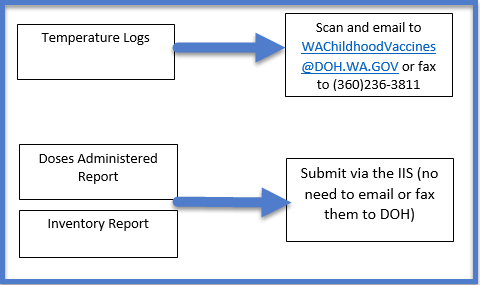
There are three accountability reports that are due every month:
-
Temperature logs: Submitted by fax or email
-
Doses administered report: Submitted through the IIS
-
Inventory report: Submitted through the IIS
Temperature logs can be scanned and emailed to WAChildhoodVaccines@DOH.WA.GOV or faxed to (360)236-3811. The doses administered report and inventory report must be submitted in the IIS. You do not need to fax or email them to us.
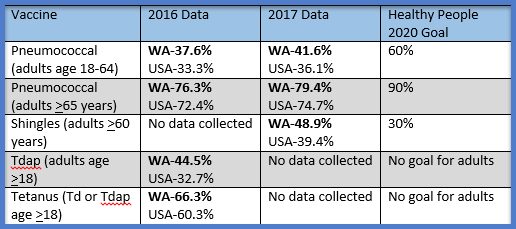
The Centers for Disease Control and Prevention’s (CDC) AdultVaxView has been updated with national, regional, state, and selected local area data on adult vaccination coverage estimates from the 2017 Behavioral Risk Factor Surveillance System (BRFSS) and the 2016-2017 National Health Interview Survey (NHIS).
Key Highlights:
- Washington is better than the national average for pneumococcal vaccination coverage rates, but has not met the Healthy People 2020 goal.
- Washington is better than the national average for shingles vaccination coverage rates, and has met and exceeded the Healthy People 2020 goal.
- In 2016, Washington was better than the national average for Tdap and tetanus vaccination coverage rates.
 These data can help guide your prevention efforts and identify strategies to improve vaccination coverage among adults in your community. Use the national Standards for Adult Immunization Practice to increase vaccination coverage rates among adult patients in your clinic. The CDC recommends using evidence-based strategies to further improve vaccination coverage:
- Use standing orders and provider reminders alone or in combination with health systems interventions
- Assess vaccination status at adult patient visits
- Issue strong recommendations for indicated vaccines
- Offer vaccines or refer patients to other providers for vaccination
- Record vaccinations given in the state Immunization Information System
Summer is a great time to start planning for when flu vaccines are delivered and when your office can start administering vaccine. The American Academy of Pediatrics (AAP) offers the Influenza Implementation Guidance 2018–2019: For Pediatricians, Physicians, Nurse Practitioners, Physician Assistants, Nurses, Medical Assistants, and Office Managers. Please note, although this page is dated 2018–2019, most of the guidance should still be relevant. AAP will update the page, if needed, when ACIP publishes its influenza recommendations for the 2019–20 season.
|