In this Issue
1. From the Principal's Desk
2. Thank you to our Students, Staff and Community
3. Recognitions
4. Recent Student Successes
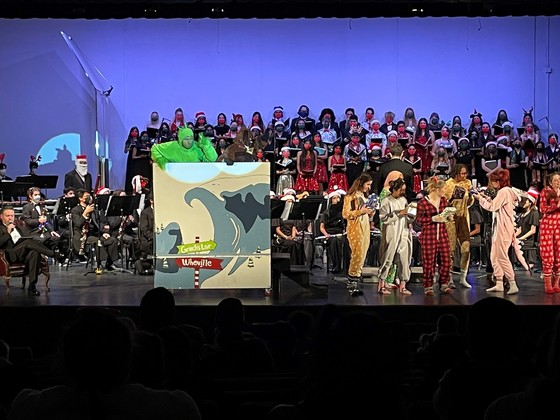 Tiny Tots Show
Holiday Spectacular is tonight at 7:00pm
Get tickets here
1. From the Principal's Desk
Dear Members of the Chantilly Community:
Happy Friday! As mentioned in my last two messages to the community, a lot of planning and work is underway at CHS to better identify students that are struggling and link them with the academic, social, and emotional support they need. The article abstract below reminds all of us that the best advocate for students are students themselves. For a number of reasons, students are often reluctant to ask for help and they continue to struggle as a result. The article below offers some guidance to parents and teachers as to how they can help students learn how to speak up when needed and obtain the assistance they need. I hope you find it helpful.
Have a good weekend,
Scott
Getting Teens to Ask for Help When They Don’t Know They Need It
In this Edutopia article, Sarah Gonser says many secondary-school teachers are frustrated when students don’t ask for help when they’re confused in class, or fail to take advantage of after-school office hours for one-on-one support. For teenagers, says Gonser, several factors may be at work: “a potent mix of peer pressure – the urgent need to appear competent in front of friends and classmates is a driving force at this age – and a lack of metacognitive skills when it comes to assessing their own learning and knowledge gaps.”
The key, she concludes from interviews with practitioners and researchers, is to “lower the temperature” around help-seeking, making it a “normal part of being a good learner, something students feel comfortable and empowered to do regularly.” Here are several strategies she gathered from front-line educators:
-
Reconsider after-school office hours. These generally conflict with students’ clubs, jobs, and chilling out – no wonder they don’t show up. Better to schedule brief check-ins with students during class time and systematically see all students over several weeks. A variation on this is conducting brief in-class “interview assessments” to get a feel for how well students know the material.
-
Teach metacognitive skills. To ask for help, students must first know when they’re struggling, which requires self-awareness and honesty. Explicit instruction is necessary to get teens past denial – beyond the familiar pattern of making the teacher do all the work of identifying what’s wrong and fixing it. Students might be prompted to ask themselves, Do I need to ask for help? Are there areas that are unclear to me? Could I teach this concept to a friend or family member? What is a strategy I want to try using more often? How am I doing in this class, this unit, this project? How do I know?
-
Normalize asking for help. Students need to be reminded how commonplace needing and asking for help is in all walks of life. Teachers’ personal stories from adolescence are helpful, as is inviting in other adults to talk about help-seeking in their work.
-
Provide non-public options. One study found that a private sign-up for an SAT prep class got an 80 percent participation rate, compared to 53 percent with a public sign-up. It’s also important that students know they can reach out for help via e-mail or text – with explicit limits to protect teachers’ out-of-school time.
-
Model assertiveness. What may seem like a teacher ignoring a student may be a simple matter of the teacher not being aware of the situation. Students need to see what it looks like to speak up with strength, not meanness.
-
Provide conversation-starters and role-plays. These are especially helpful for shy students and English learners. Some prompts:
- I’m struggling with ---. Can we talk about it later?
- I’m working hard, but I’m still not understanding ---. Can you help me?
- I’m not sure what I need. Can you please talk to me?
- Can you give me advice about ---.
“How Kids Can Overcome the Awkwardness of Asking for Help” by Sarah Gonser in Edutopia, November 19, 2021
Scott
2. Thank you to our Students, Staff and Community
Toys for Tots is a United States Marine Corps Reserve program started in 1947 to collect toys for underprivileged children.
This year the students and staff of Chantilly High School, Chantilly Academy and, the Chantilly High School community donated over 850 toys for children in need in our area this holiday season!
The success was the result of efforts by a wide variety of groups and individuals at Chantilly High School. These groups included Chantilly Academy Air Force Junior ROTC, Chantilly Academy Cosmetology Classes, the Key Club, and individual students, staff, and community members.
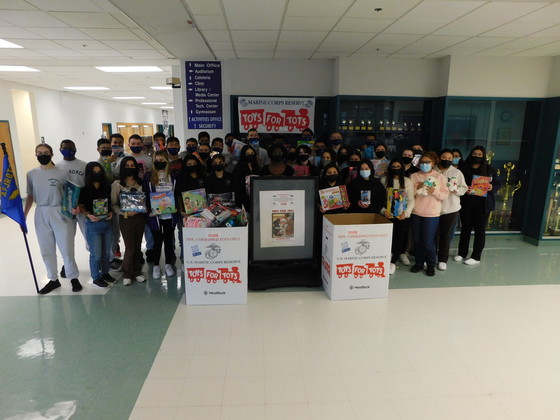 Toys For Tots Donations
3. Recognitions
Chantilly AFJROTC is very proud to announce that two of our CHS Air Force Junior ROTC cadets were selected to the Air Force Chief of Staff Flight Academy! One cadet was selected as a Primary (guaranteed seat) and one was selected as an Alternate (awaiting a seat)! The Flight Academy is a $20,000 scholarship to earn a private pilot’s license next summer!
Cadet Michael Tress – Primary (Chantilly High School)
Cadet Nathan Good – Alternate (Chantilly High School)
Please join us in congratulating this accomplishment!
4. Recent Student Successes
This is the next installment for the school year of what has become a weekly segment aimed at recognizing students for demonstrating recent improvement or achievement in academics, behavior or citizenship. At the end of each recognition, you will see the name of the nominating teacher or staff member. On a rotating basis, departments will nominate students. I meet with recognized students each week to congratulate them in person.
- For being kind to others around him and being willing to accept newcomers into his social realm, Seth Buerger has also excelled in academics and has been patient with those around him. Ms. Rebecca Daniels
-
Edras Cordero Godoy is a wonderful young man. He works hard in class, is very motivated to learn and is always on task. He asks questions to learn more and lends a helping hand to fellow students. Edras arrives at school every day ready to work and to learn. Love having him in class. Ms. Tatiana Kahn
- Even though Karen Munoz Chinchilla has a very full academic schedule this year, she shows up to every class with a positive attitude and a helpful spirit. Karen quietly lends support and friendship to everyone she meets, and, somehow, she always seems to know who needs it most. Thank you, Karen, for being an example of kindness and perseverance to us all. Ms. Gwen Dillon
-
Cristian Plazaola Urias is a hardworking student doing great work in class. He completes all assignments, is always on task, and never fails to help his fellow students when asked. Cristian is an exceptionally well mannered, polite young man who is a pleasure to have in class. Ms. Tatiana Kahn
-
Alex Rojas is doing exceptionally well this year as a sophomore! He has made so much progress. He participates in Biology every class, contributing answers during class discussions. He is able to advocate for assistance when he needs it. During advisory, he shares his perspective and is respectful of other’s opinions. Alex made A/B honor roll for 1st quarter and is on track to do so again for 2nd Quarter. I am proud of his hard work and perseverance, and he should be too. Ms. Jennifer Garrod-Smith
-
Emily Scheibel is a responsible/conscientious and engaged student who has shown tremendous personal growth and maturity this year. Ms. Theresa Giroux
-
Jacob (Jay) Wiggins has been on a roll these last few classes. Keep up the good work, Jay! Ms. Krisitn Dreyer
|