|
|
In This Issue:
SimLEARN Virtual Academy
SimLEARN Virtual Academy (SVA) leverages innovation and technology to advance simulation education through synchronous and asynchronous modalities.
Learn about available courses, click here. For more information, visit www.simlearn.va.gov.
|
|
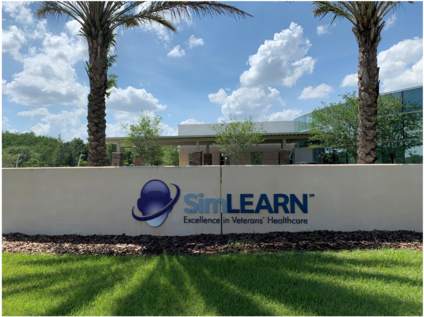
By: Eric Bruns, MBA, Executive Director, VHA SimLEARN
Orlando, Fla. - Since our founding in 2009, SimLEARN has been an acronym for Simulation “Learning, Education and Research Network.” As we continue to grow and adapt under the DEAN’s Office of Healthcare Innovation and Learning (OHIL), we want our name, mission, and vision to reflect all that we do here at SimLEARN. That’s why we’ve rebranded LEARN to stand for Learning, Evaluation, Assessment, and Research Network. We are thrilled to have the unique work we do, from developing curricula and best practices to innovative training that meets the needs of our Veterans, clearly defined in our new acronym!
For the rest of the story, click here.
Photography provided by Kophie Mathis.
|
|
|
|
By: VHA SimLEARN Staff, VHA SimLEARN, Orlando, Florida
Orlando, Fla. - The 2021 International Meeting on Simulation in Healthcare (IMSH) was held virtually this year with opportunities to access the educational presentations, once registered, until December 31, 2021. The conference theme of IMSH Delivers: Bringing Learning to Life offered live virtual presentations, pre-recorded sessions, research-based activities, simulation demonstrations, and other offerings. Several staff members from SimLEARN participated in the conference, and Michelle Regragui, MSHS, BSN, RN, Simulation Nurse Educator shared, “the IMSH 2021 conference provided the adaptability to expand simulation learning and growth through the use of virtual platforms allowing for the positive learning experience.”
For the rest of the story, click here.
|
|
By: David J. Adriansen, Ed.D, NREMT, CHSE, NTSP Director of Simulation | VA National Telestroke Program, Office of Connected Care, Palo Alto VA Health Care System
Jane A. Anderson, Ph.D., RN, FNP-C, FAANP, NTSP Chief Nursing Officer and Chief of Implementation Services | VA National Telestroke Program, Office of Connected Care, Palo Alto VA Health Care System
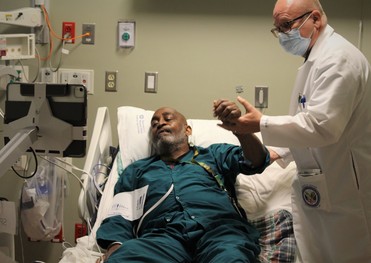
ICU MD conducted stroke assessment as guided by Telestroke Neurologist at Leavenworth VA. (L-R) William Burton, Standardized Patient and James Hignight, MD. VA Staff Photograph by Joseph Banks.
Palo Alto, Calif. - The VA National Telestroke Program (NTSP) serves Veterans with acute stroke symptoms at VA emergency departments, urgent care centers, and hospitals. Each year, the VHA reports approximately 4,500 Veterans are diagnosed with an acute ischemic stroke (AIS). According to the American Stroke Association, stroke is the 5th leading cause of death in the United States and a leading cause of serious long-term disability. Dr. Glenn Graham, Telestroke Program Executive Champion, and original founder in 2017, explained the program has grown in providing acute stroke expertise to VA facilities that lack around-the-clock acute stroke coverage. The NTSP is comprised of a virtual “hub” of VA stroke neurologists located around the country that participate in a 24/7/365 call schedule to provide coverage to participating facilities.
When a Veteran with acute stroke symptoms presents at a participating VA facility, front-line staff use a mobile device to videoconference with the Telestroke Neurologist. The neurologist examines the patient, reviews the medical record and CT images, advises the local treating physician as to a diagnosis and recommended treatment, and documents recommendations in the patient record. These recommendations are executed by the local treating provider.
Once official travel was minimized in March 2020 due to the pandemic, the NTSP Implementation Team had to transition to virtual training. After four months of adapting curriculum and processes, the NTSP was able to conduct its first Go-Live Course in August 2020 at the Albuquerque VA via livestreaming coaching and educational presentations. A new four-day virtual Go-Live Activation Course culminated in separate Emergency Department and ICU Telestroke Simulations. VA laptops and a livestreaming meeting application were used so both hospital and NTSP staff could observe remotely. Each simulation was followed by a structured debriefing and Process Flow Mapping discussion.
For the rest of the story, click here.
|
By: Debra A. Bartoshevich, MSN, RN, CHSE, CEN, Simulation Program Director | Audie L. Murphy VA Hospital San Antonio, Texas
San Antonio, Texas - We South Texans don’t do cold well and so when the ice storm of February 2021 arrived, we weren’t prepared for single-digit temperatures, icy roads, and a grid that lost power for 96 hours. The last time single digits were in San Antonio was over 30 years ago.
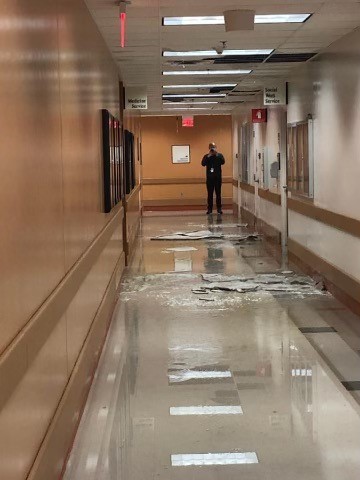
Christopher Sandles, the Director of South Texas Veterans Health Care System (STVHCS) declared weather leave for many of us who lost power, heat, electricity, and water at our homes, not to mention impassable ice-covered roads. Three days later, when the South Texas Veterans Health Care System Simulation Team arrived back to work, they were welcomed by water damage to their simulation center, equipment, and administrative offices. Sprinkler system pipes had frozen and burst causing severe flooding to the area. The floor in which the simulation center was located had over 6 inches of water. Water poured in from the ceiling and had gone unnoticed because it occurred on the weekend in an area that is usually unoccupied.
For the rest of the story, click here.
Photography provided by Sui Unzelman, DNP, RN, VHA-CM
|
By: Charlotte Pham, DO, Advanced Clinical Simulation Fellow | Durham, North Carolina
Jason Chandrapal, MD, Advanced Clinical Simulation Fellow | Durham, North Carolina
Durham, N.C. - A medication error is any preventable event that may cause or lead to inappropriate medication use or patient harm. Such events may be related to prescribing, order communication, product labeling, packaging, nomenclature, compounding, dispensing, distribution, administration, education, monitoring, and use. In the United States, 7,000 to 9,000 people die annually due to a medication error, and hundreds of thousands experience adverse reactions or other medical complications. These mistakes also represent a significant financial burden, with the estimated total cost of looking after patients with medication-associated errors exceeding $40 billion each year (Tariq et al., 2021).
In addition to direct patient harm and financial burden, medication errors have a steep psychological cost that can be far wider-reaching. As a facilitator, Jason recounts, "From my personal experience as an intern on a busy surgical service, I forgot to restart a patient's anticoagulation following surgery, and they subsequently developed a blood clot. I felt terrible and disappointed because I felt that the patient trusted me, and I broke that trust. It is a memory that we still vividly remember many years later and fortunately turned it into an opportunity for growth and improvement."
For the rest of the story, click here.
|
By: Jonathan Borgwing, EdD, Associate Director for Training | VHA SimLEARN
Orlando, Fla. - The SimLEARN Innovation Center for Education (SLICE) is proud to announce the following sites have become cells:
• Cleveland, OH
• Minneapolis, MN
• Pittsburgh, PA
• Oklahoma City, OK
• Orlando, FL
• Las Vegas, NV
• Harbor, NY
• Cincinnati, OH
• Togus, ME
• Wilmington, DE
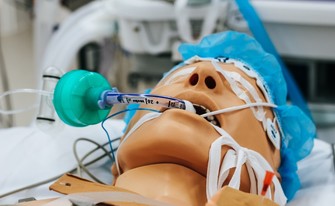
SLICE Cells are facilities that have partnered with SimLEARN to bring cutting edge Simulation Curriculum and resources to their facilitates. Currently we are rolling out OOORAM 2.0 (Out of Operating Room Airway Management), an updated and revised OOORAM course.
Read more about SLICE Centers at the SimLEARN website: https://www.simlearn.va.gov/SIMLEARN/Training_Operations_Home_Page.asp
|
By: VHA SimLEARN Staff, VHA SimLEARN, Orlando, Florida
Orlando, Fla. - SimLEARN is excited to announce the continuation of certification for Veterans Health Administration (VHA) simulation centers. The goal for national certification is to continue a structured program that supports improved local delivery of simulation-based training, augments access to developed instructional curricula, and increases continuity across the VHA. Certification ensures prioritization of the priorities of the VA Secretary and Executive In Charge. Facility Simulation Certification has been in existence since July, 2015 and remains one avenue for continuous process improvement and reflects the principles of highly reliable organizations.
For the list of the newest SimLEARN Certified Simulation Centers, click here.
Back to top
|
|
|
|
|
|