|
|
|
|
 By Scott Wiltz, MD, MPH, FAAFP
SimLEARN Associate Medical Director for Training and
Lygia L. Arcaro, PhD, RN
National Director, Nursing Programs
VHA SimLEARN National Simulation Center
ORLANDO, Fla. – The Trauma Nursing Core Course (TNCC) sponsored by the Emergency Nurses Association (ENA) provides nurses the knowledge and practice to complete rapid and accurate assessments when caring for ill or injured patients. TNCC is internationally recognized as the Standard of Care for trauma patients, but the practices can also be applied to medical patients, particularly those with multiple medical system involvement.
The course was first taught at the VHA SimLEARN National Simulation Center in Orlando, Florida in September 2014. As of Sept. 14, staff have trained 1,002 students and granted 18,236 Continuing Education Credits through 66 provider classes and 20 instructor classes. Starting with Battle Creek, Michigan in December 2017, SimLEARN began offering virtual components whereby learners could be at a remote site and participate synchronously with a live, in-person class at the National Simulation Center. Since then, 65% of learners have been trained using the virtual component.
For the rest of the story, click here.
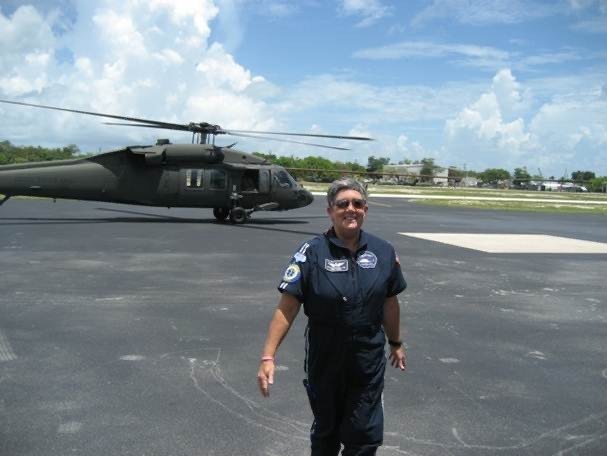
In this photo, Susie Martenson, SimLEARN TNCC lead, is on the tarmac in her role as a flight nurse after a mission. (VA courtesy photo)
Back to top
|
|
|
By Gerald Sonnenberg
EES Marketing and Communication
ORLANDO, Fla. – The COVID-19 pandemic created a need to address the educational requirements of VHA staff in non-standard ways, at least in the interim. As a result of the pandemic, in-person courses offered at the VHA SimLEARN National Simulation Center (NSC) in Orlando, Florida were repeatedly cancelled in an ongoing effort to help stop the spread of the virus. Instead, SimLEARN courses, like the highly effective Trauma Nursing Core Course, are being held in a live, virtual format.
Staff at the NSC are working on offering a greater variety of live, virtual courses. This situation is fluid. If you desire to take a specific course or know the status of their availability, please contact VHA SimLEARN NSC Support VHASimLEARNNSCSupport@va.gov.
For more information about the SimLEARN program, please visit the SimLEARN website.
The VHA public internet site for COVID-19 training is www.va.gov/COVIDtraining.
Back to top
|
|
|
ORLANDO, Fla. – When emergencies happen, VA’s frontline health care workers step up to meet the challenges, which often means relying on skills and training they may not often use. However, thanks to VA’s Simulation Learning, Education and Research Network (SimLEARN), VA providers can keep their skills sharp and maintain readiness for any situation.
SimLEARN, based in Orlando, Florida is an innovative training program that helps VA providers and frontline staff practice skills in a safe learning environment that simulates real-life situations. Through a variety of face-to-face and virtual courses direct care providers can practice foundational skills they might not get to use very often. This helps ensure that doctors, nurses and other providers can confidently respond to life-threatening situations when they happen.
For the rest of the story, click here.
Back to top
|
By Jane Robinson, MSN, RN, CEN
Systems/Hospital Activation Nurse
Simulation Outreach Network
VHA SimLEARN National Simulation Center
ORLANDO, Fla. – Opening a new clinical facility, renovating an existing space, or offering new clinical services comes with many potential hazards associated with the introduction of new processes and equipment, such as staff new to Veterans Affairs (VA), and/or new to the clinical locations; and the availability of resources. Process-oriented simulation is a useful tool to proactively identify gaps or deficiencies. SimLEARN’s Simulation Outreach Network’s (SON) System/Hospital Activation Team is available to assist facilities as they open new clinical spaces or offer new clinical services.
For the rest of the story, click here.
Back to top
|
By Jean Borck, MSN, BSN RN
Simulation Education Specialist
Zablocki VA Medical Center
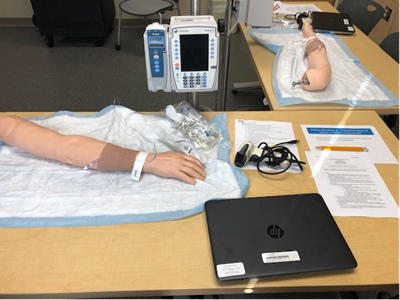
MILWAUKEE, Wisc. – Blood transfusion reaction is a high-risk, low volume event in clinical areas requiring quick interventions from nursing staff. Research shows ensuring proper identification of the blood product and patient identification can prevent blood transfusion reactions from occurring. The occurrence of transfusion reactions is one in 100 transfusions and are the most frequent adverse event with blood transfusions (Delaney, Wendel, Bercovitz, Cid, Cohn, Dunbar, Apelseth, ... Ziman, 2016). Incidents of wrong blood error numbers continue to grow each year making up half of all blood-transfusion related events, but very few are ABO-incompatible transfusions (Bolton‐Maggs, & Cohen, 2013).
The Blood Transfusion Administration (BTA) course at the Zablocki VA Medical Center combines a didactic psychomotor case study simulation facilitated by an instructor, followed by two high-fidelity clinical immersive simulations. Nurses attend the course within six months of hire and often have various experiences from different schools and hospital systems on blood transfusion workflow. In providing a didactic case study, the nurse can initiate blood transfusion therapy while following the organizational protocol and policy.
For the rest of the story, click here.
This photo shows the Blood Transfusion Administration Didactic Psychomotor classroom set-up. (VA photo by Jean Borck)
Back to top
|
By Vanessa Aycock, RN, MSN, CCRN-K, BC, CEN
Simulation Nurse Educator
Northern California Health Care System
MATHER, Calif. – The Sacramento VA Medical Center (VAMC) is the parent facility for the Northern California Health Care System (NCHCS) in VISN 21. It is comprised of nine Outpatient Clinics located in the California cities of Chico, Fairfield, Mare Island, Martinez, McClellan, Oakland, Redding, Yreka and Yuba City. In addition, a rehabilitation and extended care facility is also located in Martinez.
With the outbreak of COVID 19 in February 2020, the Simulation Team at NCHCS began to collaborate and create scenarios for intubation of a COVID positive patient, donning and doffing of personal protective equipment, and transporting COVID positive patients throughout the medical center. In addition, the team addressed the swabbing of patients, use of the hepafilter on a bag valve mask device along with the new algorithms for Basic Life Support and Advanced Life Support as published by the American Heart Association, mock codes of a COVID positive patient, and post mortem care.
For the rest of the story, click here.
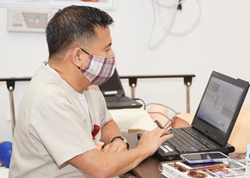
This photo shows Al Daniel Caballes, RN, simulation instructor, setting up a 3G Instructor Monitor for a simulation scenario. (VA photo by Jon-Nolan Paresa)
Back to top
|

By Lisa Baker, MEd, BSN
VHA National Program Director
Resuscitation Education Initiative (REdI)
VHA SimLEARN National Simulation Center
ORLANDO, Fla. – As of Oct. 1, a new program developed by the American Heart Association (AHA) is available as part of the Resuscitation Education Initiative (REdI) program resuscitation training portfolio. The Advisor: Basic Life Support (BLS) Program is designed for candidates who pass the cognitive portion of the HeartCode BLS Provider course but cannot independently perform the physical skills of cardiopulmonary resuscitation (CPR). The training specifically meets the needs of individuals with physical disabilities by focusing on their abilities to communicate and advise another person on how to perform the skills of CPR and use an AED while waiting for emergency responders to arrive.
The Advisor: BLS program will be assigned as part of the BLS permanent waiver training. Candidates will complete the HeartCode BLS online training through the Talent Management System (TMS) and present a course completion certificate for a one-hour face-to-face or virtual session with a BLS instructor. During the one-hour session, the candidate will review and certify on directing the actions of a rescuer for adult, child and infant BLS skills. Upon successful completion, candidates will receive an electronic course completion card for Advisor: BLS program.
For additional questions or concerns, contact your local facility Resuscitation Program Director.
Back to top
|
By Sherri Boisvert, PhD., MSN, RN and
Michelle Regragui MSHS, BSN, RN
Simulation Outreach Network Simulation Nurse Educators
VHA SimLEARN National Simulation Center
ORLANDO, Fla. – Safety, remains in the forefront of health care, including health care simulation education. In 2019 and 2020, the Simulation Learning Education and Research Network (SimLEARN) and SimLEARN’s Simulation Outreach Network (SON) hosted the Safe Patient Handling and Mobility (SPH&M) conference.
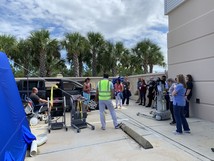
During the simulation scenarios a new concept was tested involving the simple use of a yellow safety vest. The vests were utilized by the SPH&M participants involved in the role of safety officers. The safety officers were charged with ensuring safety of the simulations. Instructions provided prior to each session focused on the importance of their role while wearing the vests.
For the rest of the story, click here.
In this photo, an individual is wearing a safety vest during training. (VA courtesy photo)
Back to top
|
By Lisa Baker, MEd, BSN
VHA National Program Director
Resuscitation Education Initiative (REdI)
VHA SimLEARN National Simulation Center
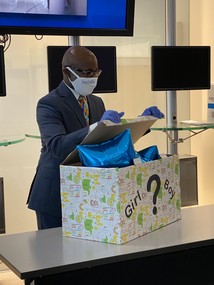
ORLANDO, Fla. – Healthcare Simulation Week, sponsored by the Society for Simulation in Healthcare, was Sept. 14-20. It celebrates professionals who use health care simulation to improve the safety, effectiveness and efficiency of health care delivery. To kick off the week, Simulation Learning Education and Research Network (SimLEARN) hosted a gender reveal ice cream social to recognize SimLEARN staff and welcome its newest member to its mannequin family. Eric Bruns, SimLEARN director, revealed the gender by opening a box filled with blue balloons. This newest mannequin will be utilized for activation and system testing of the initial medical response in a pediatric emergency.
SimLEARN is comprised of a team of physicians, nurses, simulation technicians, curriculum developers, project managers, biomedical, broadcast and administrative support staff. Together, this team designs, develops and delivers educational experiences to enhance knowledge, validates expertise through repetition and promotes safe patient outcomes. SimLEARN puts on national train the trainer courses, hosts a variety of health care related events, provides support to the field through outreach and system testing, and administers and evaluates the national resuscitation program.
For more information about SimLEARN, go to www.simlearn.va.gov.
In this photo, Eric Bruns, SimLEARN director, opens a box filled with balloons to announce the gender of the National Simulation Center's newest mannequin addition. (VA courtesy photo)
Back to top
|
By Lygia Lee Arcaro, RN
SimLEARN Director, Nursing Programs
VHA SimLEARN National Simulation Center
ORLANDO, Fla. – Do you remember what you were doing in June 2011? Simulation Learning, Education, and Research Network (SimLEARN) staff were celebrating 13 months in existence as the first Simulation Community of Practice Call was just beginning. Meeting monthly, there were no guest speakers on the earlier calls as these calls centered on operations. The audience? The VISN (Veterans Integrated Service Network) Simulation Champions who were designated between 2009 and 2010 attended.
Most of the attendees were learning more about simulation and how to execute the concept and practice at their sites. Early adopters were present and tended to concentrate on life saving skills such as basic and advanced life support, anesthesiology topics, physical assessment skills, and care of the critically ill patient, just to name a few of the classes taking place. Some VISNs purchased simulation equipment for all medical centers under their governance.
For the rest of the story, click here.
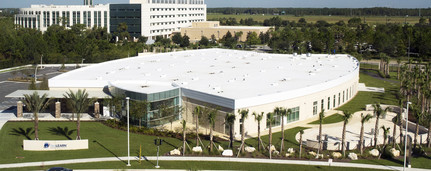
In this photo is the VHA SimLEARN National Simulation Center. (VA courtesy photo)
Back to top
|
|
|
|
|
|
|