|
|
|
|
By Gerald Sonnenberg
EES Marketing and Communication
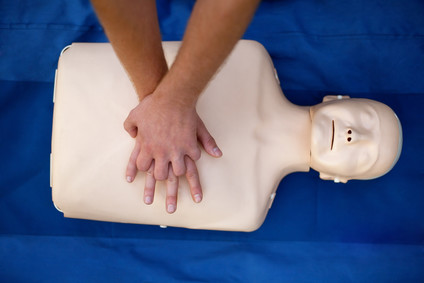
ORLANDO, Fla. – Since 2010, the Simulation Learning, Education and Research Network’s (SimLEARN) Resuscitation Education Initiative (REdI) has been providing standardized, documented, tracked and monitored advanced cardiac life support (ACLS) and basic life support (BLS) training throughout the Veterans Health Administration (VHA). REdI provides clinical training and support using American Heart Association guidelines to educate and train VA medical center clinical and non-clinical staff.
REdI is also responsible for the oversight of resuscitation curricula, the evaluation of resuscitation training materials and the performance of needs assessments for equipment procurement. In accomplishing this part of the REdI mission, local facility program directors are offered three delivery methods for BLS training: the Resuscitation Quality Improvement (RQI) program, HeartCode Complete and traditional classroom, instructor-led training.
For the rest of the story, click here.
Back to top
|
|
|

By Gerald Sonnenberg
EES Marketing and Communication
ORLANDO, Fla. – The list of courses offered at the VHA SimLEARN National Simulation Center for the first quarter is below. For more information, check availability, or to enroll in the courses, please refer to the course catalog.
The following courses are scheduled to take place through December 2019:
- Musculoskeletal Training (MSK) Dec. 3
- Trauma Nursing Core Course (TNCC) Dec. 3
- Simulation, Technology, Operations, Maintenance and Practices (STOMP) Nov. 13
- Introduction to Clinical Simulation (ICS) Oct. 29
- Point of Care Ultra Sound (POCUS) Nov. 5
- Fundamentals of Critical Care Support (FCCS) Nov. 13
- Simulations for Clinical Excellence in Nursing Services (SCENS) Nov. 13 & Dec. 9
- SimLEARN Faculty Instructor Course (SFIC) Dec. 17
- Maintenance of Certification of Anesthesia (MOCA) Nov. 22 & Dec. 13
- Peripherally Inserted Central Catheter Course (PICC) Dec. 17 & 19
If you have questions, please contact EES SimLEARN NSC Support EESSimLEARNNSCSupport@va.gov.
For more information about the SimLEARN program, please visit the SimLEARN website.
Back to top
|
|
|
By Adam Stump
Public Affairs Specialist
VA Digital Media Engagement
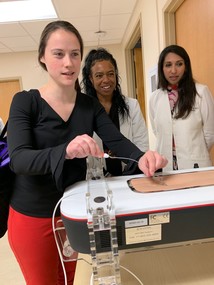
RICHMOND, Va. – A crowd of people gathered around Jonathan Nguyen as he spoke to a mannequin lying in a hospital bed. Stranger yet, this one talked back. As its eyes blinked and its chest cavity rose and fell from simulated breathing, it told Nguyen about its pain.
This interaction displayed the latest simulation center for improving Veteran care, unveiled Sept. 17 at the Hunter Holmes McGuire VA Medical Center in Richmond, Virginia. The opening coincided with Healthcare Simulation Week Sept. 16-20.
For the rest of the story, click here.
In this image, Dr. Denise Lester, center, and Dr. Meenakshi Bindal, right, show a Congressional staffer how a spinal cord stimulation lead is placed into a person's spine during the simulation center opening Sept. 17, at the Hunter Holmes McGuire VA Medical Center in Richmond, Virginia. (VA courtesy photo)
Back to top
|

By Lucy S. Witt, MD, MPH
Hospitalist
and Joyce Akwe, MD, MPH, FACP
Chief of Hospital Medicine
Atlanta VA Health Care System
DECATUR, Ga. – “Call a Code-99!” – a phrase that immediately gets most clinicians’ hearts racing. Codes are often chaotic, complex and require coordination among a, sometimes, large team of staff members. Clearly identifying the role of each team member, their responsibilities and bedside position may improve the success of a code situation. Simulation is an effective way to test interventions aimed at improving real life outcomes. Recently the Atlanta VA Medical Center (VAMC) used simulation to do just that.
For the rest of the story, click here.
Back to top
|
By David J. Adriansen, EdD, NREMT, CHSE
Director, VA Midwest Region Simulation Program
Minneapolis VA Health Care System
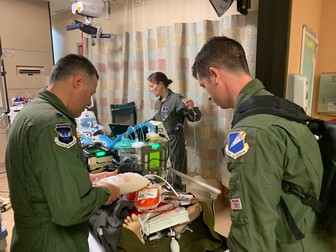
MINNEAPOLIS – The Minneapolis-St. Paul Air Reserve Station is a national sustainment training center for Air Force Active, Guard and Reserve Critical Care Air Transport Team (CCATT) units, and the Minneapolis VA Medical Center (VAMC) helps support the training of Air Force units through a VA-DOD Healthcare Sharing Agreement. CCATTs travel to the Twin Cities quarterly for a 5-day course which culminates in an aeromedical training mission. In September, the 934th Aeromedical Staging Squadron (ASTS) CCATT, based at the Minneapolis-St. Paul Air Reserve Station, conducted their training mission.
As part of the exercise, two mannequins are staged in the closed Medical Intensive Care Unit or MICU at the Minneapolis VA. A CCATT arrives at the hospital, which is designated an overseas location for the exercise, to obtain a briefing from ICU staff and then transport the “patients” to the Air Reserve Station for an actual 3-hour flight (simulated flight to Germany) for treatment.
In this image, members of the 934th ASTS prepare a "patient" for transport during from the Minneapolis VAMC during a training exercise for Air Force Critical Care Air Transport Teams. (VA courtesy photo)
Back to top
|
By Lygia Lee Arcaro, Ph.D, RN
VHA SimLEARN National Director,
Nursing Programs
VHA SimLEARN National Simulation Center
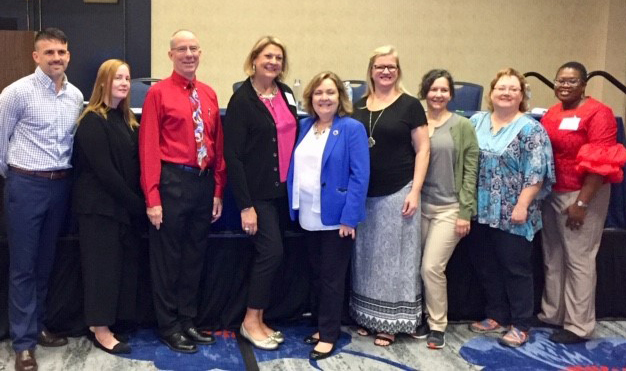
ORLANDO, Fla. – Program directors (PDs) for the RN Transition to Practice Program (RNTTP) met in Orlando, Florida during September. Speakers included seasoned PDs and nurse executives who provided information for implementing and effectively managing this program. Providing clinical and leadership curriculum and experiences support the RN residents at the health care systems.
The RNTTP program focuses on providing safe and qualified nursing care to Veterans. One teaching and learning method includes incorporating simulation into the program. An example includes development of critical thinking and communication skills as a member of a team with other nurses. This may be accomplished by using a mannequin as the patient until the skill the nurse, or nurses, are learning is mastered. Deborah Meyers, MSN, RN, WCC, Nurse Educator from the James E. Van Zandt VA Medical Center in Altoona, Pennsylvania attended the conference. She said, “a lot of people are using simulation more than expected. I learned a lot, and (it was) nice to see different ways of doing things.”
In this image, (left to right) Members of the RNTTP Field Advisory Committee pose for a photograph: Scott E. Gilliland, BSN, RN, nurse manager; Jacque Cushard, RN, clinical Nurse educator; R. Clark Campbell, MSN, RN-BC, FHIMSS, CPHIMS; Rebecca E. Long, MS, RN, CMSRN, ACNS-BC, ambulatory specialty clinical nurse specialist; Judith Wendt, MSN, RN, associate chief, nursing Service/academic affiliations; D. Nicole Coxe, MSN, RN, chief nurse, education and resources; Susan Parker, MSN, RN-BC, RNTTP nurse manager; Deborah Bailey, RN, MSN, CMSRN, clinical instructor; Ninilola Ogundare, DNP, MHA, MSN, RN, RN residency coordinator/nurse educator. (VA courtesy photo)
Back to top
|
|
|
|
|
|
|