|
|
|
|
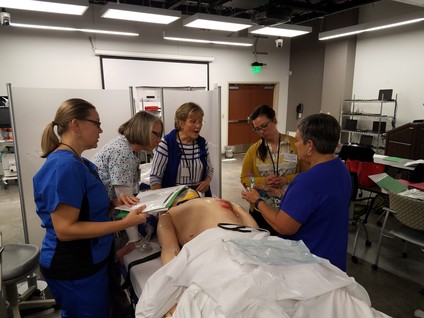 Courses like Trauma Nursing Core Course (TNCC) pictured here are available during the final quarter of the fiscal year. (VA photo by Gerald Sonnenberg)
By Gerald Sonnenberg
EES Marketing and Communication
ORLANDO, Fla. – The list of courses offered at the VHA SimLEARN National Simulation Center for the fourth quarter is below. For more information, check availability, or to enroll in the courses, please refer to the course catalog.
The following courses are scheduled to take place through September 2019:
- Trauma Nursing Core Course Instructor (TNCC) Aug. 12 and Sept. 16
- Trauma Nursing Core Course (TNCC) July 9, Aug. 13 and Sept. 17
- Introduction to Clinical Simulation (ICS) July 9, Aug. 20 and Sept. 10
- Point of Care UltraSound training (POCUS) Aug. 27
- Simulations for Clinical Excellence in Nursing Services (SCENS) July 23
- Fundamental Critical Care Support (FCCS) July 16 and Aug. 20
- Simulation Technology, Operations, Maintenance and Practices (STOMP) July 30 and Aug. 6
- Musculoskeletal Clinician (MSK-C) July 30 and Aug. 27
- SimLEARN Faculty Instructor Course (SFIC) Sept. 24
- Maintenance of Certification of Anesthesia (MOCA) July 19, Aug. 9 and Sept. 6
- Out of Operating Room Airway Management (OOORAM) Sept. 10
If you have questions, please contact EES SimLEARN NSC Support EESSimLEARNNSCSupport@va.gov.
For more information about the SimLEARN program, please visit the SimLEARN website.
Back to top
|
|
|
By Gerald Sonnenberg
EES Marketing and Communication
SYRACUSE, N.Y. – The VHA SimLEARN National Simulation Center (NSC) provides VA clinicians with a wide variety of courses designed to improve their skills, as well as provide our Veterans with an even higher level of care. Oftentimes, the public benefits from the care of a VA physician trained in an NSC course. That was the case recently when Dr. Ryan Reed, chief resident of quality and patient safety at the Syracuse VA Medical Center (VAMC) in New York was moonlighting at a local, private hospital.
For the rest of the story, click here.
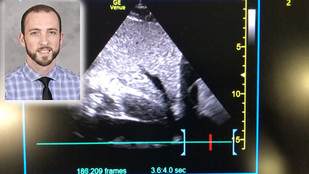
In this image, (inset) Dr. Ryan Reed. The rest of the image is of the subcostal inferior vena cava view that Dr. Reed obtained using point of care ultrasound. (VA courtesy photo)
Back to top
|
|
|
By Lichelle Bevett, MSN Ed, CPAN, RN
Post Anesthesia Care Unit RN
VA Southern Nevada Healthcare System
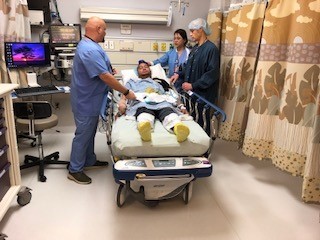
NORTH LAS VEGAS, Nev. – Lichelle Bevett, the VA Southern Nevada Healthcare System (VASNHS) post anesthesia care unit’s (PACU) simulation instructor, and Quentin Hart, VASNHS simulation coordinator, recently teamed up to create a realistic simulation designed for the PACU environment focusing on recognizing malignant hyperthermia (MH) signs and symptoms in a standardized patient. This approach also alerts the team to determine, mix and administer the required medication and monitor the patient after treatment.
For many years, training on MH for the PACU and operating room (OR) staff at the VASNHS consisted of watching a video from the Malignant Hyperthermia Association of the United States (MAUS) and reviewing the contents of the MH cart. There was no opportunity for the participants to simulate the actual response to an MH event.
For the rest of the story, click here.
In this image, (left) James Carr and (second from right) Mellanie Buenviaje, PACU RNs have noticed signs and symptoms of malignant hyperthermia on a standardized patient (center) and alerted (far right) Mark Darcey, CRNA, to the bedside. (VA courtesy photo)
Back to top
|
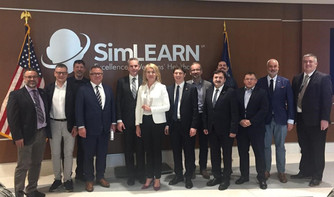
ORLANDO, Fla. – A delegation from Poland visited the VHA SimLEARN National Simulation Center recently as part of a week long exchange for the delegation to learn more about the U.S. health care system. This included the training of providers to value-based health care principles. Part of the delegation also took part in the Lake Nona Impact Forum near Orlando in an effort to create collaborations in health care innovation.
The visit to SimLEARN was coordinated by VA physician Dr. Michael S. Czekajlo of the Richmond, Virginia VA Medical Center. Dr. Czekajlo had been a Fulbright Scholar in Poland and helped Poland establish a network of 11 undergraduate simulation centers for medical schools. Poland is now looking to establish simulation centers and programs for graduate medical education and board certification. The visit to SimLEARN was to see how the largest health care system in the U.S. is implementing simulation.
In this image, (far left) Dr. Scott Wiltz, SimLEARN associate medical director for training; (third from left) Dr. Michael Czekajlo, Richmond, Virginia VAMC; and (far right) Dr. Odas Parsons, then interim SimLEARN division director. They are standing with the Polish delegation which included Professor Piotr Czauderna, MD, Ph.D, chairman of the Healthcare Section of the National Council for Development for the Chancellery of the President of the Republic of Poland; Dr. Adam Niedzielski, vice-director of the Polish National Health Service; and Malgorzata Galzka-Sobotka, Ph.D, a senior health care policy advisor to the Polish Ministry of Health. (VA courtesy photo)
Back to top
|
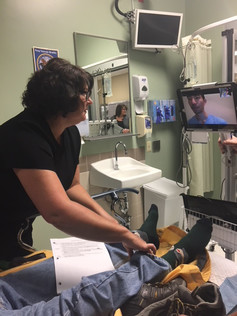
ORLANDO, Fla. – The VA National Tele-Stroke Program (NTSP) is a collaboration with the VA’s Office of Rural Health and the Office of Neurology to improve access to acute stroke services for Veterans residing in rural communities. This is done by using mobile and telehealth technologies to bring acute stroke expertise to the bedside anywhere in the country.
The VA National Tele-Stroke Program has been implemented in 24 facilities, in which simulation was an integral part of training. VA facilities partnering with the NTSP participate in a three-day “Go-Live” training program to prepare them to recognize and treat acute stroke, while incorporating the use of mobile and telehealth technologies.
For the rest of the story, click here.
In this image, a nurse communicates with an National Tele-Stroke Program neurologist during training. (VA courtesy photo)
Back to top
|
By Gerald Sonnenberg
EES Marketing and Communication
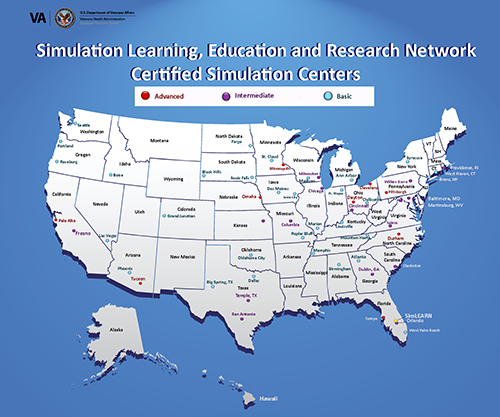
ORLANDO, Fla. – We have added a new map on our Certified Simulation Centers page illustrating where each facility is located. SimLEARN staff awards new simulation certifications twice each year to qualified facilities. Facility certifications last for two years, are renewable and they are a distinctive accomplishment. A list of these facilities and the new map are available here on the SimLEARN website.
The map not only includes the locations, but it also illustrates the three tiers of certification: basic, intermediate and advanced. Please click here to view SimLEARN's Certified Simulation Centers.
Back to top
|
|
|
|
|
|
|