|
|
|
|
 By Gerald Sonnenberg
EES Marketing and Communication
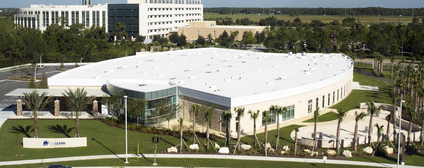
ORLANDO, Fla. – The list of courses offered at the VHA SimLEARN National Simulation Center for the remainder of the third quarter is below. For more information, check availability, or to enroll in the courses, please refer to the course catalog.
The following courses are scheduled to take place through June 2019:
- Trauma Nursing Core Course (TNCC) May 7 and June 4
- Point of Care Ultra Sound training (POCUS) May 21 and June 18
- Simulations for Clinical Excellence in Nursing Services (SCENS) May 14 and June 11
- Fundamental Critical Care Support (FCCS) May 21 and June 18
- Simulation Technology, Operations, Maintenance and Practices (STOMP) June 25
- Musculoskeletal Clinician (MSK-C) May 14 and June 25
- Maintenance of Certification of Anesthesia (MOCA) May 3 and June 7
If you have questions, please contact EES SimLEARN NSC Support EESSimLEARNNSCSupport@va.gov.
For more information about the SimLEARN program, please visit the SimLEARN website.
Back to top
|
|
|

By Janet Sprehe, DNP, APN-BC, CVRN, RN-BC
Program Director of Simulations/REdI
James A. Haley VA Hospital and Clinics
TAMPA, Fla. – According to 2018 statistics from the National Institute of Mental Health (NIMH), 20 Veterans end their lives each day by suicide. That’s why the James A. Haley VA Hospital in Tampa and the Puget Sound VA Healthcare System in Seattle have been conducting suicide simulation challenges with other VA facilities across the country since 2016. This effort is in cooperation with the VA strategic plan to help reduce suicide rates among Veterans.
Suicide is a leading cause of death in the United states. In 2016, over 45,000 lives were lost to suicide, and suicide rates have increased over 30% in half the U.S. states since 1999 (CDC, 2018). This increase has been a major concern across VHA.
For the rest of the story, click here.
Back to top
|
|
|
By Quentin Hart, BSN, RN
Clinical Nurse Educator and Simulation Center Coordinator
VA Southern Nevada Healthcare System
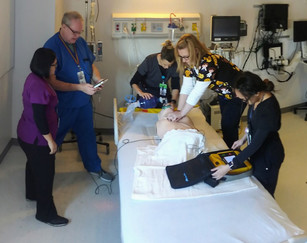
NORTH LAS VEGAS, Nev. – It’s no secret that poor-quality cardiopulmonary resuscitation (CPR) can lead to adverse patient outcomes. Compressions at an inadequate depth and rate, incomplete thoracic recoil, unnecessary interruptions or failure to properly use available equipment can lead to the lack of return of spontaneous circulation in patients experiencing cardiac arrest (Li et al., 2013). Without frequent and proper training, CPR providers often overestimate their effectiveness in achieving adequate CPR (Cheng et al., 2015).
Traditional Basic Life Support (BLS) certification is completed every two years and does not require follow-up training in between classes. Unfortunately, skills gained in programs such as BLS start to deteriorate just two weeks post training, with much of the skills completely extinguished within six months (Herbers & Heasers, 2016). The implementation of the Resuscitation Quality Initiative (RQI) goes far to reinforce technical skills, but lacks the successful teamwork element and the use of backboards and automated external defibrillators (AED’s).
For the rest of the story, click here.
In this image, Nurses at the VASNHS take part in HFLD CPR training. From left: Lorena Velazquez, RN; Quentin Hart, RN; Jennifer Bagwell, nursing student; Lindsey Haener, RN; and Danielle Valerio, RN. (VA photo by Rachel Surryhne)
Back to top
|
By Misoor Goueli, MD, MBA
Staff Physician
Assistant Professor, Department of Medicine, University of Cincinnati
Simulation Lab, Medical Director
Cincinnati VA Medical Center
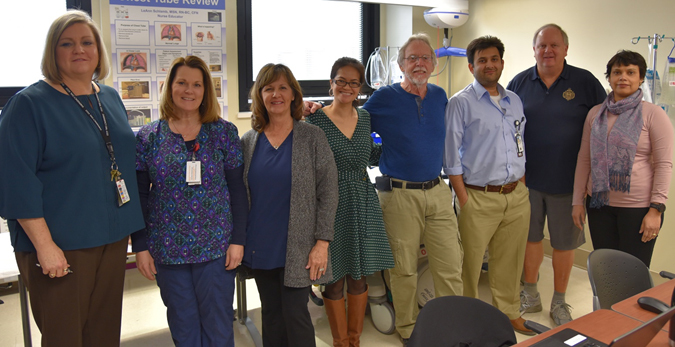
CINCINNATI – A simulation approach using standardized patients (SP) can greatly improve a facility’s ability to teach provider/patient communication skills. Anecdotally, VA based simulation labs suffer from a lack of SP specific expertise and will often hire outside SPs or forego the SP experience all together. The Cincinnati VA Medical Center (CVAMC) took an approach to bring a limited SP program to life within the VA simulation environment.
Initially the idea of bringing an SP program to the simulation lab seemed like a daunting task. Luckily, CVAMC has a robust voluntary services program and is situated near the University of Cincinnati College of Medicine (UCCOM), which features a highly functioning, dynamic SP program. Accordingly, CVAMC elected to leverage these two resources to benefit our Veteran population.
The first step taken was to approach voluntary services with a proposal for services. A formal proposal was drafted that included a work description, time commitment, expectations and outcomes that were expected to be achieved. The work description was modeled after the University of Central Florida program, which can be found here.
For the rest of the story, click here.
In this image, participants, instructors and volunteers stand for a photograph during a musculoskeletal clinician training. This is one of the many standardized patient-based simulation offerings available at the Cincinnati VAMC simulation lab. From left to right, Dr. Leslie Long, Susan Honkomp, NP; Sherri Rosser, NP; Dr. KimYen Nguyen (instructor); Ron Pinkerton (SP volunteer); Dr. Ishaque Syed (instructor), Ron Stowell (SP volunteer); and Dr. Sheela Kamath. (VA photo by Christopher Malott)
Back to top
|
By Mary E. Holtschneider, RN-BC, BSN, MEd, MPA,
NREMT-P, CPLP
Co-Director, Interprofessional Advanced Fellowship
in Clinical Simulation
Simulation Education Coordinator
Durham VA Health Care System
DURHAM, N.C. – Thirteen high school students interested in health care careers recently visited the Durham VA Health Care System (VAHCS). The students from the J.D. Clement Early College High School in Durham had the opportunity to learn firsthand what it is like to be a health care professional.
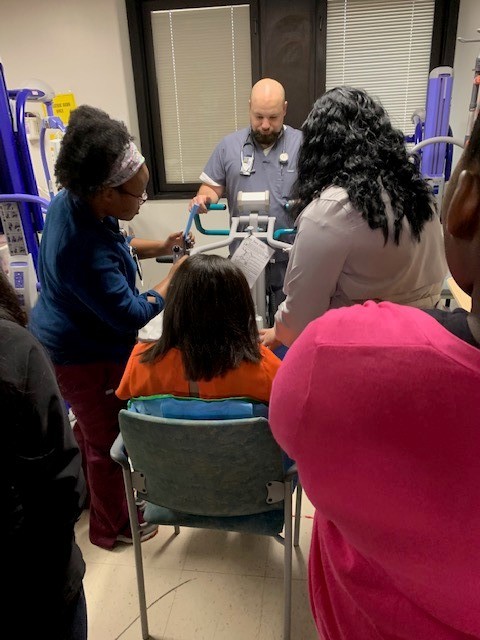
The New Graduate Nurses in the RN Transition to Practice (TTP) program, enjoyed sharing their nursing experience with the students. The TTP nurses held an interactive session demonstrating lifesaving skills, including effective CPR and defibrillation, on computerized mannequins. Additionally, they taught the students safe patient handling and evacuation methods.
One of the TTP nurses works in the Durham Community Living Center and led the group on a tour, where they interacted with Veterans and staff. One of the TTP nurses said, “programs like this in public schools are vital to give adolescents the chance to investigate potential passions, as well as learn from real world experience.”
Social workers and physical therapists also talked with the students about their roles and explained the ways they make a difference in Veterans’ care and lives every day. One student, at the end of the day, said, “I want to come back and work here some day!” The TTP nurses are pleased to provide education to encourage the students’ journey in pursuing a health-focused career.
In this image, TTP graduate students Ayanna Blevins (left) and Michael Duda (center) demonstrate safe patient handling for local high school students. (VA photo by Mary Holtschneider)
Back to top
|
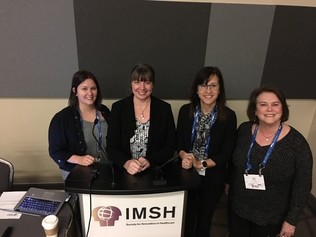
SAN ANTONIO – Staff from the Olin E. Teague Veterans Medical Center in Temple, Texas and Audie L. Murphy Memorial VA Hospital in San Antonio collaborated for a presentation on Veteran suicide at the 2019 International Meeting on Simulation in Healthcare (IMSH) event in January. The presentation addressed suicide prevention and offered simulations on the topic.
The simulation modalities included standardized patients, role playing, telephone and table-top simulations to bring awareness of the Operation S.A.V.E. Program. Operation S.A.V.E. is a program designed to help you act with care and compassion if you encounter a person who is suicidal. The acronym “SAVE” summarizes the steps needed to take an active and valuable role in suicide prevention: Signs of suicidal thinking; Ask questions; Validate the person’s experience; Encourage treatment; and Expedite getting help.
Kristy Causey, RN; Debra Bartoshevich, MSN, both simulation program directors, along with Dr. Bonnie Haupt, DNP, RN, from Audie L. Murphy VA and Diane Ferguson, BSN, from the University of Texas Health Science Center in San Antonio, presented comparison data regarding the effectiveness of using a standardized patient versus table-top simulation. The submitted title of the hot-topic was, “It’s your Call 1-800-273-8255 Operation S.A.V.E. Preventing Veterans Suicide.”
In this image, (left to right) Kristy Causey, RN; Bonnie Haupt, DNP, RN; Debra Bartoshevich, MSN; and Diane Ferguson, BSN, are photographed at the 2019 International Meeting on Simulation in Healthcare (IMSH) event in January. (VA courtesy photo)
Back to top
|
By Gerald Sonnenberg
EES Marketing and Communication
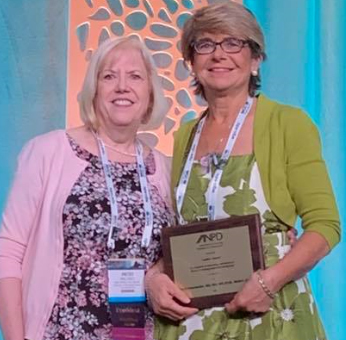
ORLANDO, Fla. – Mary E. Holtschneider, RN-BC, BSN, MEd, MPA, NREMT-P, CPLP, (pictured right) is the co-director of the Interprofessional Advanced Fellowship in Clinical Simulation, as well as the simulation education coordinator at the Durham VA Health Care System. She is pictured here after receiving the Association of Nursing Professional Development (ANPD) Leadership Award at the ANPD conference in April.
According to Gwen Waddell-Schultz, MSN, RN-C, NE-BC, VHA-CM, chief nurse for Education, Medicine and Nursing at the Durham VA Medical Center, "This award recognizes her influence in the interprofessional practice and learning environments, the NPD specialty, the profession of nursing, and health care.”
In this image, Mary Holtschneider (right) received her award from Patsy Maloney, Ed.D, RN-BC, CEN, NEA-BC, president of the Association of Nursing Professional Development. (VA photo by Dr. Chan Park)
Back to top
|
|
|
|
|
|
|