|
|
|
|

By Gerald Sonnenberg
EES Marketing and Communication
ORLANDO, Fla. - Three VHA leaders in simulation training were selected to be recognized
for their expertise in leadership and mentoring in the field of clinical simulation
training to earn the 2017 VA Under Secretary for Health’s Awards for Excellence in
Clinical Simulation Training, Education and Research. This award program
recognizes clinical and executive leaders in VHA’s clinical simulation who have
supported and advanced VHA’s strategic plan for simulation. The annual awards
were established as a means of promoting and advancing system-wide progress of
VHA goals, objectives and strategies for the deployment of clinical simulation
to improve the quality of health care Veterans receive.
The
following are the selectees and their categories:
-
Chan W. Park, M.D., FAAEM, director of simulation
education and co-director of the Interprofessional Advanced Fellowship in
Clinical Simulation at the Durham VA Medical Center (VAMC) in Durham, North
Carolina, is the recipient of the Excellence in
Clinical Simulation Training, Education and Research Practice Award.
-
Mary
Ellen Elias, MSN, RN-BC, VA Pittsburgh Healthcare System simulation
coordinator, and co-director Interprofessional Advanced
Fellowship in Clinical Simulation, is
the recipient of the Excellence in Clinical Simulation Training, Education and
Research Champion Award.
-
Wilma Ayala, Doctor of Nursing Practice (DNP), MS, RN, Nurse
educator-BC, Resuscitation Education Initiative (REdI) program director at the VA
North Texas Health Care System in Dallas was selected as the recipient of the Excellence in Clinical Simulation
Training, Education and Research Champion Award for REdI.
For the rest of the story and more about the award recipients, click here.
|
|
|
|
By Gerald Sonnenberg
EES Marketing and Communication
ORLANDO, Fla. – Approximately 100 VHA staff from
Veteran Integrated Service Network medical facilities (VISN) participated in a
“hands on” wheelchair prescription course July 24-26 at the VHA SimLEARN
National Simulation Center (NSC). It was sponsored jointly by the
Rehabilitation and Prosthetics Services Program Office, Physical Medicine and Rehabilitation Service
(PM&R) and the Spinal Cord Injury and Disorders Program Office.
This is the second year this type of training took place at the
NSC. But unlike last year’s assistive technology course, this training
“concentrated on wheelchair prescription including basic manual wheelchairs,
custom manual wheelchairs, scooters, power wheelchairs, specialized sports
wheelchairs and handcycles,” said Bill Wenninger, MS, PT, a rehabilitation
planning specialist at PM&R Central Office based at the Milwaukee VA
Medical Center (VAMC). He is the primary planner and coordinator of the event.
Veterans
with mobility issues require specialized equipment and interdisciplinary care
delivery to optimize their care and function. Clinicians in these specialized
clinics need to collaborate closely with prosthetic and sensory aids service
representatives to obtain the most appropriate mobility device for the Veteran.
This face-to-face conference provided attendees the opportunity to handle,
manipulate and program the various wheeled mobility devices to help them understand
set-up, application and educational needs as they relate to Veterans with
disabilities.
For the rest of the story, click here.
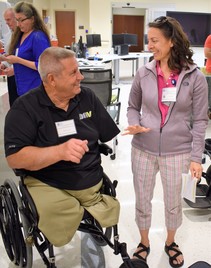
(Left to right) Jim Sursley, Vietnam Veteran and former commander of the
Disabled American Veterans, and Robin Blount, physical therapist with the
Charleston, South Carolina VA Medical Center, discuss wheelchair issues for Veterans. (VA photo by Randy McCracken)
|
|
|

By Gerald Sonnenberg
EES Marketing and Communication
ORLANDO, Fla. – A full slate of simulation training courses in fiscal year 2019 are now available for which staff can now register. These courses at the VHA SimLEARN National Simulation Center (NSC) include:
Simulation, Technology, Operations, Maintenance, and Procedures (STOMP)
Trauma Nursing Core Course (TNCC)
Fundamental Critical Care Support
Introduction to Clinical Simulation
Point of Care UltraSound (POCUS)
and more.
To see a full list of available courses, as well as information about each course and how to register, click here.
|
By Daniel Desormeaux
Education Project Manager
VHA SimLEARN National Simulation Center
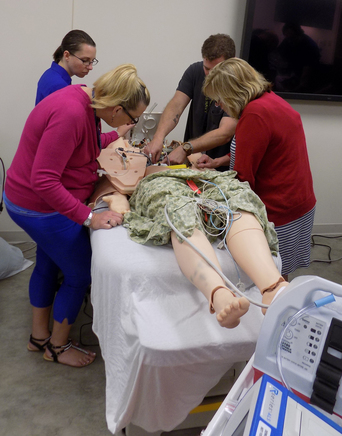
ORLANDO, Fla. – VHA staff attended the Simulation, Technology, Operations,
Maintenance and Procedures (STOMP) 101 pilot course, the week of June 25 at the
VHA SimLEARN National Simulation Center (NSC). The STOMP course was recently
updated with new offerings planned for Fiscal Year 2019.
The course provides participants
with the baseline knowledge of local simulation program infrastructure and life
cycle management of simulation assets, as well as basic hands-on skills to
operate, maintain and recognize common deficiencies.
The target audience is comprised of novice personnel assigned to
operate and maintain simulation assets within a facility. STOMP 101 teaches
operations and maintenance of various mannequins and basic task trainers
required to conduct immersive and valuable medical simulation training. This
course combines small group and hands-on simulation activities where
participants can demonstrate the competencies necessary to accomplish basic
operations and functions within a simulated environment.
For more information about STOMP 101 and other NSC courses, click here.
In this image, students conduct preventive maintenance on a
mannequin. (Left to right) Theresa
Houston, nurse educator; Brenda Nielsen, training technician; Cathy Beamer, nurse
educator; and James Bloodgood, STOMP 101 faculty. (VA photo by Daniel Desormeaux)
|
By Janet Sprehe DNP, APN-BC, CVRN, RN-BC Program Director of
Simulations/REdI
Tampa VA Medical Center
TAMPA, Fla. – International collaboration brings health care providers
with similar research interests and passions together to share talents and
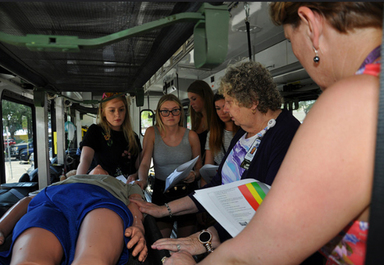
resources to help address mutual areas of concern. The James A. Haley Veterans’ Hospital (JAHVH) and clinics
has a mobile Simulation Bus that teaches facility staff and outside community
agency staff about disaster preparedness, while it also informs the community
how Veterans' hospitals can deploy their dual use vehicles (DUV) and utilize the
vehicles in national emergencies.
This past spring semester, the University of
South Florida (USF) College of Nursing had the opportunity to host 16 nursing
students from Scotland. The sixteen nursing students were in their community
nursing rotation and were excited to learn about America’s perspectives and
cultures, as well as what drives them.
For the rest of the story, click here.
In this image, Dr. Carol Wilson, simulation faculty (second from right),
discusses the triage color scheme for disasters with the Scottish nursing
students. (VA courtesy photo)
|
 By Kristen Hanten, RN, MSN & Lisa Hubbard, ARNP
Mobile
Simulation Training Team
OMAHA, Neb. – SimLEARN’s Mobile Simulation Training Team (MSTT) mission is
to maximize training capacities at the local-facility level by bringing
simulation-based training to health care facilities. During July 23–26 and
July 29 – Aug. 4, MSTT completed Musculoskeletal (MSK) knee and shoulder course
training at the VA Medical Center in Iron Mountain, Michigan; and Community
Based Outpatient Clinics (CBOC) in Rhinelander, Wisconsin; and Marquette,
Michigan; as well as an outreach clinic in Manistique, Michigan.
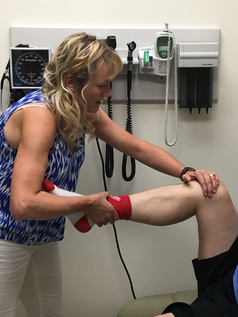
This
face-to-face simulation training is designed to enhance primary care providers’
knowledge, skills and confidence to manage common MSK problems. In addition,
this training emphasizes appropriate resource utilization and access to
specialty care. MSK complaints account for approximately 20 percent of visits
to primary care and urgent care clinics each year. The target audience for this
training includes physicians, nurse practitioners and physician assistants
which staff primary care clinics and CBOCs. However, with patients presenting
more frequently to urgent care and emergency departments with MSK complaints,
this training can be quite valuable for these providers as well.
For the rest of the story, click here.
During training, Nurse Practitioner Colleen Burton performs a
knee exam to stress the medial collateral ligament on Dr. Lee Morrow, MSTT provider
educator. (VA photo by Kristen Hanten)
|
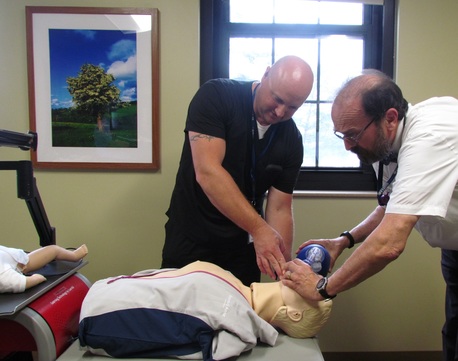 SIOUX FALLS, S.D. - The Sioux Falls
VA Health Care System was recognized as the 100th VA medical center (VAMC) to implement the American
Heart Association's new model of Advanced Cardiovascular Life Support (ACLS)
and Basic Life Support (BLS) certification, known as Resuscitation Quality
Improvement (RQI).
This is the newest way for health care employees to maintain
competency and certification, which is required for ACLS and BLS. It combines
online learning with hands-on assessments using simulation equipment. This
program was piloted in July 2016 at VAMCs in Topeka, Kansas; Asheville, North Carolina, and
Pittsburgh.
In this image, (right to left) Donald Anderson, Registered Respiratory Therapist (RRT) and Bob Godes, Nuclear Medicine Technologist
(CNMT), conduct RQI training. (VA photo by Shirley Redmond)
|
|
|
|
|
|
|