|
|
|
|
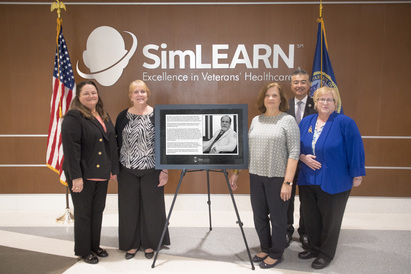
(Left to
right) Mary Fakes, Dr. Janice Jesse, Mary Peterson, Dr. Haru Okuda, and Dr. Lygia
Arcaro stand in front of the plaque for the Dr. Robert L. Jesse Innovation Room
in the lobby of the VHA SimLEARN National Simulation Center. (VA photo by J.D.
Johnson)
By Gerald Sonnenberg
EES Marketing and Communication
ORLANDO,
Fla. – On Feb. 21, staff at the VHA SimLEARN National Simulation Center held
a special room dedication ceremony in honor of the late Principal Deputy Under
Secretary for Health Dr. Robert L. Jesse, who passed away Sept. 2, 2017. Dr.
Jesse was an advocate for the development of a national simulation-based
training program and the building of the National Simulation Center. In
attendance for the Dr. Robert L. Jesse Innovation Room ceremony was his wife Dr.
Janice Jesse, and Dr. Jesse’s sister Mary Peterson, as well as leaders from the
Orlando VA Medical Center (OVAMC).
Dr.
Haru Okuda, SimLEARN national medical director and Patient Care Services
acting deputy chief patient care services officer, opened the event, and
Dr. Carolyn Clancy, VHA executive in charge, offered her remembrances via
teleconference of Dr. Jesse’s long and distinctive career with VA as a
physician and advocate for America’s Veterans.
The room was then dedicated and a plaque unveiled by Dr. Okuda; Dr. Lygia
Arcaro, SimLEARN nursing program director, Office of Nursing Services; and Mary
Fakes, acting deputy chief learning officer, Employee Education System. This
was followed by a benediction by Chaplain Marvin Luckie, OVAMC supervisory
chaplain, and special remarks by Mary Fakes, which closed the ceremony.
The plaque reads in part,
“Dr. Robert L. Jesse, M.D., Ph.D., was a visionary leader within VHA. One of
his greatest legacies as a leader was his ability to encourage others to reach
their potential. He ensured others were recognized and received credit for
their efforts, though he never sought accolades … Upon appointment to the
position of VA Principal Deputy Under Secretary for Health on July 4, 2010, he
continued to advocate and support the SimLEARN National Simulation Program. The
51,000 sq. ft. National Simulation Center was completed in September 2016. The
Robert L. Jesse Innovation Room is dedicated to Dr. Jesse in memory of his
passion, vision, leadership and dedication to our Nation’s Veterans.”
A full image of the plaque is available here.
|
|
|
|
By Gerald Sonnenberg
EES Marketing and Communication
ORLANDO,
Fla. – The VHA
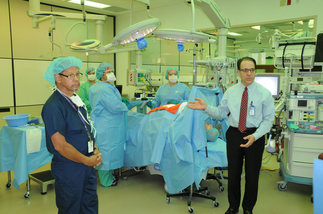
SimLEARN National Simulation Center (NSC) officially opened its new facility
next to the Orlando VA Medical Center (VAMC) in September 2016 with the overall
purpose of improving the care of our Veterans by providing top notch training
to VA providers and clinicians. By the end of fiscal year 2017, staff at the
51,000-square-foot, high-technology advance training center provided training
and simulation orientation to more than 3,400 learners and visitors. Staff also
conducted more than 60 immersive, simulation-based training courses.
SimLEARN’s influence reached beyond its walls to VAMCs around the country resulting in an increase of 17 VHA SimLEARN Certified
Simulation Centers; including 2 advanced, 7 intermediate, and 8 basic
simulation centers. Staff at these facilities are able to provide simulation training
to their local staff once they have obtained the necessary training from the
NSC. In addition, Resuscitation Education Initiative (REdI) staff in Orlando implemented
Resuscitation Quality Improvement training at 41 VAMCs to support maintenance
of competence of advanced cardiovascular life support (ACLS) and basic life
support (BLS) skills. REdI staff also provided HeartCode BLS and voice assisted
mannequin (VAM) training to 107,972 providers and staff throughout the nation,
as well as ACLS and VAM training to another 21,418 VHA providers.
For the rest of the story, click here.
|
|
|
By Gerald Sonnenberg
EES Marketing and Communication
ORLANDO, Fla. – A variety of simulation training courses at the VHA SimLEARN National Simulation Center (NSC) are now available. These courses include:
Introduction to Clinical Simulation Instructor
The available dates for this two-day course are June 12, July 10 and Aug. 7.
Simulation, Technology, Operations, Maintenance, and Practices (STOMP)
The available dates for this three-day course are June 19, July 17 and Aug. 28.
Musculoskeletal (MSK) Clinician Training
The available dates for this two-day course are April 24, July 24, Aug. 21 and Sept. 5.
Fundamental Critical Care Support (FCCS) Training
The available dates for this two-and-a-half day course are April 3 and 17, May 8, June 5, July 17 and 31, and Aug. 14.
Simulations for Clinical Excellence in Nursing Services (SCENS)
The available dates for this four-day course are May 21, June 18, July 23, and Aug. 13 and 27.
Trauma Nursing Core Course (TNCC)
The available dates for this two-and-a-half-day course are June 12, July 10, and Aug. 7.
For details about the courses and how to register, click here.
|

By Yvonne Lin-Chen, RN, MN
and Anisa Young, BSN, MN, MS, AGCNS-BC, CNRN, CRRN
Nurse Educators/Simulation
Lab
VA Puget Sound Health Care
System
SEATTLE
- Autonomic dysreflexia (AD) is a
syndrome that affects an individual with spinal cord injuries at the sixth thoracic
(T6) vertebral level or higher. Most AD cases can be treated and
prevented if the individual or caregiving team is aware of this syndrome,
recognizes the symptoms, understands the causes and implements a treatment
algorithm in a timely manner. If
untreated, it can become a life-threatening medical emergency with uncontrolled
hypertension, as well as lead to severe
complications such as seizures, myocardial infarction, cerebral hemorrhage and death.
The Spinal Cord Injury (SCI) unit at the
VA Puget Sound Health Care System hosts an annual AD competency fair. In 2017, the
unit incorporated simulation into the AD competency fair to achieve the
following goals: promptly promote nursing driven AD protocol; orient new hire
nurses, which includes new graduate nurses, as well as non-SCI experienced
nurses to SCI specific AD management; and create a venue to promote teamwork
among new hires and existing staff.
For the rest of the story, click here.
In this image, the “patient” is experiencing an
autonomic dysreflexia episode. The caregiving team recognized it and carried
out a nursing driven AD protocol such as sitting the patient upright, checking
the bladder and bowel and removing restricted clothing. (Pictured left to right) Zenit Kebede,
nursing assistant; and registered nurses Dhanwant Kaur, Yasmiene Shemdin and Kouassi
Assie. (VA photo by Yvonne Lin-Chen)
|

By Laura Conklin, MSN, RN, CHSE
VA Connecticut Healthcare System
WEST HAVEN, Conn. – Recently, the VA Connecticut Healthcare
System hosted its third annual poverty simulation, “A Day in the Boots
of a Hero.” This interactive, inter-professional simulation was a
collaborative education endeavor between VA Connecticut and Fairfield
University with the objective to increase awareness and sensitivity for our
Veteran population living in poverty.
According to the United States Census Bureau (2014), the official poverty rate was 14.8 percent; more than 46
million people are living in poverty. Living in poverty can affect not
only access to health care, it can also create barriers to making health care a
priority. As Majerol (2017), stated, “Cost can pose a barrier to factors that
allow people to live a healthy lifestyle such as accessing health care and healthy
food. Moreover, people with low socioeconomic status are more likely to live
in areas with higher concentrations of air
pollution. Poverty can cause cumulative disadvantages that can negatively impact health.”
For the rest of the story, click here.
|
By Bill Outlaw
Communications Manager
VHA Office of Patient Care Services
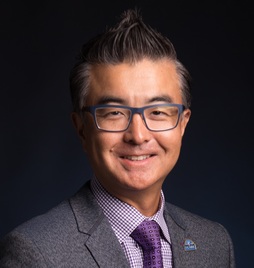
ORLANDO, Fla. – As a child growing up in the Alexandria, Virginia area, Haru Okuda, MD, loved playing the violin. Starting at age seven with the Suzuki Method, he learned early that practice makes perfect. As he developed skills as a violinist, eventually becoming Concertmaster for the Brown University Orchestra, Dr. Okuda realized a concurrent passion in the field of medicine.
His interest in medicine was sparked early in high school, while attending the Thomas Jefferson High School of Science and Technology. Coming from a long family history of physicians, Dr. Okuda knew one day he would have to decide between music and a career in medicine. He chose the medical career path, but realized early on in medical school and his residency that something was wrong with the traditional paradigm of how physicians and health care teams were trained.
For the rest of the story, click here.
|

By Debra A. Bartoshevich, MSN, RN, CEN
Simulation Center Director
Audie L. Murphy VA Hospital
LOS ANGELES – Nurses
Bonnie Haupt, DNP, CHSE, CNL, RN , and Debra Bartoshevich, MSN, RN, CEN, from
the Audie L. Murphy Memorial VA Hospital in San Antonio presented at the
International Meeting for Simulation in Healthcare (IMSH) 2018. IMSH is the world's largest conference for health care
simulation educators, researchers and practitioners and was held Jan. 13-17 in
Los Angeles. The Audie L. Murphy Memorial VA Hospital is part of the
South Texas Veterans Health Care System.
Both of the submitted abstracts, “Infection Prevention using
TeamSTEPPS,” and “Where’s the Brief?; Designing IPE Simulation with the
TeamSTEPPS Frameworks,” were accepted for presentation at the Rapid-Fire
sessions Jan. 15.
For the rest of the story, click here.
(Left to right) Bonnie Haupt, DNP, CHSE, CNL, RN, and Debra Bartoshevich, MSN, RN, CEN, pose for a selfie at IMSH. (VA courtesy photo)
|
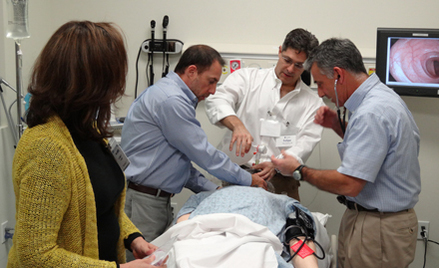
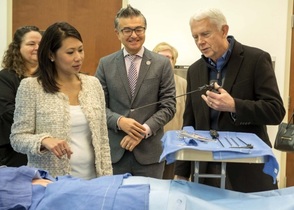 ORLANDO, Fla. - On Jan. 6, the Orlando VA Medical Center hosted U.S. Congressional Representative Stephanie Murphy, from Florida district 7, and Michigan District 1 Representative Jack Bergman. Part of their visit involved a tour and demonstration at the VHA SimLEARN National Simulation Center.
Bergman is a retired U.S. Marine Corps lieutenant general, and he is on the House Veterans Affairs Committee (HVAC). Murphy is a freshman representative on the Defense and National Security committees.
SimLEARN staff provided presentations and a simulation exercise.
In this image, Representative Murphy (front left) and Representative Bergman (far right) are provided a demonstration of some of the capabilities of simulation by Dr. Haru Okuda (center), SimLEARN national medical director, while Mary Fakes, (back left) EES acting deputy chief learning officer, looks on. (VA photo by Michael Strickler)
|
|
|
|
|
|
|