|
|
|
|

By Gerald Sonnenberg
EES Marketing and Communication
ORLANDO,
Fla. – A variety
of simulation training courses at the VHA SimLEARN National Simulation Center
(NSC) and in Palo Alto, California are now available. The scheduled classes go
well into 2018. A full list of courses is available here.
Some of the available
courses are featured below. However, a list of courses available over the next
quarter of fiscal year 2018 is available here.
The Trauma Nursing Core Course (TNCC) teaches registered nurses core level
knowledge and psychomotor skills, which are defined as central or key elements
of the multidimensional processes involved in the initial assessment and
management of sick or injured patients. TNCC also provides a foundation for
integrated communication and collaboration in identifying and treating the sick
or injured. For more information or to register, click
here.
The first Musculoskeletal (MSK) clinician class for
2018 is scheduled for Feb. 21-22. This face-to-face simulation training is
designed to enhance primary care providers’ knowledge, skills and confidence to
manage common musculoskeletal problems. In addition, this training emphasizes
appropriate resource utilization and access to specialty care. For more
information or to register, click here.
The Out of Operating Room Airway Management
(OOORAM) simulation instructor training course has seats available for three
scheduled presentations in 2018. The first is in February. This course combines
didactic, small group and hands-on simulation activities so participants can
develop the skills necessary to design, develop, implement and debrief
simulation-based OOORAM training in their work
centers. For more
information or to register, click here.
Next is a General
Simulation Instructor Course in Palo Alto, California. This course combines
didactic, small group, and hands-on simulation activities led by experts in
health care simulation training. The 2.5 day, face-to-face classes are
intended for both novice and advanced beginner health care simulation educators
across a variety of disciplines including physicians, nurses, respiratory
therapists, pharmacists, and associated health care providers. For more
information or to register, click here.
|
|
|
|
By Leslie Dubow
Associate Director for Educational Gaming
ORLANDO,
Fla. – The VHA’s Goals of Care Conversations game-based learning
module was nominated as a finalist and then chosen as the Best Government Game
Nov. 30 during the 12th annual Serious Games Showcase and Challenge
(SGS&C) at the 2017 Interservice/Industry Training Simulation and Education
Conference (I/ITSEC) here. It was among several other
educational products selected as finalists in the showcase.
Serious games are educational products that employ game
technology in design and development to provide an immersive and engaging
learning experience. The Employee Education System (EES) Educational Gaming
office developed the “Goals of Care Conversations” game-based learning, or
serious game product, this year in support of the VHA Medical Ethics Program
office, physicians and other providers who care for Veterans. This, as well as other
educational products, were selected as finalists in the showcase.
Goals of Care Conversation provides learners with meaningful
opportunities to acquire and practice communication skills needed to conduct
high-quality, goals-of-care conversations with patients who have a serious
illness. The learner practices these skills in an immersive and realistic
environment, with immediate feedback from a virtual mentor to help reinforce
important skills. This virtual training program will help busy clinicians
practice, including the patient and their care givers, in making quality-of-life
decisions with empathy and caring.
The challenge was an international competition that included
learning games from government, industry and academia. Each game was evaluated during two rounds of
evaluation by a team of international game development and educational
professionals. Games were evaluated based on a carefully crafted rubric that
included ensuring the games met stated learning objectives while remaining
interesting and engaging. The finalists were invited to display their games in
Orlando during I/ITSEC in November.
I/ITSEC is the world's largest modeling,
simulation and training conference. As an integral part of I/ITSEC, the
SGS&C incubates and celebrates the use of games and game technology as a
delivery medium for instructional material. The SGS&C is divided into the
following categories: business,
government, student, mobile and innovations. After a rigorous, two-tiered
evaluation, the team chooses the best game in each category.
Aurelio
Maldonado, EES project manager, and Leslie Dubow, EES associate director for
Educational Gaming, led the team that developed the product. They also accepted
the award on behalf of VHA.
|
|
|
By Gerald Sonnenberg
EES Marketing and Communication
ORLANDO, Fla. – VHA staff
train regularly to care for our Veteran patients in VA facilities. It is rare
for staff to be involved in an emergency outside of VA, but it does happen.
That situation happened recently when Phil Hargreaves, director of VHA’s National
Simulation Network, was waiting to board a flight to Washington D.C. at the
Orlando International Airport.
Hargreaves, a registered nurse, who also leads VHA’s Resuscitation Education Initiative (REdI), was nearby when he overheard a call for a doctor to a nearby gate. REdI is a national program to standardize, document, track and monitor the
provision of Advanced Cardiac Life Support (ACLS) and Basic Life Support
(BLS) training throughout VHA.
For the rest of the story, click here.
|
By Catherine Kawaihalau, BSN, RN, Urgent Care Lead Nurse and
Hallry Ho, MSN, RN, Nurse Educator
VA Pacific Islands Health Care System
Spark
M. Matsunaga VA Medical Center
HONOLULU
- The “Code Blue Committee” and nursing education at the VA Pacific
Islands Health Care System (VAPIHCS), Spark M. Matsunaga VA Medical Center
(VAMC), worked collaboratively to create relevant scenarios to enhance individuals
and team performance in emergency medical crisis management. In October, the
hard work came to fruition when the nurse educators conducted two sessions of mock
code training with 24 community living center (CLC) nursing and ancillary staff
using a high-fidelity simulation mannequin the trainees named Georgia.
“Georgia” was borrowed from the Ambulatory Care Center (ACC)
on the Tripler Army Medical Center campus about half a mile away from the
CLC. The staff was excited when Georgia
arrived at the CLC. A familiarization of Georgia was given as staff huddled
around and were amazed with all her “bells and whistles.” Once the simulation
started, staff all took an active part and immersed themselves into the moment.
The verbal and written feedback indicated they truly appreciated the hands-on
experience and requested to have similar training more often.
“I love this training,” said one participant. “We should do this at least every
six months,” said another.
This simulation
experience validated their knowledge and skills, as well as identified areas that
needed improvement as individuals and as a team working in emergency medical
crisis management.
Moving
forward, future mock code training will be virtually extended to remote
community based outpatient clinic staff throughout the Pacific, which includes
all the Hawaiian Islands, Guam and American Samoa. Unannounced mock codes will
be conducted annually in ACC and CLC with more frequent planned sessions to
further increase staff responsiveness.
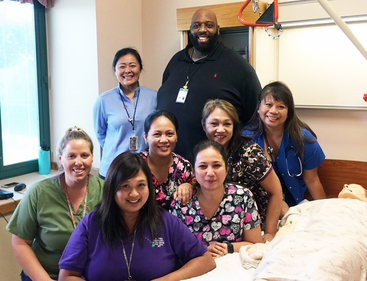
In the photo, (Left to right, top row) Hallry Ho, RN, and Richardo Woolcock, chaplain. (Middle row): Amanda Hiljus, RN; Jingle
Tabayan, LPN; Ruth Javier, RN; and Judy Gilliland, RN. (Bottom row) Lorlyn Dela
Cruz, RN, and Judy Gilliland, RN. (VA photo by
Colette Kon)
|
By David Cochennic, Management Analyst and
Lionel Dacpano, Project Manager
ORLANDO, Fla. – Ten members from the National
Simulation Network’s (NSN) Resuscitation Education Initiative (REdI) team
traveled from Orlando to Washington D.C. to provide the American Heart
Association HeartSaver Cardio Pulmonary Resuscitation Artificial External Defibrillator
and First Aid course to Veterans Affairs Central Office (VACO) non-clinical
staff members.
The team was led by the NSN
Director, Phil Hargreaves, and they came prepared to provide training to over
200 VACO staff. This VACO-required
course was available over a three-day period and offered both full-day and
blended courses. Some of the attendees included the Assistant Secretary of VA’s Office of Human Resources and Administration (HR&A), Peter Shelby and Deputy Assistant Secretary for Administration, HR&A, Roy Hurndon, who both attended the full-day
HeartSaver course.
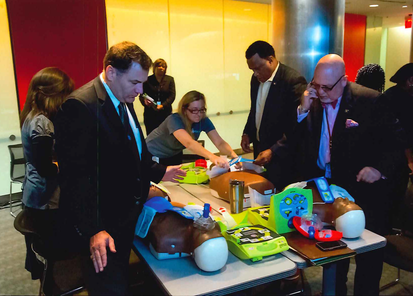
In the photo, Tracey Robilotto (center), REdI associate director, leans in to help a
VA central office staff member with the proper placement of the pads for the Artificial External
Defibrillator or AED. Assistant Secretary for HR&A Peter Shelby is also
pictured (left) practicing the steps with a mannequin. (VA photo by
Dave Cochennic)
|
By Robert Kononowech, M.S., MPH, and Douglas Paull,
M.D., MPH, VA National Center for Patient Safety
ANN ARBOR, Mich. - Incorrect
procedures (wrong site, wrong side, wrong patient, wrong procedure, wrong
implant, etc.), though infrequent, have the potential to cause devastating
consequences to patients, families, providers and health care organizations.
The Joint Commission’s Universal Protocol remains the gold standard in the
prevention of incorrect procedures (Norton, 2008).
An
integral part of the Universal Protocol is conducting a pre-procedure “timeout”
immediately prior to the start of the procedure. The timeout allows staff to
verify the patient’s identity, the procedure to be performed and the procedure
site; it also affords staff the opportunity to certify the informed consent and
review pertinent medical images. However, despite the importance of
pre-procedure timeouts as a patient safety tool and a VHA policy requiring a timeout
before any invasive procedure (VHA, 2013), compliance with timeouts outside the
operating room (OR) has been an ongoing issue (Neily, et al., 2009). This is
due, in part, to a lack of training and awareness of timeout procedure and
policy.
For the rest of the story, click here.
|

ORLANDO, Fla. – SimLEARN staff recently awarded new simulation certifications to qualified facilities. Facility certifications last for two years and are renewable. They are a distinctive accomplishment.
There are three tiers of certification: basic, intermediate and advanced. Congratulation to the facilities listed below on their certifications:
VA Palo Alto Health Care System - Palo Alto, California – Advanced
Louis Stokes Cleveland VA Medical
Center - Cleveland, Ohio – Intermediate
South Texas Veterans Health Care System (Audie L. Murphy VA
Hospital) San Antonio, Texas – Intermediate
Wilkes-Barre VA Medical Center -Wilkes-Barre, Pennsylvania
– Intermediate
Carl Vinson VA Medical Center -
Dublin, Georgia – Basic
James J. Peters VA Medical Center - Bronx, NY – Basic
Marion VA Medical Center - Marion, Illinois – Basic
VA Southern Nevada Healthcare
System - Las Vegas, Nevada – Basic
VA Ann Arbor Healthcare System - Ann Arbor, Michigan – Basic
A facility can request certification after one year of existence while meeting the basic level criteria. A non-binding email of intent and certification application is required. New certification criteria will be announced in
2018. Please contact the team by sending an email to EESFacilitySimulationCertification@va.gov. For a full list of certified simulation centers, click here.
|
 ORLANDO, Fla. - The SimLEARN Hospital Activations Team began testing new VA medical centers (VAMCs) in 2012 to work with local staff and rehearse patient flow, as well as test hospital systems for unanticipated events or situations. To this end, SimLEARN was asked to apply simulation technology to tackle one of the greatest challenges facing medical practitioners and hospital risk managers which is to identify previously unknown clinical issues as VA "stands up" hospitals.
A video about this innovative team is available on two formats: YouTube and Bright Cove.
|
 By Spencer Donovan, Pharm.D.
and Alexander Goldman, Pharm.D.
Interprofessional Fellows in Advanced Clinical Simulation
Providence VA Medical Center
PROVIDENCE, R.I. - The Providence VA Medical Center (PVAMC) simulation center is responsible for the training and certification of many clinical staff members in the provision of Advanced Cardiac Life Support (ACLS). In the center’s hands-on ACLS sessions, numerous physicians and nurses expressed unfamiliarity with the crash cart and its contents, especially those clinicians that were relatively new to practice.
Most of the feedback the center received on the crash cart pertained to the medications included in the cart, as the carts in the facility are always sealed shut when they are not in use.
The ability to quickly obtain and use the correct medication or tool in the crash cart is vital to the successful response to emergent situations and patient outcomes in a resuscitation attempt. To address this need, a 10-minute presentation was developed by the simulation fellows and a University of Rhode Island nursing student to educate clinicians about the uses and locations of all items in the crash carts.
For the rest of the story click here.
|
|
|
|
|
|
|