|
|
|
|
 An image of the VHA SimLEARN National Simulation Center. (VA courtesy photo)
By Gerald Sonnenberg
EES Marketing and Communication
WASHINGTON, D.C. – Five VHA leaders have been singled out for their expertise in
leadership and mentoring in the field of clinical simulation training to earn
the 2016 VA
Under Secretary for Health’s Awards for Excellence in Clinical Simulation
Training, Education and Research. This award program recognizes clinical and
executive leaders in VHA’s clinical simulation who have supported and advanced
VHA’s strategic plan for simulation.
The annual awards were established as a
means of promoting and advancing system-wide progress of VHA goals, objectives
and strategies for the deployment of clinical simulation to improve the quality
of health care Veterans receive.
The
following are the selectees and categories:
- Joe Battle, director of the James A. Haley Veterans
Hospital and Clinics, is the recipient of the Excellence in Clinical Simulation Training, Education and Research
Executive Leadership Award.
-
Steven Howard, M.D., co-director of the VA
Palo Alto Simulation Center in Palo Alto, California is
the recipient of the Excellence in Clinical Simulation Training, Education and
Research Practice Award.
-
Douglas Paull, M.D., MS, FACS, FCCP, CHSE, senior medical officer/deputy director,
National Center for Patient Safety, Ann Arbor, Michigan, is the recipient of the Excellence in
Clinical Simulation Training, Education and Research Champion Award.
-
Sonya Dunn, Resuscitation Education Initiative (REdI) program
director and simulation center director, at the Lexington VA Medical Center
(VAMC) in Kentucky, and Reggie Horwitz, RN-BC, MSN, AGCNS, AGPCNP-BC, NP-C,
CCRN, CEN, REdI
coordinator/critical care nurse educator, at the Durham VAMC in North Carolina,
were both selected as the recipients of the Excellence
in Clinical Simulation Training, Education and Research Champion Award for
REdI.
“Since the inception of the USH Simulation Awards in 2010, we have identified
and recognized VHA staff members who are national and international leaders in
health care simulation,” said Dr. Haru Okuda, SimLEARN national medical
director. “The quality of the recipients from this year continues to
ensure VA maintains its innovativeness and advantage in progressing
simulation-based health care training for the clinical providers in order to
improve Veteran care and contribute to the field of health care simulation.”
For more information about the awards, click here.
|
|
|
|
By Gerald Sonnenberg
EES Marketing and Communication
ORLANDO, Fla. – On Sept. 15, SimLEARN staff at the
Veterans Health Administration’s (VHA) National Simulation Center (NSC) hosted
a Facebook live event during the first Healthcare Simulation Week
Sept. 11-15. The event was organized by the Society for Simulation in
Healthcare (SSH) and was designed to
generate widespread recognition of the role that simulation plays in health care
education and training.
Viewers
were taken on a 360-degree tour of the NSC by Dr. Haru Okuda, SimLEARN national
medical director. They also saw a demonstration of how VHA is preparing
clinical staff to better care for our Veterans, as well as some of the advanced
technology available making this training possible.
The Facebook live broadcast can be seen here on the SSH
Facebook page. Click on the video titled “VHA National Simulation Center Tour.”
“This week recognizes the
ongoing contributions that professionals in health care simulation make to
advancing patient care,” said Jennifer Manos, RN, MSN, MBA, SSH executive
director. “It also raises awareness of health care simulation in communities
throughout the world.”
The VHA NSC provides a high-fidelity
training environment by replicating actual patient treatment areas including an
outpatient clinic setting, as well as an inpatient/hospital setting. More information about the NSC is available here.
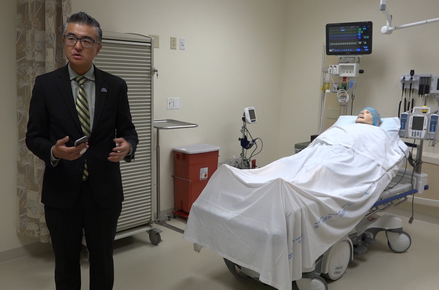
In the photo, Dr. Haru Okuda, SimLEARN national medical
director, talks to viewers of the Facebook live, 360 degree facility tour. In
his right hand is a cell phone which allowed him to answer questions or view
comments in real time from the viewers. (VA photo by Ramon Garcia)
|
|
|
|
ORLANDO, Fla. – The Employee Education System's (EES) Educational Gaming provides serious educational games that use commercial, game-based mechanics, structured play, rules, aesthetics, challenges and game thinking to immerse learners, motivate actions, solve problems and promote learning with formative and summative feedback.
Gaming products focus on improving safety, care and service for Veterans by providing engaging and effective game-based learning opportunities.
A variety of products are available here. Video previews of available products and other training scenarios are available here.
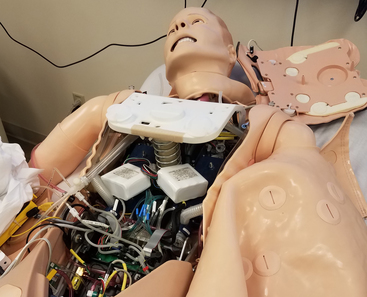 ORLANDO, Fla. - Mannequins used for health care simulation training can help make medical personnel even better at caring for our Veterans. But did you ever wonder what makes them tick? The purpose of the Simulation, Technology, Operations, Maintenance, and Practices (STOMP) course is to train Healthcare Simulation Personnel to operate simulation equipment provided through association with SimLEARN.
SimLEARN designs and delivers medical simulation curricula for use on the appropriate operation of simulation equipment in order to achieve the course objectives. This intensive, 3-day course is designed to give participants the knowledge and hands-on skills to operate, diagnose and repair deficiencies and maintain the technologically advanced health care simulation equipment required to conduct immersive, plausible and immensely valuable medical simulation training.
More about this course and others is available here.
|

By Jutta Novalija, M.D., Ph.D., CHSE, Anesthesiologist,
Director of Milwaukee VA Simulation Program and Tina T. Smith, MS, CHSE, RN-B
Clement
J. Zablocki VA Medical Center
MILWAUKEE – Undergoing surgery and anesthesia is much safer now, and
many practicing physicians and nurses can go through their entire career
without encountering a life-threatening crisis. In preparing for critical
events, simulation is a powerful teaching tool to maintain or further develop
skills and prepare the team to function well when seconds count.
Malignant Hyperthermia (MH) is one of these serious events that
can happen in the operating room (OR). This is a life-threatening complication
if not treated immediately and managed correctly. While extremely rare, some
people have a violent reaction to medications routinely administered during
general anesthesia and develop extremely high body temperature, dangerously
rapid heart rate and breakdown of muscle cells. To prepare for a crisis like
this, the interprofessional operating room team at the Clement J. Zablocki VA Medical
Center here practices regularly with how to respond to a patient presenting MH using
high-fidelity simulation. The curriculum was published, and simulation as a teaching
tool is valued. But, how do you know that the team really learned from these
drills?
Recently,
a patient developed complications at the end of a seemingly routine procedure.
For the rest of the story, click here.
|
ORLANDO, Fla. – A Fundamentals in Critical Care Support (FCCS) class is
coming up Oct. 31 - Nov. 2. The immersive simulation experience delves
into complicated critical care
situations that may be encountered frequently when caring for Veterans.
A
recent class included 11 nurses and 2 pharmacists with varying degrees of
intensive care experience. Dr. Patricio Bruno, associate medical director for
training at SimLEARN, spearheaded the 2.5 day learning experience, along with faculty
Dr. John Barwise, Dr. Donald Kowalewski, and Sherri Shepherd Ph.D., MSN, RN. Simulation
technicians Ivan Rosado and Rick Harper created scenarios so credible that
learners forgot the experiences weren’t real.
According to one student, “The
simulation experience was amazing.” While another said, “What a great learning
experience, I feel much more confident in caring for the critically ill Veteran.”
For
more information, or to register for the upcoming course, click here.
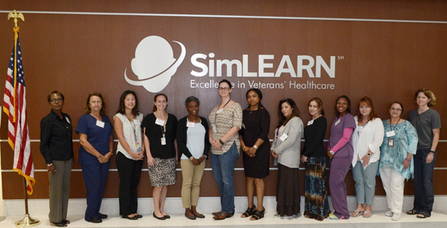
In the photo, (left to right) are recent FCCS class participants: Beverly
Buchanan, Renee Cortez, Kettly Darius, Debra Defreitas-Cook, Lucinda Flaherty,
Brittany Fries, Teresa Geide, Latiffany Jackson, Teresa Landry, Jennifer
Mcguigan, Mirian Onyebueke, Kim Port, and Angela Young. (VA photo by Ramon Garcia)
|

ORLANDO, Fla. –
Two upcoming courses at the VHA SimLEARN National Simulation Center (NSC) still have openings.
The first is the Musculoskeletal (MSK) clinician class Oct. 11-12. This face-to-face simulation training is designed to
enhance primary care providers’ knowledge, skills and confidence to manage
common musculoskeletal problems. In addition, this training emphasizes
appropriate resource utilization and access to specialty care. To register for this class, click here.
The second is an Introduction to Clinical
Simulation Instructor (ICSI) course Oct. 17-19. This course provides a
theoretical foundation for simulation-based training by combining didactic,
small group and hands-on simulation activities. Participants can develop
the skills necessary to design, develop, implement and debrief simulation-based
health care training scenarios in their work centers. To register for this class, click here.
|
By Adrienne Koch, M.Div.
and Marame Gattan, M.D.
Inter-professional
Advanced Fellows in Clinical Simulation 2016-2017
Durham
VA Health Care System
Durham, N.C. – A physician
and a chaplain walk into a patient’s room... This may sound to you like the
beginning of a bad joke, but in our case, it’s the beginning of good practice.
In 2012, a sociologist wrote for the Huffington
Post on “Speaking Different Languages: Physicians
and Chaplains in Health Care.” The author “shadowed
and interviewed physicians and chaplains at large academic hospitals learning
how they see each other and work together.” She found that “while some
physicians — especially those caring for severely-ill patients and their
families — work regularly with chaplains, others do not know who the chaplains
are or how to contact them.”
For the rest of the story, click here.
|
|
|
|
|
|
|