|
|
|
|
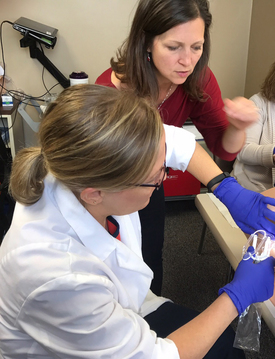
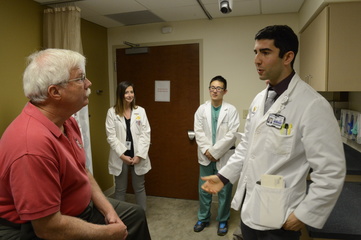
Dr. Aimee
Sanders instructs Nurse Practitioner Karen Kulp (left) on pelvic examinations.
(VA photo by Traci Turner)
By Lionel Dacpano
Program Manager
SimLEARN Resuscitation Education Initiative
GRAND ISLAND, Neb. –
A new SimLEARN Mobile Simulation
Training Team (MSTT) at the VA Nebraska-Western Iowa Health Care System
(NWIHCS) is taking to the roads to conduct simulation training with providers
at all levels across the region. Recently, this SimLEARN MSTT partnered with the VHA Women’s Health
Services and developed a 1-day mini residency for rural providers and nurses.
The event was held in Grand Island on May 2 and again in Norfolk, Nebraska on
May 4.
Typically,
VHA Women’s Health holds a 3-day mini residency conference in Orlando with more
than 200 participants.
SimLEARN MSTT and Women’s Health worked together to
condense this course to accommodate and provide training for providers and
nurses serving in rural community based outpatient clinics (CBOCs) and smaller
VA facilities.
For the rest of the story, please click here.
|
|
|
|
 By Gerald Sonnenberg
EES Marketing and Communication
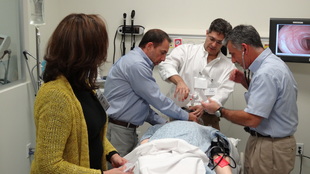
ORLANDO, Fla. – There are two upcoming classes at the VHA Simulation Learning, Education and Research Network (SimLEARN) National Simulation Center for the Out of Operating Room Airway Management or OOORAM. These two-day courses begin on July 25 and Aug. 29.
The purpose of this face-to-face training is to address the gap of qualified clinicians who can facilitate OOORAM training using simulation. This course combines didactic, small group and hands-on simulation activities so participants can develop the skills necessary to design, develop, implement and debrief simulation-based OOORAM training in their work centers. This training targets novice/aspiring and current medical simulation educators, across varied disciplines with a commitment to develop and implement OOORAM simulation-based programs at their home facility, including nurses, physicians, respiratory therapists and educators.
To enroll in the July 25 course, click here. To enroll in the Aug. 29 course, click here.
For more about the courses offered at SimLEARN, click here.
(Above) Clinicians practice on a mannequin during an OOORAM class. (VA courtesy photo)
|
|
|
By David J. Adriansen, Ed.D., NREMT
VISN 23 Simulation Champion
Minneapolis VA Health Care System
MINNEAPOLIS – Veteran Integrated Service Network (VISN) 23 launched an
inaugural Post-Operative Rescue Course (PORC) on April 24 at the University of Nebraska
for 15 fourth-year medical students.
Developed by Dr. Jason Johanning, VISN 23 chief medical officer,
the PORC was designed to focus on mid-level provider responses to
post-operative emergencies in the absence of surgical staff.
During the course, Dr. Doug Paull, with the VA National
Center for Patient Safety, highlighted cases of surgical errors and how to work
toward a culture of safety. This one-day course consisted of minimal lecture
time before a heavy concentration of break-out sessions for targeted simulation
cases. These included responding to a graft disruption with distal disruption;
anaphylaxis after receiving a new medication; and responding to a patient with
a wired jaw and severe nausea and vomiting.
The course was developed by Johanning as
a collaborative effort with Dr. Matthew Goede and Kami Willett, RN, from the Omaha,
Nebraska VA; Katie Phillips, RN, VISN 23 Tele-ICU; and Doctors Lisa Schlitzkus
and Jessica Summers from the University of Nebraska. The course objectives were
to prepare nurse practitioners, physician assistants and hospitalists
confronted with unique post-surgical emergencies through simulation used to
reinforce response training.
Evaluations reflected a positive response to this
inaugural class on surgical safety, and the consensus was that additional
simulation training was desired. Plans are to offer this course within VISN 23
sites before eventually launching this course nationally.
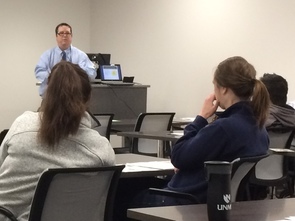
In the photo, Dr. Doug Paull, VA National Center for Patient Safety,
discusses Surgical Safety during a PORC Course in April at the University of
Nebraska. (VA courtesy photo)
|
 By Gerald Sonnenberg
EES Marketing and Communication
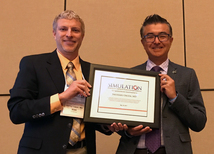
ORLANDO, Fla. – In May, Dr. Haru Okuda, SimLEARN national medical director, received the award for the 2017 Distinguished Educator by the Society for
Academic Emergency Medicine Simulation Academy for his contribution to Emergency
Medicine Graduate Medical Education through the creation of SimWars.
SimWars is a simulation-based competition between teams
of residents that compete in various aspects of patient care focusing on
critical thinking, teamwork and communication in front of a live audience. Originally created for the specialty of
Emergency Medicine in 2007, SimWars has now been reproduced on four continents
(North America, Asia, Europe and Australia). It has also been held at multiple national and
international conferences representing diverse medical societies including
neurocritical care, obstetrics/gynecology and oral maxilla facial surgery. In
2015, SimWars was published into a textbook entitled "SimWars Simulation Case
Book: Emergency Medicine."
Dr. Haru Okuda (right), SimLEARN national medical director, receives the award from Dr. Torrey Laack, chair of the awards committee, Simulation Academy of the
Society for Academic Emergency Medicine. Laack is also co-medical director of the Mayo Clinic Rochester Multidisciplinary Simulation
Center. (VA courtesy photo)
|
 By Gerald Sonnenberg
EES Marketing and Communication
ORLANDO, Fla. – The
VHA SimLEARN National Simulation Center (NSC) partnered with the University of
Central Florida, College of Medicine to host 120, third-year medical students
in May. The purpose of the two-and-a-half-hour training was to involve the students
in follow-up care of geriatric patients through Longitudinal
Curricular Themes (LCT’s) which, according to the UCF College of Medicine
website, “emphasize critical aspects of medicine and medical care that are not
addressed in the basic core curriculum.” The LCTs addressed in this training were
patient safety, medical informatics, geriatrics/palliative care and
ethics/humanities.
The
students were broken up into four groups of 30 students, and then broken into
groups of six. The groups were briefed and sent to five different treatment
rooms. Each room conducted the same scenario.
Each
student had the opportunity to conduct a follow-up assessment of a geriatric
patient following a fall. Standardized patients (actors) had a specific script
to follow which provided the actor’s medical history, their environment and
other factors that would help lead to a possible cause for the falls. Students
also discussed ethical principles in practice and applied value clarification
while constructing the range of preferences for treatment with the patient.
They also had to identify types of medical errors (skill-based,
knowledge-based, rule-based) and determine action plans to correct, mitigate or
prevent the errors. The students were then debriefed on the training.
In the photo, Ali Mozayan, a medical student with the University of Central Florida in Lake Nona, Florida, talks with a standardized patient during training at the VHA SimLEARN National Simulation Center. Note the camera at the top of the image. Cameras throughout the training areas record training and provide immediate visual feedback. (VA photo by Ramon 'Boty' Garcia)
|
 By Beth Perry,
MSN, APRN-BC and
Thomas Oates,
PharmD
Advanced
Clinical Simulation Fellows
Providence VA Medical Center
PROVIDENCE, R.I. – When our fellowship
began, we chose our project topic to be about how Veterans were assessed for Military
Sexual Trauma (MST) here. Interest in this topic arose from being present for a
panel discussion for returning women Veterans speaking candidly about the
difficulties they faced after being discharged from the military. One topic
noted during this discussion pertained to obtaining treatment at the VA for MST.
After reviewing both
the Veterans Integrated Service Network (VISN) 1 and the Providence VA Medical
Center (PVAMC) websites, we found there was ample information regarding MST available
for Veterans, but information regarding the assessment of MST was limited for providers.
For the rest of the story, please click here.
|
|
|
|
|
|
|