|

Fall 2026
(Pre-decisional)
Editor's Note: At the present time, we are limited in distribution to recipients with a “va.gov” email only. If you would like to add or update your contact information, please email us!
|
|
|
ACCENT is a nationwide network of VA researchers and operations partners, fostering collaboration and knowledge diffusion in the areas of Access and Community Care among VA investigators, VA Operational Partners, VISN and VA facility leadership, and VA Health Systems Research to support and inform national priorities for achieving high-quality and timely access to care. ACCENT extends the work initiated by the Community Care Research Evaluation and Knowledge (CREEK) Center and the Veterans Access Research Consortium (VARC).
View the recording of the ACCENT CORE Cyberseminar (held February 12, 2024) Introducing the Access and Community Care Engagement Network Team (ACCENT).
Visit the ACCENT Website!
The ACCENT website has a variety of additional resources including: the Healthcare Access and Community Care Active Projects Inventory; recently published papers; minutes from the Veterans Community Care Operation Partners Call; and information on utilizing community care data captured in the Consolidated Data Set and Program Integrity Tool.
|
|
To subscribe to the quarterly ACCENT CORE newsletter or share content for the newsletter, please email us.
For inquiries specific to data, you can reach out to the ACCENT data team.
|
|
|
ACCENT and Veterans Community Care (VCC) meet on the second Friday of every month from 12:00-12:30 PM EST to share research, deliver operations updates, and discuss network news. To attend these sessions and stay informed, you can email Valerie Marteeny to be added to the calendar invitation. Additionally, if you have research findings or information you would like to present or share as a bulletin, email Kristin Mattocks and/or Valerie Marteeny to secure a spot on the meeting agenda.
At the October 2026 meeting, Veterans Community Care leadership explained that the office is advancing a strategic transformation focused on modernizing data and clinical infrastructure, strengthening care coordination, and implementing value‑based care models to enhance access, quality, and system performance. VCC leadership underscored the need for aligned research partnerships and improved cross‑system coordination as critical enablers of these priorities, particularly for Veterans with complex care needs.
Also at the October 2026 meeting, Dr. Tim Hofer (VA Ann Arbor) presented on “Assessing Quality of VA and Community Cancer Care in the MISSION Era” (IIR 21-024). This cancer care quality research uses national claims data to examine fragmentation, treatment quality measures, and differences across VA, community care, Medicare Fee‑for‑Service, and Medicare Advantage. Current findings highlight variations in chemotherapy, radiation, and end‑of‑life care quality, and note that about one‑third of Veterans receiving VA‑funded major cancer treatment are enrolled in Medicare Advantage plans.
|
|
Mending the Safety Net: Supporting Mental Health Care Following a Positive Suicide Screening
PI: Dr. Jason I. Chen (I01RD000409; start date: January 1, 2026)
National data show the majority of Veterans who die by suicide have encountered VA services in the years prior to their death. Consequently, developing strategies to maintain these Veterans in VHA care may help create additional opportunities for suicide risk identification and treatment. Prior research identified potential systems-level gaps associated with VHA mental health care utilization for Veterans with elevated risk (as identified by suicide risk screening). The current project seeks to evaluate the association between systems-level variables, such as MH care quality and care continuity, and VA and Community Care MH utilization following a positive suicide risk screening utilizing a sequential, explanatory mixed-method approach. In light of changes in the RISK ID algorithm, analyses will be updated once follow-up data are available.
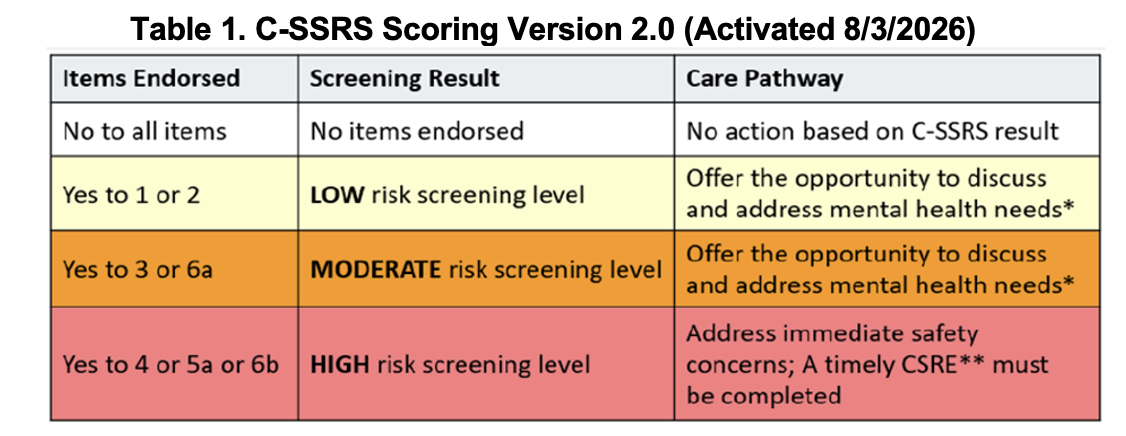
Bottom Line Up Front (BLUF): Estimates based on past VHA suicide screening data suggest large increasesin Veterans identified as potentially needing further MH support, including referrals to Community Care. These will likely impact access to care, such as care coordination and wait times. Primary Care settingswill probably identify more Veterans with elevated suicide risk compared with the prior scoring algorithm because in early August 2026, VHA expanded the threshold for follow-up action needed based on Columbia-Suicide Severity Rating Scale (C-SSRS) responses. Previously, C-SSRS screens were either positive or negative. Now there are four screening outcomes (no items endorsed vs. low, moderate, or high risk; depending on items endorsed; Table 1, below).
Veterans with low and moderate risk results must be offered the opportunity to discuss and address MH needs. For those deemed high risk, staff/providers must address immediate safety concerns and complete/refer for a timely Comprehensive Suicide Risk Evaluation (CSRE).
Using suicide screening data from FY2019-FY2025, we sought to estimate how the new scoring algorithm may impact care pathways. Under the new scoring, our data suggest an up to 4X increase in the number of Veterans who will be identified as needing an opportunity to discuss MH needs. Notably, there will be a larger proportion identified in Primary Care settings (~34% increase). Restricting to those who were deemed moderate or high risk, we estimate a 2X increase in the number of Community Care Mental HealthReferrals and a 2X increase in the number of Veterans having at least one VA MH visit after suicide screening. We are currently awaiting regulatory approval for accessing more granular data on VA Community Care MH utilization.
|
|
Recent Cyberseminars
September 15, 2026
Improving Veterans' Access to Home and Community-Based Services: National Patterns and Facility-Level Approaches
Presenters: Dr. Heather Davila and Dr. Mary Good
Drs. Davila and Good presented qualitative and quantitative findings from a national QUERI-funded evaluation examining Veterans’ access to home‑ and community‑based services that support aging in place. Drawing on interviews with VA staff and national utilization data, they described common access barriers, strategies used to strengthen HCBS coordination, and rural–urban differences in HCBS use across facilities.
For a comprehensive list of all ACCENT CORE and other Cyberseminars, visit the HSR website's Cyberseminars section. You will need VA intranet access to register for all upcoming sessions or to view the archive of previously-held sessions.
|
|
|
Bonilla, A. G., Lov, D., Haderlein, T. P., Jackson, N. J., & Leung, L. B. (2026). Matching Primary Care and Integrated Mental Health Visits by Care Modality and Linkage to Same-Day Services for Veterans. Telemedicine and e-Health. https://pubmed.ncbi.nlm.nih.gov/42615207/
Boykin, D., Romero, L., Parra-Valencia, I., Lee, J., Chen, P. V., True, G., Fortney, J., Hundt, N. E., & Cully, J. A. (2026). Perspectives of Rural and Urban Veterans with Military Sexual Trauma Seeking Psychotherapy Through Community Care: A Qualitative Study. The Journal of Behavioral Health Services & Research. https://pubmed.ncbi.nlm.nih.gov/42562930/
Gould, C. E., Carlson, C., Schultz, S. K., Filips, J., Trivedi, R. B., & Burningham, Z. (2026). Rural and Non-Rural U.S. Veterans Receiving Virtual Geriatric Mental Health Services in the Clinical Resource Hubs. Psychiatric Research and Clinical Practice. https://pubmed.ncbi.nlm.nih.gov/42851643/
Gustavson, A. M., Pomasko, M., Khaldy, N., Mamkhezri, J., Patel, T., Mog, A. C., Merkel, C., Frazier, J., Jungman, J., Havran, M., & Gray, K. E. (2026). Enhancing Rural Veteran Access to Specialty Pelvic Health Rehabilitation Through Mentorship and a Novel Model of Care Coordination. Military Medicine. https://pubmed.ncbi.nlm.nih.gov/42611736/
Harker, K., Howard, T., Smith, B., Pinheiro, S., & Boucher, N. A. (2026). Community Health Workers in the Veterans Administration: Exploring Opportunities and Barriers to Integration for Rural and Caregiver Populations. Medical Care, 64(9), 611–622. https://pubmed.ncbi.nlm.nih.gov/42417485/
Hwang, C. S., Roberts, E. T., Sileanu, F. E., Li, Y., Thorpe, C. T., Mor, M. K., Radomski, T. R., Cashy, J., Schwartz, A. L., Suda, K. J., Schleiden, L. J., Anderson, T. S., Vanneman, M. E., & Gellad, W. F. (2026). Impact of VA-Purchased Community Care on Polypharmacy and Potentially Inappropriate Medication Use in Older Adult Veterans. Health Services Research, 61(4). https://pubmed.ncbi.nlm.nih.gov/42544017/
Jaske, E., Wheat, C. L., Nelson, K., Curtis, I., Wahlberg, L., & Felker, B. (2026). Veterans Affairs Clinical Resource Hub Improve Access to Mental Health Services for Rural Veterans. Telemedicine and e-Health. 32(10), 995–1002. https://pubmed.ncbi.nlm.nih.gov/42273918/
Kim, G. Y., Koh, D. J., Costanza, M., & Tang, G. L. (2026). Veterans Affairs Community Care Vascular Surgery Procedural Costs from 2020 to 2025 Dominated by Infrainguinal Endovascular Interventions. Journal of Vascular Surgery. https://pubmed.ncbi.nlm.nih.gov/42705506/
Kuwonza, F. M., Palani, S., Smith, K., & Pizer, S. D. (2026). Veterans' Urgent Care Use and Subsequent Utilization in the Community. Health Services Research, 61(5). https://pubmed.ncbi.nlm.nih.gov/42683654/
Moghanaki, D., Harpole, D. H., & Kelley, M. J. (2026). Reconsidering Community Care Referrals for Veterans with Lung Cancer. JNCI Cancer Spectrum, 10(4). https://pubmed.ncbi.nlm.nih.gov/42537037/
Rossetti, N. E., Heiden, B. T., Eaton, D. B., Jr, Tohmasi, S., Seyoum, N., Thomas, T., Schoen, M., Brandt, W. S., Malone, S., Yan, Y., Baumann, A., Chang, S. H., Patel, M., Kreisel, D., Nava, R., Meyers, B., Kozower, B., & Puri, V. (2026). Trends in Lung Cancer Survival: Superior Outcomes in US Veterans Compared with the General Population. JNCI Cancer Spectrum, 10(4). https://pubmed.ncbi.nlm.nih.gov/42166749/
|
|
Saffar, D., Rose, L., Gao, Y., Hofer, T. P., Kerr, E. A., Saini, S. D., & Adams, M. A. (2026). Trends in Outpatient Specialty Care Referrals and Specialty Clinic Wait Times in the Veterans Affairs Health System Before and After VA Community Care Expansion. J Gen Intern Med. https://pubmed.ncbi.nlm.nih.gov/42624996/
Schmajuk, G., Wilson, C. R., Nasrallah, C., Hamblin, A., Tarasovsky, G., Li, J., Flynn, B., Williams, A., Chang, E., Richards, J. S., & Ng, B. (2026). Expansion of Access to Rheumatology Care for Rural Veterans: Program Development and Initial Feasibility of the National Tele-Rheumatology Program Using the RE-AIM Framework. J Rural Health 42(3). https://pubmed.ncbi.nlm.nih.gov/42593426/
Shen, Y. J., Auty, S. G., & Griffith, K. N. (2026). Are the Best Worth the Wait? Physician Quality Scores and Access Delays. Health Services Research, 61(4). https://pubmed.ncbi.nlm.nih.gov/42423262/
Shteyler, V. M., Luo, Y., Kuo, A. C., Iannuzzi, J. C., & Whooley, M. A. (2026). Community-Based Surgery and Postoperative Survival Among Veterans Affairs Enrollees. JAMA Network Open, 9(8). https://pubmed.ncbi.nlm.nih.gov/42574014/
Suzuki, H., Vaughan-Sarrazin, M., Ohl, M., Mecham, B., McCoy, K., & Livorsi, D. J. (2026). Changing Patterns of Specialty Care for Diabetic Foot Ulcers Among Rural and Urban Veterans Following the VA MISSION Act. International Wound Journal, 23(9). https://pubmed.ncbi.nlm.nih.gov/42712013/
Suzuki, H., Vaughan-Sarrazin, M., Ohl, M., Mecham, B., McCoy, K., Brennan, M. B., Robbins, J. M., & Livorsi, D. J. (2026). Community Care Consultations for Veterans with Diabetic Foot Ulcers. Am J. Managed Care, 32(9). https://pubmed.ncbi.nlm.nih.gov/42809496/
Vashi, A. A., Rose, L., Urech, T., Buggaveeti, A. E., & Tran, L. D. (2026). Modernizing the Front Door to Care: Evaluation of Veterans Administration Health Connect's Impact on Access, Utilization, and Patient Experience. Health Services Research, 61(4). https://pubmed.ncbi.nlm.nih.gov/42470152/
Vashi, A. A., Tran, L. D., Urech, T., Buggaveeti, A. E., & Rose, L. (2026). Bridging Gaps in Acute Care Access for Rural Veterans: The Reach and Impact of VA's Virtual Emergency and Urgent Care Programs. J Rural Health, 42(3). https://pubmed.ncbi.nlm.nih.gov/42569843/
Williams, L. S., Myers, L. J., Daggy, J., Tang, Q., Kirchgassner, J., Bastin, G., Chagwena, F., Taylor, S., Odrzywolski, K., Nobel, L., Damush, T. M., & Wilkinson, J. R. (2026). Implementation of a Stroke/TIA e-consult Increases Outpatient Stroke Teleneurology Consults Placed in VHA Compared to Community Care. Frontiers in Health Services, 6. https://pubmed.ncbi.nlm.nih.gov/42558720/
Wong, M. S., Steers, W. N., Lind, K. E., & Washington, D. L. (2026). Trade-Offs Between Patient Experience and Health Care Access: Comparing Veterans Health Administration Versus Community Care by Veteran Race and Ethnicity. Medical Care. https://pubmed.ncbi.nlm.nih.gov/42683682/
Zhang, A., Lipsey, D., Figueroa, S., Price, M. E., Nebeker, J., Pan, E. C. R., Griffith, K., & Pizer, S. D. (2026). Veteran Health Information Exchange Volume and 30-day Readmissions, Avoidable Hospitalizations, and In-hospital Mortality: Evidence from Community and Veterans Health Administration Direct Care. J American Medical Informatics Association. https://pubmed.ncbi.nlm.nih.gov/42515823/
|
|
|
|
|