
HERC Spotlight: August 2026
Veterans Health Administration sent this bulletin at 08/18/2026 11:20 AM EDT
Health Economics Spotlight
|
||
In This Issue
|
|||
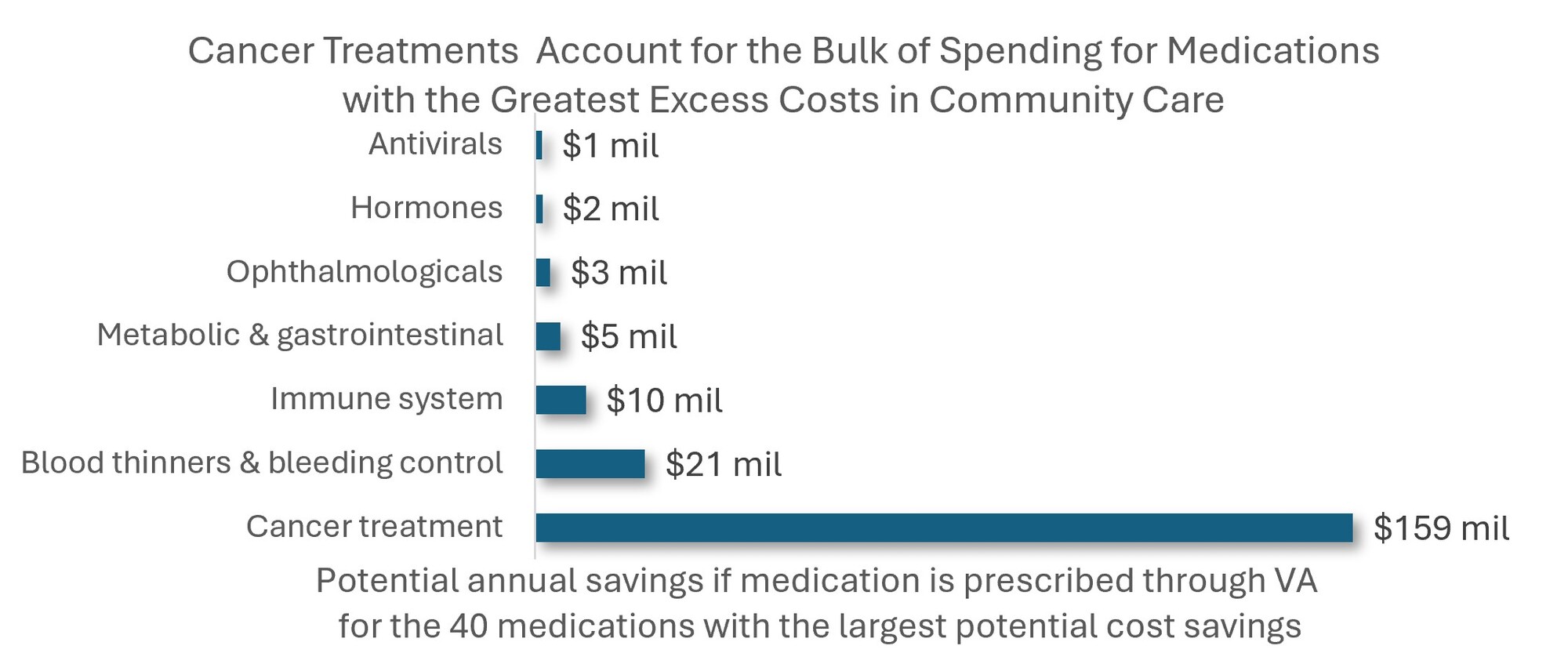
SpotlightHigh-cost medications drive increase in VA pharmacy expenditures under community care expansionVA spent $270 million dollars filling prescriptions through community care, with a small handful of drugs accounting for the bulk of this spending, according to a new analysis from a team of VA investigators. The 2018 MISSION Act expanded access to VA-paid medications from community-based pharmacies, allowing eligible Veterans to receive up to 14 days of medications. While VA pays a negotiated amount for prescriptions through VA pharmacies, when Veterans receive prescriptions through community-based pharmacies, VA pays the billed amount. To understand the economic impact of this prescription expansion, a multidisciplinary team from across VA compared community care pharmacy claims to VA-provided pharmacy claims in FY 2024. They looked at the medications patients were receiving from non-VA pharmacies and the financial impact to VA. The full report is available on the HERC website. In FY 2024, the VA processed payments for 1.44 million community-based prescriptions, spending a total of $348 million. While the median payment was $11, the mean was $276 per prescription, indicating that expensive drugs accounted for a disproportionate share of total spending. For every National Drug Code analyzed, the average VA cost was lower than the average payment made to non-VA pharmacies.
In total, the VA could save $270 million if all medications filled by non-VA pharmacists were instead filled by VA, with high-cost biologics and oncology medications accounting for the bulk of this excess spending. While thousands of drugs were prescribed through community care, only 40 accounted for 74% ($201 million) of the excess costs. The authors note that it may not be possible to distribute all of these medications through VA without limiting access, but they highlight ways the VA can reduce costs without negatively impacting access. Strategies include enhanced utilization management, such as filling brand-name prescriptions and high-cost medications though VA pharmacies when possible, real-time prescription monitoring, and strategic expansion of VA's capacity to deliver high-cost infusions. While it is not practicable to move all high-cost medication to VA pharmacies, future work is needed to investigate which medications could be shifted into VA. Visit the HERC website to view the full report. Wagner, TH, Sessions JK, Bailey AL, Downing GJ. VA Pharmacy Operations Under the VA MISSION Act: An Economic Overview. Technical Report 48. Health Economics Resource Center, VA Palo Alto Health Care System, U.S. Department of Veterans Affairs. May 2026. |
|||
SeminarBeyond the Clinic – The Hidden Work of VA Primary Care CliniciansHERC Health Economics Seminar Wednesday, September 9 at 1pm ET |
|||
Register |
|||
|
|
|||
|
Understanding how much time clinicians spend in the electronic health record (EHR), and what specific activities are conducted, is essential for healthcare systems to manage productivity and protect the workforce from burnout. Using timestamps of activities processed by all primary care clinicians in the VA EHR, our team developed a method for measuring primary care clinician EHR workload. This cyberseminar presents results from a study examining weekly primary care clinical and EHR activities during and outside of clinic hours over time. Intended audience: This seminar may be of interest to researchers, clinic supervisors and directors, and policy makers who are interested in understanding primary care clinician workload. |
|||
ResourcesNosos risk adjustment score is available through FY25Nosos is a VA-specific risk score researchers can use to adjust for risk when making comparisons of treatments or outcomes. It is designed to predict annual costs, and the scores are centered around 1. A value of 1 means that the patient is expected to have costs that are the national average for VA patients. If a patient has a risk score of 2.5, then the patient has an expected cost that is 2.5 times higher than the average VA patient. Nosos builds on the CMS Hierarchical Condition Categories risk adjustment model by including psychiatric comorbidities, medication use, and additional VA-specific items such as priority status. Learn more about Nosos in HERC's Guide to the Nosos Risk Adjustment Score. Nosos risk scores are available through FY25 and are accessible through VINCI for approved research and operations projects. Interested in seeing how other VA researchers have used Nosos risk scores? Select publications are listed below.
|
|||
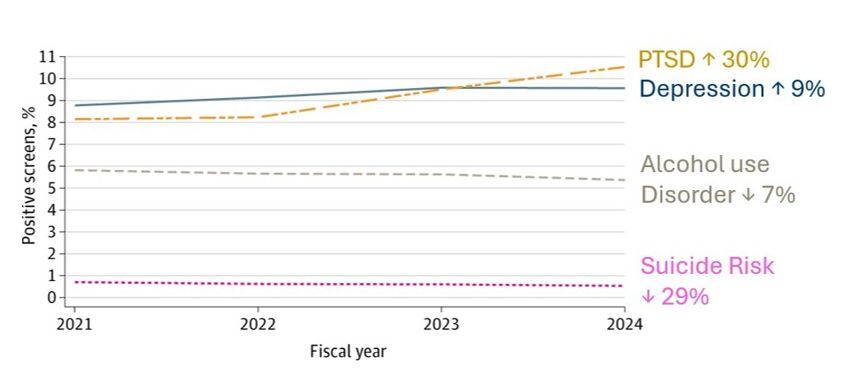
PublicationsPositive suicide risk screens are decreasing among Veterans but positive PTSD screens have increased in recent yearsIn a closed cohort of over 3 million patients continuously enrolled in VA primary care from 2021 to 2024, HERC researchers found that rates of positive screens for PTSD and for depression increased over time, while positive screen rates for suicide risk and alcohol use disorder had slight decreases. Findings emphasize the ongoing need to manage depression and PTSD among veteran patients. VA’s substantial investment in suicide prevention efforts and VA’s uniqueness in conducting routine screens for alcohol use disorder (AUD) may have contributed to the reductions in suicide risk and AUD, but links between VA’s efforts and reductions in risk need to be evaluated. Trends in positive mental health screens, 2021 to 2024 View the full results at JAMA Network Open: |
|||

|
Health Economics Resource Center (HERC) |
 |
 |
 |
||||||||||||||
|
You have received this message because you are subscribed to VA Health Economics Resource Center. Access your Subscriber Preferences to make changes to your subscription or Unsubscribe. Get this as a forward? Sign Up to receive updates from HERC. Please do not reply as this email box is not monitored. To contact HERC please email herc@va.gov. |
||
 |
 |