
HERC Spotlight: May 2026
Veterans Health Administration sent this bulletin at 05/06/2026 11:44 AM EDT
Health Economics Spotlight
|
||
In This Issue |
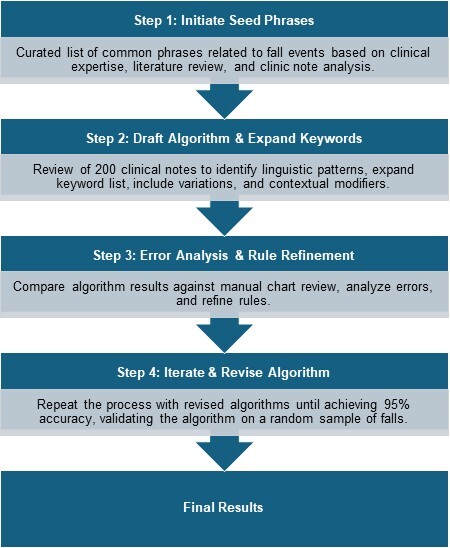
SpotlightA Natural Language Processing Algorithm for Identifying Falls in VA DataFalls are among the most serious and costly adverse events in nursing home care, affecting nearly half of all residents. In VA Community Living Centers, the VHA National Center for Patient Safety requires standardized fall documentation in VistA. However, because these events are only captured in structured clinical notes, researchers seeking to study falls in VA must rely on manual chart abstraction or diagnosis code queries, both of which have significant drawbacks: chart abstraction is resource-intensive and time-consuming, while diagnosis codes are often the least accurate method of fall identification. As a result, many researchers turn instead to the CMS Minimum Data Set (MDS), a federally mandated assessment used in all Medicare- and Medicaid-certified nursing homes. The MDS, however, has its own limitations: it uses a look-back period of up to 90 days, meaning falls can be missed or imprecisely timed, it cannot capture the exact date a fall occurred, and it has been shown to underreport falls relative to the medical record. A team of researchers led by Laura Graham developed a natural language processing (NLP) algorithm to extract fall dates directly from VHA EHR text. This algorithm offers a faster, more precise, and more complete alternative to manual chart abstraction, diagnosis code queries, and MDS-based fall documentation (Figure 1). It is available to VA data users in the VA Git Repository. A new publication in JAMDA describes the development and validation of this NLP algorithm. Findings: Among 38,852 veterans residing in VA CLCs between 2012 and 2024 (12 years), approximately half experienced at least one fall during their nursing home stay. |
|||
|
The NLP algorithm achieved 96% accuracy against manual chart review and identified nearly 61% more falls than were captured by the MDS alone. Critically, the MDS does not capture the exact date of a fall, a limitation that the NLP algorithm directly addresses, finding a median lag time of 17 days between fall EHR documentation and a fall-positive MDS assessment. During algorithm development, the team identified significant variability in documentation practices both across VA facilities and over time, which required the incorporation of facility-specific rules to account for differences in note structure and improve the algorithm's accuracy. Implications for VA Research: These findings have important implications for VA research and operations. Accurate and timely fall documentation affects reimbursement, facility ratings, public reporting, pay-for-performance programs, and quality improvement efforts, all areas of core interest to HERC and the broader VA research community. |
Figure 1. Pipeline for NLP Algorithm Development
|
||
|
The study team is continuing to build on this work by exploring the use of large language models (LLMs) to further improve the algorithm's performance and assessing model performance in different populations outside of the nursing home. Accessing the algorithm: The algorithm is available as a SAS file on the VA Git Repository for anyone interested in using or adapting it, and the authors welcome feedback from the research community. Graham LA, Liu X, Jing B, et al. Using Natural Language Processing to Improve Fall Documentation in VA Nursing Home Residents. J Am Med Dir Assoc. 2026 Apr 29;27(6):106189. |
|||
May SeminarsDaVINCI Military Health System Cost Data: Similarities and Differences with VA Cost Data and Examples in ResearchHERC Health Economics Seminar Wednesday, May 13 at 1pm ET |
|||
|
|
Register |
||
|
|
|||
|
Military Health System databases and cost variables will be presented. Similarities and differences with VA cost data will be explained. Examples in research will be presented. Intended audience: This seminar may be of interest to researchers, providers, and policy makers who are interested in understanding the Military Health System cost data available inside VINCI. |
|||
An Overview of VA Staffing Data SourcesHERC Heath Economics Seminar Wednesday, May 27 at 1pm ET |
|||
|
|
Register |
||
|
|
|||
|
Many operations and research projects require information about VA staffing, such as staffing levels, staff turnover, staffing costs, staff roles, etc. This presentation will describe a variety of VA staffing data sources available through VA’s Corporate Data Warehouse (CDW) and web-based reports. Intended audience: Investigators, project managers, or data analysts with a need to compile or analyze data related to VA staffing. |
|||
ResourcesHERC Discharge Data Updated for FY25FY25 HERC Discharge data is now available on VINCI. The MCA Discharge (DISCH) National Data Extract (NDE) includes information on the entire span of an inpatient hospitalization. It provides the discharge bed section but does not have detailed information on other treating specialties during an inpatient stay. HERC’s Discharge dataset includes the information in the MCA DISCH NDE with additional fields containing cost and length of stay subtotals for each inpatient category of care (e.g., acute medicine, psychiatry, nursing home, etc.). Information about using the data is available in the related guidebook on the HERC website. |
|||
New Resources for Mortality DataThe VHA Data Portal includes two new pages on death-related data:
The VHA Data Portal is a one-stop-shop for VA data users. It includes information on commonly used VA data sources, data access, and resources for using VA data. |
|||
UpdatesJoin the HERC TeamWe are hiring a statistical programmer with strong data science and programming skills and some knowledge about health care. The candidate will prepare and analyze datasets on health care utilization and costs and contribute to scientific papers on health economics. Visit the HERC website to learn more and apply. |
|||
Thank you for Participating in the 2026 Needs AssessmentThank you to everyone who participated in the 2026 needs assessment for VA Office of Research & Development resource centers. Your input is truly valuable to us, and we use the feedback you provide to plan future products and services. If you did not have a chance to participate and would like to provide feedback on our products and services, we welcome feedback at herc@va.gov. |
|||


|
Health Economics Resource Center (HERC) |
 |
 |
 |
||||||||||||||
|
You have received this message because you are subscribed to VA Health Economics Resource Center. Access your Subscriber Preferences to make changes to your subscription or Unsubscribe. Get this as a forward? Sign Up to receive updates from HERC. Please do not reply as this email box is not monitored. To contact HERC please email herc@va.gov. |
||
 |
 |