|
 Winter 2026
(Pre-decisional)
Editor's Note: At the present time, we are limited in distribution to recipients with a “va.gov” email only. If you would like to add or update your email address, please let us know at VHAACCENTCORE@va.gov
|
|
|
ACCENT is a nationwide network of VA researchers and operations partners, fostering collaboration and knowledge diffusion in the areas of Access and Community Care among VA investigators, VA Operational Partners, VISN and VA facility leadership, and VA Health Systems Research to support and inform national priorities for achieving high-quality and timely access to care. ACCENT extends the work initiated by the Community Care Research Evaluation and Knowledge (CREEK) Center and the Veterans Access Research Consortium (VARC).
View the recording of the ACCENT CORE Cyberseminar (held February 12, 2024) Introducing the Access and Community Care Engagement Network Team (ACCENT).
|
|
Interested in receiving the quarterly ACCENT CORE newsletter? Email VHAACCENTCORE@va.gov
New research published or presented at a conference? Please let us know so we can share it with the community in our next newsletter. Email VHAACCENTCORE@va.gov
Email accent.data@va.gov if you have questions for the ACCENT data team.
|
|
Check out the ACCENT CORE Website
Check out the ACCENT website, where you will find funded projects, recently published papers, minutes from monthly calls with the VA Office of Integrated Veteran Care (IVC), information about using community care data captured in the Consolidated Data Set and Program Integrity Tool, and information about current access- and community care-related programs and projects.
|
|
Update to Frequently Asked (Data) Questions
The ACCENT data group has updated the “Frequently Asked (Data) Questions” document. The most notable additions are information about standardized episodes of care (SEOCs) and guidance on how to select claims from the Integrated Veteran Care Consolidated Data Set (IVC_CDS). The updated document can be found on the Information on Specific Community Care Programs and Policies (va.gov) webpage under the Data Documents section.
|
New Documentation on Date Fields in IVC_CDS
In response to requests for guidance in determining which date fields in IVC_CDS to use for data pulls and analysis, The Access and Community Care Engagement Network Team (ACCENT) data group has published “A Guide to Date Fields in the Integrated Veteran Care Consolidated Data Set (IVC_CDS)”. This document extensively describes the date fields found across all tables in IVC_CDS and how they relate to each other. Additionally, discussion about which date fields to use when creating a dataset, along with examples, is included. An analysis of missingness in date fields is also included. The new document can be found on the Information on Specific Community Care Programs and Policies (va.gov) webpage under the Data Documents section.
|
|
Veteran Engagement in Research
Following a successful first year, we are pleased to announce the return of our Veteran and Caregiver Engagement Panel (VCEP) for FY26. If you would like to workshop your access and/or community care related research with a diverse and dedicated group of Veterans and caregivers, please reach out to Kenda.Steffensmeier@va.gov. Meeting opportunities have been filling up quickly!
Additional Veteran Engagement Resources for Researchers
In addition to the ACCENT Veterans and Caregivers Engagement Panel, here are some reminders about other opportunities available for engaging Veterans in research.
 |
|
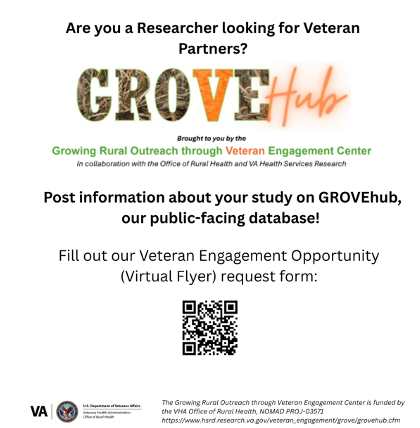
Growing Veteran Engagement (GROVE) Hub
Since 2020, the VHA Office of Rural Health has supported the Growing Rural Outreach through Veteran Engagement (GROVE) Center to promote the collaboration of Veterans and Caregivers through authentic engagement in research and quality improvement projects. Visit the GROVE Hub website to learn more.
|
Overdose Prevention Veteran Engagement Panel
The VHA Pain/Opioid Consortium of Research (Pain/Opioid CORE) and the VHA Office of Mental Health-Substance Use Disorders Program partnered to launch a national, virtual Overdose Prevention Veteran Engagement (VE) Panel. The Overdose Prevention VE Panel began meeting in May 2025 and is a group of 11 Veterans from across the country who have experience with opioid addiction and other drug use harms. They can provide meaningful consultations to VHA investigators at any stage of the research process, where Veterans’ experiences, values, and expertise contribute to research decision-making.
Interested in a consultation studio with the VE Panel about your research study or evaluation project related to preventing or reducing opioid harms? Limited pre-work from the guest investigator/PI is required. Engagement staff will meet with you to help develop key questions or brainstorm ideas for how the VE Panel can provide Veteran-centered feedback for your project. Staff then draft a meeting facilitation guide, invite you to a ‘dry run’ to workshop the guide, facilitate the VEP meeting, and provide you detailed meeting notes. You attend the VE Panel meeting to observe, interact, and ask clarifying questions of the panel.
If you are interested in meeting with the Overdose Prevention VE Panel to discuss your project, please email Tracy.Sides@va.gov to request a consultation or learn more!
Highlighting Current Research
New Project Announcement!
Funder: VA Quality Enhancement Research Initiative (QUERI DSL 24-244)
Title: Establishing a Learning Community to Optimize the Mental Health Care Continuum for Veterans
MPIs: Dr. Christopher Miller, Dr. Sara Landes
Start Date: Preliminary supplement 10/1/24; primary funding 10/1/25
The overall goals of this project are to (1) establish a Learning Community to inform VA efforts to improve Veteran access, quality, and experience of mental health care across direct VA mental health care and VA-purchased mental health care delivered in the community, (2) conduct a needs assessment to integrate data regarding where Veterans are receiving their current mental health care, and (3) Use rigorous quality improvement methods to test and further refine practices for ensuring that Veterans get access to mental health care in the most appropriate setting for them.
In Case You Missed it!
VA Providing Access Choices and Excellence (ACE) Enterprise-Wide Initiative
Pursuant to the Executive Order (EO) 14296 dated May 9, 2025, Keeping Promises to Veterans and Establishing a National Center for Warrior Independence, VA’s Access Choices and Excellence to Veterans (ACE) is spearheading an enterprise-wide initiative to increase excellence of and options for care, benefits, and services for Veterans and reduce appointment wait times.
For more information, see the email from October 3, 2025 (VA intranet link), the full ACE Plan (VA intranet link), or the SharePoint (VA intranet link).
Editor's Note: Currently, all webinar content is available on the VA intranet only.
Check out the most recent ACCENT CORE-related Cyberseminars
 |
|
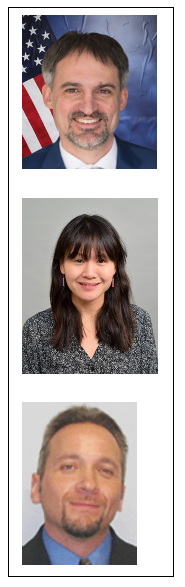
Establishing a Learning Community to Optimize the Mental Health Care Continuum for Veterans
Presenters: Drs. Christopher Miller, Bo Kim, and Jeffrey Smith
The overall goals of this project are to (1) establish a Learning Community to inform VA efforts to improve Veteran access, quality, and experience of mental health care across direct VA mental health care and VA-purchased mental health care delivered in the community, (2) conduct a needs assessment to integrate data regarding where Veterans are receiving their current mental health care, and (3) Use rigorous quality improvement methods to test and further refine practices for ensuring that Veterans get access to mental health care in the most appropriate setting for them. In this session we will present interim findings and plans for an upcoming quality improvement project.
|
10/07/2025
Presenters: Michelle Mengeling (ACCENT mPI), Kenda Steffensmeier (ACCENT VCEP liaison), Tony Pomales (ACCENT VCEP facilitator), Rachel Sears (ACCENT VCEP project coordinator), Kathryn Washington (ACCENT VCEP member; Army Veteran and former medical specialist) and Whitney Butcher (ACCENT VCEP member; Military family member and caregiver)
Session Overview: ACCENT Veteran and Caregiver Engagement Panel team members gave this presentation in HSR’s Cyberseminar series. The session provided a review of ACCENT VCEP and its practices, highlighting the perspectives and personal experiences of its members and their thoughts on how to further promote Veteran and caregiver engagement in VA research.
For a comprehensive listing of past Cyberseminars, see HERE. (You must have access to the VA intranet in order to access all past sessions.)
|
|
|
Rosen, A. K., Beilstein-Wedel, E., Gurewich, D., Davila, H., Shwartz, M. Examining Differences in Wait Times for Primary Care in the Veterans Health Administration (VA) by Race and Ethnicity: What Role Do Within-facility and Between-facility Differences Play? Med Care. 2026 Jan 5. doi: 10.1097/MLR.0000000000002279. Epub ahead of print.
Cotton, J. L., Syed, A., Abbitt, D., Mecum, A., Anigbogu, C., Jones, T. S., Aftab, M., Rove, J. Y., & Jones, E. L. (2025). Cost of veteran coronary artery bypass grafting: Veterans Health Administration versus community care. The Journal of Surgical Research, 315, 145–150. https://doi.org/10.1016/j.jss.2025.09.001
Dorneo, A., Shen, Y.-J., Kabdiyeva, A., Asfaw, D., Garrido, M. M., Pizer, S. D., Rachlin, J., & Mull, H. J. (2025). The impact of community care on spine surgical complexity and outcomes in the Veterans Health Administration. Health Services Research, e70057, e70057. https://doi.org/10.1111/1475-6773.70057
Gray, C., Buggaveeti, A. E., Urech, T., & Vashi, A. (2025). Veteran experiences and satisfaction with Veterans Affairs call centers’ Tele-triage and virtual urgent care appointments: Qualitative evaluation. Journal of Medical Internet Research, 27(v27i7e80656), e80656. https://doi.org/10.2196/80656
Hahn, Z., Naiditch, H., Brucato, M. F., Talisa, V., Tyler, B., Hotchkiss, J. R., Yende, S., McVerry, B. J., & Mayr, F. B. (2025). Post-ICU care trajectories and outcomes among veterans: Comparing VA and community hospital discharges. Chest. https://doi.org/10.1016/j.chest.2025.10.001
Hahn, Z., Naiditch, H., Talisa, V., Tyler, B., Hotchkiss, J. R., McVerry, B. J., Yende, S., & Mayr, F. B. (2025). Intensive care unit admissions purchased or delivered by veterans in the VA Health Care System. JAMA Health Forum, 6(12), e255605. https://doi.org/10.1001/jamahealthforum.2025.5605
Harris, R., Sloane, R., Mucha, M. D., Mason, T., Pearson, M., Gregor, N., Tayade, A., Kidd, B., Sher, K., Jennings, S., Manning, K. M., Allen, J., DeRose, R., Althius, K., McDonald, M., Kopp, T., Wellington, T., Abbate, L. M., & Hall, K. S. (2025). Evaluation of the Gerofit to Home model of care: A remote clinical exercise program for older adults. Journal of the American Geriatrics Society, 701-28. https://doi.org/10.1111/jgs.70128
Kizer KW. Curbing the Growing Fragmentation of Veterans’ Health Care. JAMA Health Forum.2025;6(12):e254148. doi:10.1001/jamahealthforum.2025.4148
Marcotte, L. M., Theis, M., Geyer, J., Sayre, G., Rao, M., Pho, K., Gunnink, E., & Reddy, A. (2025). Rural Veteran perceptions of a virtual health resource center in a community-based setting. Journal of General Internal Medicine. https://doi.org/10.1007/s11606-025-09980-y
Mattocks, K. M., Marteeny, V., Walker, L., Goldstein, K. M., Condon-Perry, S., Berrien, K., Weber, D., Shenette, L. L., Wallace, K., Ayisi, M. A., Sanjay, A., & Kroll-Desrosiers, A. (2025). Examining veterans’, doulas’, and VA maternity care coordinators’ perceptions and experiences with a community-based doula pilot program. Women’s Health Issues, 35 (5), 390–397. https://doi.org/10.1016/j.whi.2025.08.001
|
|
McGowan, M., Rose, D., Bonilla, A., Chawla, N., Stockdale, S. (2025). Mental health leadership perspectives on the value of a national virtual contingency staffing program in the Veterans Health Administration. Administration and Policy in Mental Health. https://doi.org/10.1007/s10488-025-01480-9
Nieser, K. J., Chen, C., Harris, A. H. S., Wagner, T. H., & Schmidt, E. M. (2025). Purchasing versus providing care at the VHA: Quality differences in follow-up after psychiatric hospitalization: Quality differences in follow-up after psychiatric hospitalization. Medical Care. https://doi.org/10.1097/MLR.0000000000002271
Ramachandran, A., Tran, L. D., Asch, S., Boothroyd, D., Justice, A., Davies, L., & Vashi, A. (2025). Emergency department utilization by veterans for low-acuity conditions after virtual care expansion. JAMA Network Open, 8(11), e2545696. https://doi.org/10.1001/jamanetworkopen.2025.45696
Rattray, N. A., Preddie, A. K., Damush, T. M., Martin, H., Baird, S. A., Kirchgassner, J., Chagwena, F., Bastin, G., Myers, L. J., Wilkinson, J., & Williams, L. S. (2025). What facility configurations make a difference in implementing a TeleNeurology program? A mixed methods approach. Translational Behavioral Medicine, 15(1). https://doi.org/10.1093/tbm/ibaf074
Shah, P., Mishra, A., Patel, K., Soltes, T., Ibrahim, K., & Vidovich, M. I. (2026). Veteran voices on the MISSION act: Satisfaction and care preferences following community referral for structural heart disease care. American Heart Journal, 292(107297), 107297. https://doi.org/10.1016/j.ahj.2025.107297
Shen, Y.-J., Thorsness, R., & Pizer, S. D. (2025). Does fee-for-service payment increase visits and improve quality among veterans with heart failure? A retrospective cohort analysis. Journal of General Internal Medicine. https://doi.org/10.1007/s11606-025-10084-w
Turvey, C., Suiter, N., Fellows, R., Domeyer, S., Fuhrmeister, L., Heeren, A., McCoy, K., & Howren, M. B. (2025). Developing a community of practice to provide care coordination and address health-related social needs for veterans receiving care in community-based settings: Program development and survey study. JMIR Formative Research, 9, e80654. https://doi.org/10.2196/80654
Vashi AA, Urech T, Wu S, Asch S. Fragmented Financing in Emergency Department Use Among US Veterans. JAMA Health Forum.2025;6(12):e255635. doi:10.1001/jamahealthforum.2025.5635
Vashi AA, Asch SM, Urech T, Wu S, Tran LD. Factors Associated With Veterans Use of Community vs VA Emergency Departments. JAMA Netw Open.2025;8(12):e2543062. doi:10.1001/jamanetworkopen.2025.43062
|
|
|
|
|