|
|
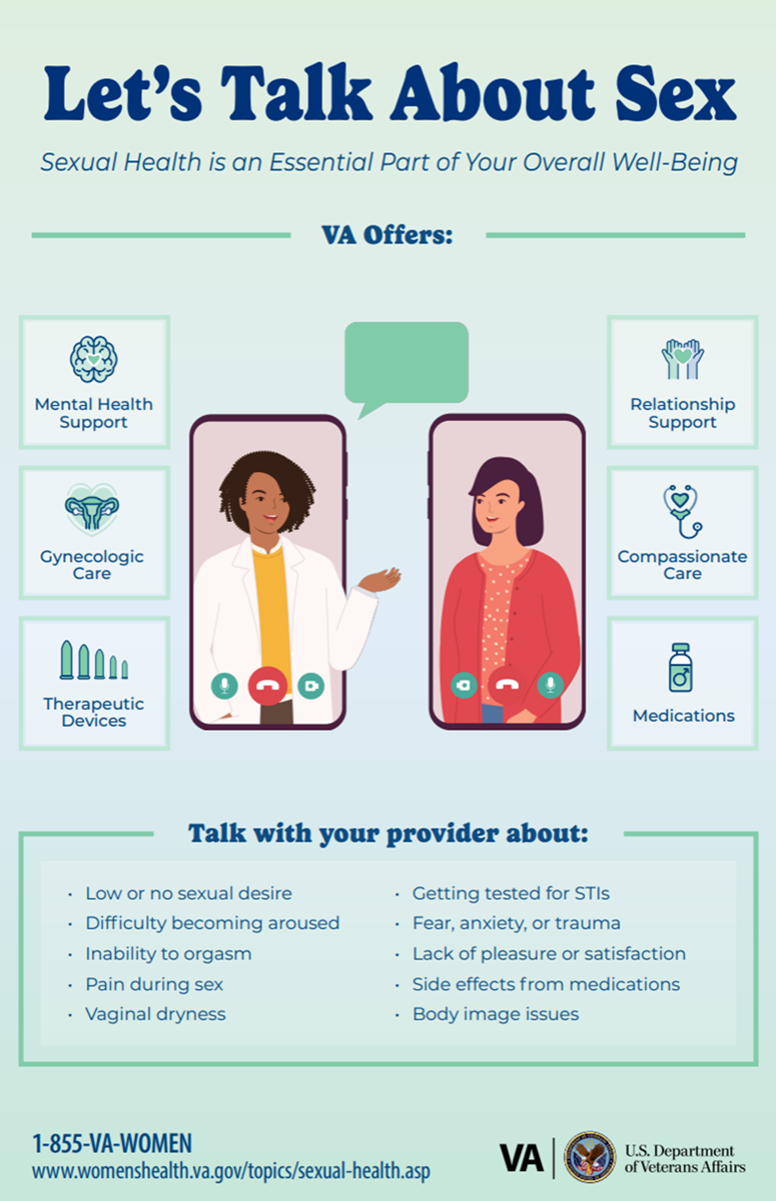
Sexual health is an important part of a woman’s overall well-being. For many women Veterans, concerns related to intimacy, desire, or physical comfort may feel difficult to talk about. You are not alone. These concerns are common, valid, and treatable. VA is committed to providing safe, respectful, and personalized care that supports every part of your health, including your sexual health.
Many factors can affect sexual well-being. These may include hormonal changes, medications, chronic pain, trauma, mobility challenges, emotional health, or body image concerns. No matter what you are experiencing, VA providers are here to help with care tailored specifically for women Veterans.
Sexual health concerns are common and treatable
It is not unusual for women to notice changes in sexual desire or function. These concerns can happen at any point in life and may be related to age, menopause, injury, stress, or past trauma. The important thing to remember is that support is available.
Common concerns include:
- Low or no sexual desire
- Difficulty becoming aroused
- Inability to orgasm
- Pain during sex
- Vaginal dryness
- Lack of sexual pleasure or satisfaction
- Pelvic floor muscle problems
- Anxiety or trauma responses during intimacy
- Side effects from medications
- Body image issues that affect confidence
|
|
|
Support for your relationships and emotional well-being
Relationships can be a vital source of connection and strength, but they can also be affected by stress, trauma, or changes in health. VA offers support to help women Veterans strengthen their relationships, whether with a partner, family member, or close friend.
If you’re navigating challenges related to intimacy, communication, trust, or emotional closeness, VA provides counseling services, couples therapy, and mental health resources designed with your unique experiences in mind.
Start with a conversation: Your VA provider can guide your next steps
If you are experiencing concerns about your sexual health, a good place to begin is by talking with your VA primary care provider. They can help you understand your options and connect you with the right services and specialists.
Every woman Veteran deserves care that honors your full well-being, including your sexual health.
|
|
|
Support and resources just for you
Women Veterans Call Center: Call or text 1-855-VA-WOMEN (1-855-829-6636) to speak with trained representatives who can help you access services and resources, many of whom are women Veterans themselves.
VA Women’s Health website: Visit www.womenshealth.va.gov/topics/sexual-health.asp to learn more about available sexual health services and additional resources.
You don’t have to navigate this alone
Taking care of your sexual health is a vital part of your overall wellness. Whether you are managing discomfort or searching for answers, VA is here to support you with expert care and understanding. You deserve to feel heard, supported, and empowered in every part of your health journey.
|
|
|
The Department of Veteran Affairs (VA) Caregiver Support Program (CSP) offers clinical services to caregivers of eligible and covered Veterans enrolled in the VA health care system. The program’s mission is to promote the health and well-being of family caregivers who care for our Nation’s Veterans, through education, resources, support, and services. Find Your Local Caregiver Support Team located at every VA facility .
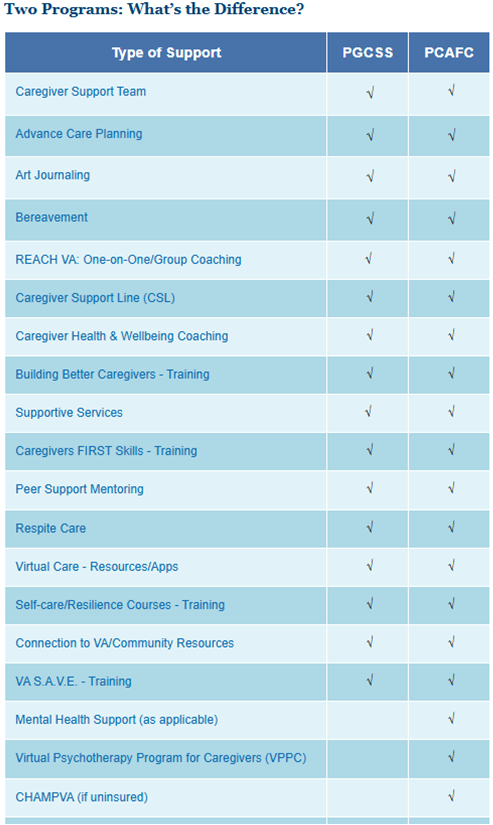
The Caregiver Support Program is comprised of 2 separate programs;
Program of General Caregiver Support Services (PGCSS)
And
Program of Comprehensive Assistance for Family Caregivers (PCAFC)
- What is the Program of General Caregiver Support Services? (PGCSS)
PGCSS is the core of VA’s Caregiver Support Program (CSP). The program provides peer support mentoring, skills training, coaching, telephone support, online programs, and referrals to available resources to caregivers of Veterans. The Veteran must be enrolled in Department of Veterans Affairs (VA) health care and be receiving assistance from a caregiver in order for the caregiver to
participate.
· What is the Program of Comprehensive Assistance for Family Caregivers? (PCAFC)
PCAFC offers enhanced clinical support and services for caregivers of eligible Veterans who have a serious injury (or illness) and require in-person personal care services among other requirements.
|
|
|
What’s Important to Know?
To feel better and improve your health, you can:
- Avoid inactivity
- Move more every day
Being active can lower the risk of:
- Depression
- Type 2 diabetes
- Heart disease
- High blood pressure
- Obesity
- Stroke
- 8 types of cancer
Being active may:
- Reduce the risk of weight gain, dementia, and falls
- Improve bone health and endurance
- Help you feel more energetic
Anything that gets the body moving counts as physical activity. It can be moderate intensity, when you can talk while being active, or it can be vigorous intensity, when you can only say a few words without taking a breath. Choose activities that you enjoy. Start at a comfortable level and gradually increase the intensity
Any amount of activity is better than none. Aim for at least 2½ hours of moderate-intensity or 1¼ hours of vigorous-intensity aerobic activity each week, or a combination of both.
Do strength activities at least twice each week using muscles from all parts of your body—the legs, hips, back, chest, abdomen, shoulders, and arms. Stretching regularly can improve flexibility, joint motion, circulation, and help relieve stress. Being active is safe for almost everyone, and its health benefits far outweigh the risks. If you have symptoms such as chest pain or pressure, dizziness, or joint pain, or are concerned about a chronic condition, talk to your health care team before increasing activity.
Want to Know More? To learn more about being active, or making a healthy living change, talk with your VA health care team. You can find additional information and resources at VA’s Prevention website using the QR code or the link below:
|
|
DIY Minestrone Soup
Ingredients
- 1 tbsp olive oil
- 1 small onion (about 1/2 cup chopped)
- 2 medium carrots, sliced
- 1 stalk celery, sliced
- 1 clove garlic (or 1 tsp garlic flakes)
- 1 tbsp pot herbs, or substitute with a combination of thyme, parsley, and bay leaves
- 1 (14.5-ounce) can reduced-sodium chicken broth (about 2 cups)]
- 1 (14.5-ounce) can no-salt-added diced tomatoes, plus 1 can of water
- 1 (19-ounce) can no-salt-added cannellini (white kidney) or other beans, drained and rinsed
- 1/2 cup frozen peas
- 1 cup cooked elbow macaroni
Directions
In a large pot, heat olive oil over medium-high heat. Add onion, carrots, celery, garlic, and pot herbs. Cook, stirring just until onions look slightly wilted. Add chicken broth, tomatoes, water, and beans. Bring just to a boil, then reduce heat to low and simmer about 10 minutes or until carrots are tender. Add frozen peas and macaroni to hot soup and serve.
Pear and Quinoa Salad
Ingredients
- 2 cups cooked quinoa (red provides more color)
- 2 cups chopped pear
- 2 stalks celery, chopped
- 1/4 cup golden raisins
- 1/4 cup sliced almonds
- 1/4 cup raspberry vinaigrette
- 4 romaine lettuce leaves
Directions
Mix all ingredients, except lettuce, in a medium bowl. Spoon mixture onto lettuce leaves. Serve at room temperature or chilled.
|
|
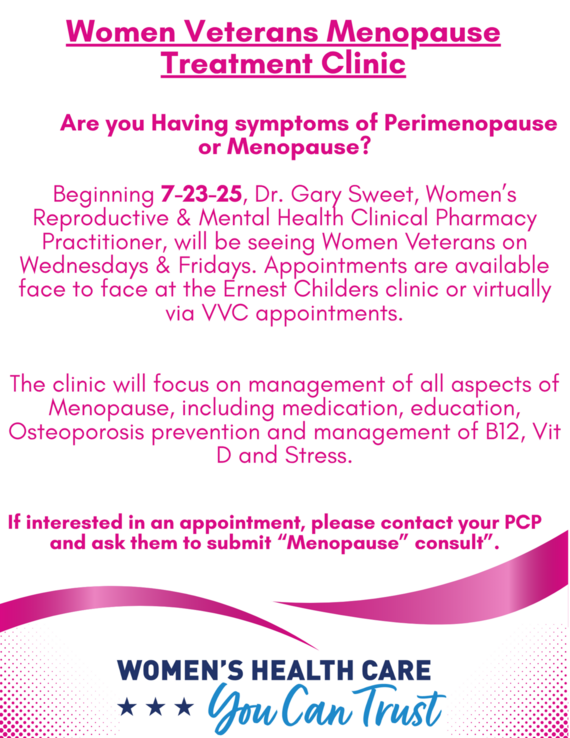
Women Veterans Menopause Treatment Clinic
Eastern Oklahoma VA Health Care System is excited to announce new Menopause related care for our Women Veterans!
Starting on July 23rd we will offer a menopause clinic to help those with various menopause symptoms.
Are you having symptoms of perimenopause or menopause?
Starting July 23, 2025, Dr. Gary Sweet, Women's Reproductive & Mental Health Clinical Pharmacy Practitioner will be seeing Women Veterans on Wednesdays and Fridays. Appointments are available face to face at Ernest Childers Clinic or virtually via VVC appointments.
The clinic will focus on management of all aspects of menopause, including medication, education, osteoporosis prevention, and management of B12, Vitamin D and stress.
If you're interested in an appointment, please contact your PCP and ask them to submit "Menopause Consult".
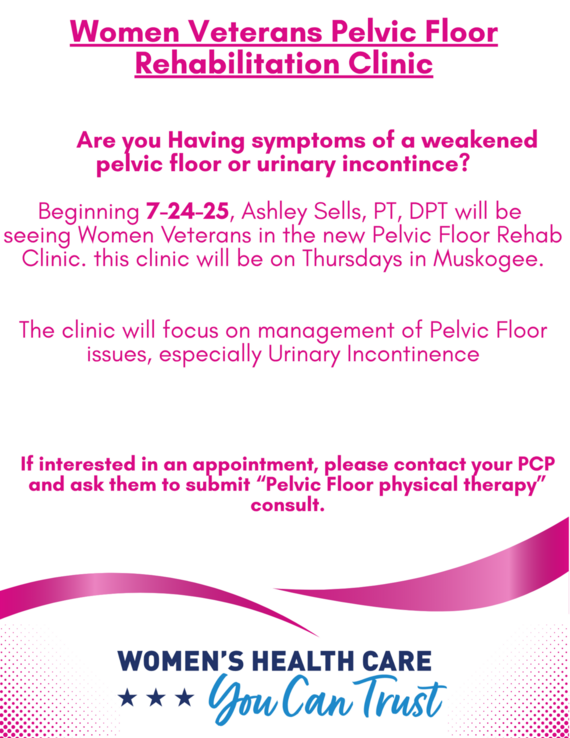
Women Veterans Pelvic Floor Rehabilitation Clinic
July 24th Eastern Oklahoma VA will be starting a Pelvic floor Physical Therapy clinic on Thursdays in Muskogee.
New state of the art pelvic floor Ultrasound equipment has been purchased and we are excited to offer this service to our Women Veterans as non surgical alternative to treat urinary incontinence.
Ask your PCP if this service could be right for you!
Are you having symptoms of a weakened pelvic floor or urinary incontinence?
Starting July 24, 2025, Ashley Sells, PT, DPT will be seeing Women Veterans in the new pelvic floor rehab clinic. This clinic will be on Thursdays in Muskogee.
The clinic will focus on management of pelvic floor issues, especially urinary incontinence.
If you're interested in an appointment, please contact your PCP and ask them to submit "Pelvic Floor Physical Therapy Consult".
|
|
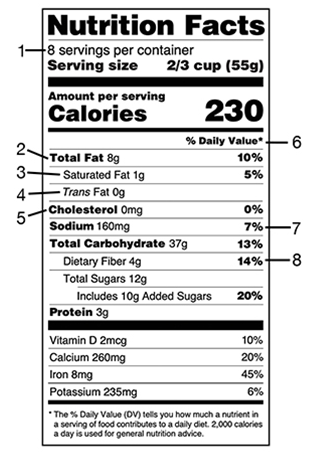
Look for the Nutrition Facts label on packaged foods. Reading labels is a big step toward eating healthier. The tips below help you know what to look for.
KNOW THE NUMBERS!
|
|
|
1. Servings. Read this closely because the package, jar, or can may contain more than 1 serving. This is how to measure 1 serving of the food in the package. If you eat more than 1 serving, you get more of everything on the label — including fat, cholesterol, and calories.
2. Total fat. This tells you how many grams (g) of fat are in 1 serving. Fat is high in calories.
3. Saturated fat. This tells you how much saturated fat is in 1 serving. Saturated fat raises your cholesterol the most. Look for foods that have little or no saturated fat.
4. Trans fat. This tells you how much trans fat is in 1 serving. Even a small amount of trans fat can harm your health. Choose foods that have no trans fat.
5. Cholesterol. This tells you how much cholesterol is in 1 serving. For many years, it was recommended to eat less than 300 milligrams (mg) of cholesterol a day. New guidelines have removed this limitation. That's because dietary cholesterol has been shown to not raise blood cholesterol levels as much as once thought. But many foods high in cholesterol are also high in saturated fat. It is recommended to limit saturated fat in your diet.
6. % Daily value. The higher the number, the more 1 serving has of that nutrient. Look for foods that have low numbers for added sugars, total fat, saturated fat, and sodium. Foods that are higher in fiber, vitamins, and minerals (such as iron and calcium) are good choices.
7. Sodium. This tells you how much salt is in 1 serving. Choose foods with low numbers for sodium.
8. Dietary fiber. This number tells you how much fiber is in 1 serving. Foods that are high in fiber can help you feel full. They can also be good for your heart and digestion. The recommended daily amount of fiber is 25 grams for women and 38 grams for men. After age 50, your daily fiber needs drop to 21 grams for women and 30 grams for men.
Limit the amount of added sugars, fat, saturated fat, trans fat, and sodium. Eating too much of these may increase your risk of certain chronic diseases like some cancers, heart disease, and high blood pressure.
|
|
Women Veterans Deserve Respect
VA promises to be a safe place to receive care.
Nationwide, 81% of women in the U.S. report experiencing some form of harassment or assault in their lifetime (compared to 43% of men). A recent women Veteran study found that some women have reported being harassed while on VA grounds, a place where all Veterans deserve respectful and safe care.
These experiences send a negative message to the Veterans VA serves. For women Veterans, harassment in a health care setting can bring up earlier military sexual trauma. This is not acceptable.
What Harassment Looks Like
For women Veterans, harassment can take many forms, including:
- Being called inappropriate names like “sweetheart” or “baby”
- Enduring catcalling, staring, or leering
- Receiving intrusive questions such as, “Are you single?”
- Being told, “You don’t look like you belong here.”
- Getting unwanted comments about appearance or clothing
- Experiencing invasive actions like being touched, followed, or photographed without permission
- Being repeatedly referred to as Mister when called for appointments
These behaviors aren’t just uncomfortable; they can also remind the Veteran of past traumatic experiences. Some Veterans may avoid, miss, or delay important health care appointments as a result.
What VA Is Doing and What You Can Do
VA is actively working to eliminate all forms of harassment in its facilities. Here's how:
Zero-tolerance policy: No form of harassment is acceptable. Ever.
Ongoing education: Staff, patients, and visitors are learning to identify and intervene in harassment through public messaging and training.
Support systems: Veterans can report harassment anonymously and receive follow-up support, counseling, and investigation.
If you see or experience harassment at a VA facility, report it.
There are several ways you can report harassment, including the following:
|
|
 Suicide is Preventable and Support is Available
Suicide has no single cause and no one approach can end it—but prevention is possible, especially when women Veterans find support before a crisis happens.
Women Veterans may have unique experiences related to military service, health and wellbeing, or trauma that can increase the risk of suicide. Some also face medical and social issues that affect relationships and quality of life. Military service can lead to readjustment issues, posttraumatic stress disorder (PTSD), trouble sleeping, or even physical injury. Additionally, reproductive health conditions that women Veterans sometimes face may take a toll on their mental health.
VA is committed to offering a growing range of resources and a network of support for all women Veterans, including those who do not, and may never, seek care within the VA health care system. Whether it's mental health care or treatment for chronic pain or other health concerns, VA can provide personalized, gender-tailored care to help women Veterans. Each VA medical center also has a Suicide Prevention Coordinator to connect women Veterans to counseling and services.
Additionally, creating a safety plan now, by identifying coping strategies and sources of support, can help give suicidal thoughts time to decrease and become more manageable in a future crisis. Download the VA Safety Plan app or create one together with your VA health care team.
The Veterans Crisis Line is free, confidential, and available 24/7. You don't have to be enrolled in VA benefits or health care to connect. Veterans, family, and friends can reach out. Dial 988 and press 1, text 828255, or chat online. Visit the VA Women’s Health suicide prevention page for more resources.
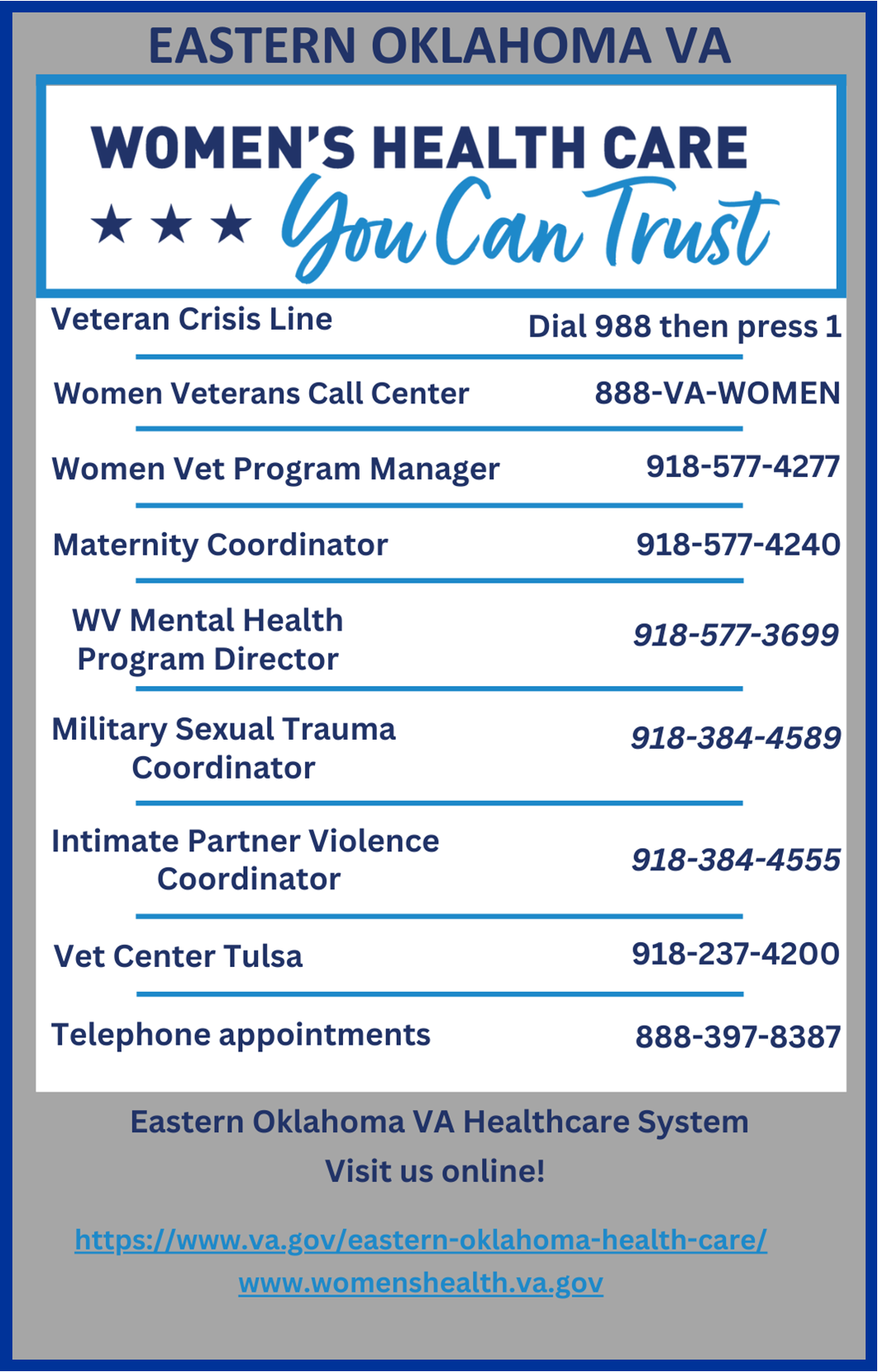
Call 1-855-VA-WOMEN (1-855-829-6636) to speak to a real person and connect to VA women’s health care.
|
|
|
Come to our New Veteran Orientation Held Monthly at Ernest Childers Outpatient Clinic in Tulsa
Are you new to VA health care? Are you a current VA patient, but want to learn more about what services and benefits VA has to offer and how to obtain them?
Join Us For New Veteran Orientation
When: The 2nd Thursday of every month
Where: Ernest Childers VA Clinic 8921 S. Mingo Rd. Tulsa, OK 74113 2nd floor, Rooms 2008 - 2010 (across from optometry)
Time: 1:00 p.m.
Open to all Veterans, family members, caregivers, and community partners.
- Meet representatives from various departments within the VA
- Learn about the processes for getting things done at the VA
- Learn about and sign up for My HealtheVet
- Question and answer session
|
|
|
Click to edit this placeholder text.
Interested in past issues of the Eastern Oklahoma VA Women Veterans Newsletter?
Scan the OR Code below or click the button link
|
|
|
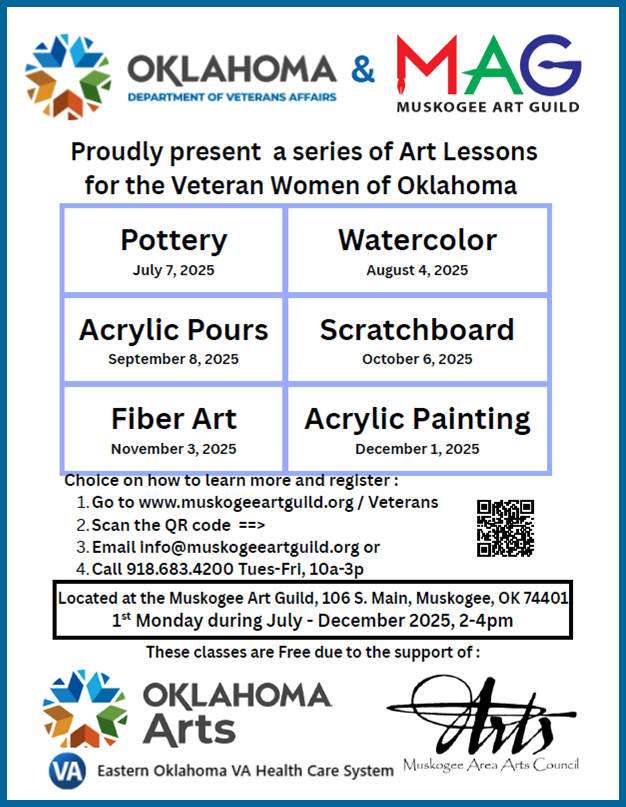
Oklahoma Arts Council, Muskogee Area Arts Council, OK Department of Veterans Affairs – Women's division proudly present a series of art lessons for the Veteran women of Oklahoma.
Get your creativity on!!!
July thru December on the first Monday of the month at the Muskogee Art Guild.
-
Acrylic Pours: September 8, 2025
-
Scratchboard: October 6, 2025
-
Fiber Art: November 3, 2025
-
Acrylic Painting: December 1, 2025
|
|
|
|
|