
Women Veterans Monthly Newsletter - May 2025
Veterans Health Administration sent this bulletin at 05/01/2025 11:00 AM EDT
WOMEN VETERANS HEALTH CARE |
|
|
Eastern Oklahoma VA Health Care System |
|
Women Veterans Program Newsletter
|
Your Maternity Care Coordinator |
|
|
Maternity Care Coordinators will help you navigate and access maternity care within and outside VAPregnant women Veterans: Every VA facility has a Maternity Care Coordinator ready to support you, provide health screenings, and ensure you have access to needed education, resources, and supplies throughout your pregnancy and the year afterward. Maternity Care Coordinators understand the unique needs of women Veterans, and having one at your side means you’ve got an advocate to ensure you and your baby receive the best care. What is a Maternity Care Coordinator? For pregnant Veterans choosing to use VA Maternity Care benefits, a Maternity Care Coordinator is a member of your VA health care team who specializes in helping you navigate your maternity care. Maternity Care Coordinators are uniquely trained to support you. They have a deep understanding of both Veteran needs and maternal care, ensuring you receive trusted, specialized health support. The Support You Need Your Maternity Care Coordinator will contact you every trimester of pregnancy, after delivery, and quarterly in the year after delivery. During these eight calls, your Maternity Care Coordinator will make sure you get the care you need by helping you:
Regular calls with your Maternity Care Coordinator ensure essential health screenings are completed and follow-up for medical conditions (such as gestational diabetes and high blood pressure) is coordinated. Your Maternity Care Coordinator will also discuss risk factors, birth spacing, family planning options, and baby safety, provide educational resources, and refer you for additional care as needed. How to Get Started Whether it’s your first pregnancy or you’re adding to your family, your Maternity Care Coordinator is in your corner, ready to provide guidance, resources, and compassionate care. You don’t have to navigate the system alone—VA is here for you and your growing family. Contact your VA health care provider or your local Women Veterans Program Manager to connect with your Maternity Care Coordinator. We are here to ensure you have the support and resources you need. Learn more by visiting the VA Women’s Health Maternity Care page. |
|
|
|
Are you a pregnant Veteran using VA maternity benefits? VA can connect you with a maternity care coordinator who will provide support throughout your pregnancy and the year after. Periodic calls are a key benefit, providing you with personalized guidance, health check-ins, answers to your questions and timely resources. Your maternity care coordinator helps keep you on track. |


Make a Safety Plan |
|
|
|
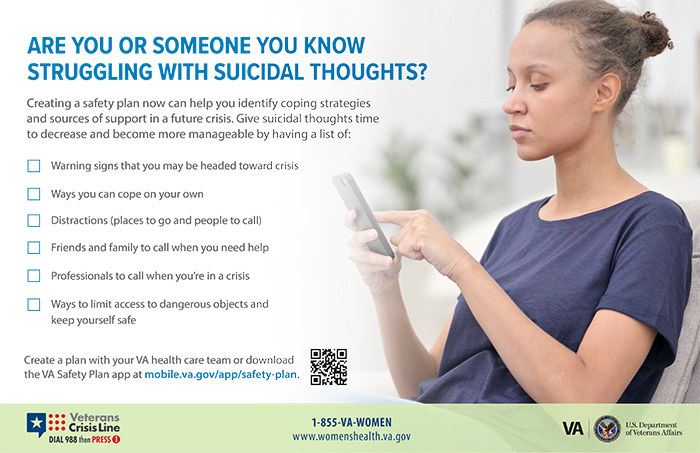
Suicide has no single cause and no one approach can end it—but prevention is possible, especially when support is found before a crisis happens. Women Veterans may have unique experiences related to military service, health and wellbeing, or trauma that can increase the risk of suicide. Some also face medical and social issues that affect their relationships and quality of life. Whether it's mental health care or treatment for chronic pain or other health concerns, VA can provide personalized, gender-tailored care to help women Veterans. Additionally, creating a safety plan now can help give suicidal thoughts time to decrease and become more manageable in a future crisis. A safety plan is a written list of coping strategies and sources of support that at-risk Veterans can use before or during a suicidal crisis. Download the VA Safety Plan app or create one together with your VA health care team. Visit the VA Women’s Health suicide prevention page for more resources, if you're in crisis. VA Safety PlanWomen Veterans should create a safety plan now, by identifying coping strategies and sources of support, to help give suicidal thoughts time to decrease and become more manageable in a future crisis. Learn more. Download the VA Safety Plan app or create a plan together with your VA health care team. While the Safety Plan app can be used on its own, creating the plan with a mental health provider can be helpful. The app is not intended to replace professional care. It is important to create the safety plan when you’re not in distress, so you can think clearly and have time to complete the steps. The safety plan includes listing six key components:
Once a safety plan is created, you can identify your reasons to live and explore more tools to help you cope. dial 988 and press 1, text 828255, or chat online. |
Veterans Crisis Line |
||
|
||
|
|
Compassionate Care for Pregnancy Loss |
|
|
You Have Support from VA, Including:
Every form of pregnancy loss comes with its own circumstances and may affect each person differently. This loss can profoundly affect your emotional and physical well-being. You may feel grief, sadness, guilt, anger, and a range of complex emotions. Physically, you may experience discomfort and hormonal changes. Coping with the loss and managing relationships during this time can also be difficult. VA offers compassionate care to help you navigate your unique journey. Your VA health care team will create a recovery plan tailored to your individual needs, including options for mental health care. Call the Women Veterans Call Center at 1-855-VA-WOMEN (1-855-829-6636) to connect with pregnancy loss support and treatment, and visit the Women’s Health Pregnancy Loss page for more information. Additionally, your local Women Veterans Program Manager can assist you in accessing care. If you’re in crisis or concerned about a Veteran, contact the Veterans Crisis Line to receive 24/7 confidential support. You don’t have to be enrolled in VA benefits or health care to connect. Dial 988 then press 1, chat online, or text 838255. |
Let's Talk About Lung Health |
|
|
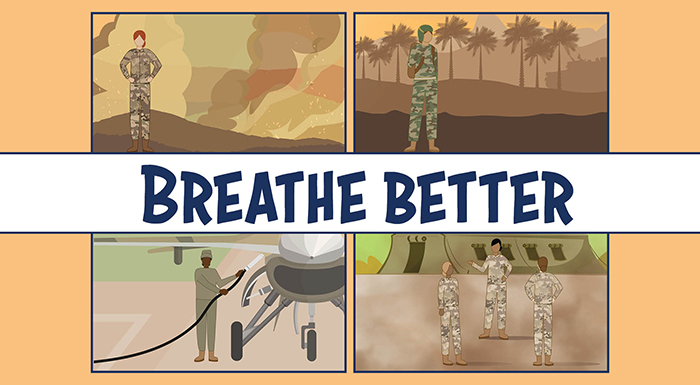
Taking a Deep Breath Should be EasyIf you’re concerned about your lungs or breathing, or if you’re experiencing symptoms such as coughing, wheezing, shortness of breath, or nasal congestion, we encourage you talk to your VA health care team about getting checked for potential lung or breathing conditions. From the fumes and toxins you may have been exposed to during your service to the air quality you breathe today, your lungs may have been through a lot! But there’s plenty you can do to improve your lung health. VA recommends that you:
VA provides several additional lung health-related services for women Veterans, including: Screening and treatment for lung conditions (including lung cancer): Lung cancer is the third most common cancer among women. For more information on symptoms of lung cancer, screening guidelines, and VA recommendations for screening, see VA Screening for Lung Cancer resources. Immunizations: Protecting your lungs means preventing infection. VA can help keep you up-to-date on the immunizations you need to prevent illnesses. Adaptive Sports Program: Being physically active can help keep your lungs healthy. VA has a library filled with exercise guidance and even provides adaptive sports opportunities for Veterans. We understand that smoking and vaping may be common in military culture. And VA knows it’s incredibly difficult to quit. Women veterans who smoke may experience difficulties getting pregnant or may be at risk for asthma, COPD, early menopause, osteoporosis, and cervical and breast cancers. VA offers a variety of smoking cessation resources so that you can take back control of your lung health!
Women are more likely than men to develop lung conditions, such as asthma and chronic obstructive pulmonary disease (COPD), and experience more severe symptoms, so staying on top of your lung health is especially important as a woman Veteran. Almost twice as many women than men have asthma, and you are at higher risk than men for asthma caused simply by air pollution. 80% of people with COPD who have never smoked are women, and COPD is the leading cause of death among women smokers in the U.S. Your deployment locations and job-related functions in the military may increase your risk of lung and breathing conditions, as well as other health concerns. Learn more about chemical, physical, or environmental hazards that you may have come in contact with during military service. You may be eligible for VA disability compensation for illnesses or conditions related to these exposures. The PACT Act expands VA health care and benefits for Veterans exposed to open burn pit emissions, Agent Orange, and other toxic substances, and adds to the list of health conditions that we assume (or “presume”) are caused by exposure to these substances. A “presumed” condition, or presumptive condition, is a condition that VA automatically assumes was caused by your service. We consider a condition presumptive when it’s established by law or regulation. Normally, your disability must connect to your military service to receive a disability rating and you must provide proof, however, under the PACT Act, you only need to meet the service requirements for the presumption. |
|
|
Military Sexual Trauma |
|
|
|
VA uses the term “military sexual trauma” (MST) to refer to sexual assault or threatening sexual harassment experienced during military service. MST includes any sexual activity during military service in which you are involved against your will or when unable to say no. Examples include:
Impact of MSTAnyone can experience MST, regardless of age, sex, sexual orientation, racial and ethnic background, or branch of service. Like other types of trauma, MST can negatively affect a person’s mental and physical health, even many years later. Things you may experience could include:
If you are having any current difficulties related to MST, VA is here to support you in whatever way will help you best—from learning more about how MST affects people, to treatment that helps you cope with how MST is impacting your life currently, or if you prefer, treatment that involves discussing your experiences in more depth. For questions about treatment and health care options related to MST, talk with the VHA MST Coordinator: Jennifer Chafin-Van Dusen LCSW Beyond MST Mobile AppFree, secure and private self-help mobile app created specifically to support the health and well-being of survivors of MST. The app has over 30 specialized tools and other features to help MST survivors cope with challenges, manage symptoms, improve their quality of life and find hope. Users do not need to create an account or be in treatment to use the app. Any personal information entered in the app is not shared with anyone, including the VA. |

Time to Move |
|
|
|
Being physically active can improve your health. Any amount of physical activity is better than none. A single bout of activity provides immediate health benefits such as lowering anxiety and blood pressure and improving quality of sleep. There are even more long-term health benefits. What's Important to Know?All adults should avoid inactivity by moving more and sitting less. Regular physical activity lowers the risk of depression, type 2 diabetes, heart disease, high blood pressure, obesity, stroke, and 8 types of cancer. It may also reduce the risk of weight gain, dementia and falls, improve bone health, endurance and help you feel more energetic. Be active for any and all reasons that are meaningful to you! Physical activity is anything that gets the body moving. It can be moderate intensity, meaning that you can talk while being active, or it can be vigorous intensity, meaning that you cannot say more than a few words without taking a breath. Choose activities that you enjoy and start at a comfortable level. Once the activity begins to seem easy, be active for a longer amount of time, or be active more often, or a combination of both. Physical activity is safe for almost everyone, and its health benefits far outweigh the risks. Even if you think you are out of shape, or have not been active in a long time, you can still be active safely. Unless you have a chronic condition, such as diabetes, heart disease or arthritis, or you have active symptoms, such as chest pain or pressure, dizziness, or joint pain, you do not need to talk to your health care team before starting activity. If you have a concern about a health condition, talk with your health care team about the types and amounts of activity that are best for you. For important health benefits, do at least 2½ hours of moderate-intensity or 1¼ hours of vigorous-intensity aerobic activity each week, or an equal combination of both. Any amount of activity is better than none and your episodes of activity can last any amount of time. You should be active as often as possible during the day and week. Do muscle strengthening activities at least twice each week and try to use muscles from all parts of your body—the legs, hips, back, chest, abdomen, shoulders and arms. Stretching regularly can improve flexibility, joint motion, circulation, and can also help relieve stress. |

Interested in Past Newsletters? |
|
|
New Veteran Orientation |
|
Come to our New Veteran Orientation Are you new to VA health care? Are you a current VA patient, but want to learn more about what services and benefits VA has to offer and how to obtain them? Join Us For New Veteran Orientation |
|
When: Where: Time: |
|
Open to all Veterans, family members, caregivers, and community partners.
|
Your Eastern Oklahoma
|
 |
Michele Reeves, BSN, RN Email: Michele.Reeves@va.gov |
 |
Makyla Clark, MSN, RN, CLC Email: Makyla.Clark@va.gov |
 |
Kellie Zimmerman, RN Email: Kellie.Zimmerman@va.gov |
 |
Stephanie Frink, RN Email: Stephanie.Frink@va.gov |
 |
Tia Miller, BSN, RN Email: Tia.Miller@va.gov |
Keep updated & let us know how we're doing. |
 |
 |
 |
 |
 |
|
You have received this message because you are subscribed to Veterans Health. Access your Subscriber Preferences to make changes to your subscription or Unsubscribe. Get this as a forward? Sign Up to receive updates from Veterans Health. Having questions or problems? Please visit subscriberhelp.govdelivery.com for assistance. |
||
 |
 |