|
|
A NEWSLETTER FOR PROVIDERS WHO TREAT VETERANS
|
|
Addressing Complexity: Treating PTSD When Dissociation and Somatization are Present
Abigail Angkaw, PhD and Brittany Davis, PhD
Wednesday, April 16 at 2:00pm ET
|
|
 Photo by Timur Weber
|
|
About the Topic
Complex presentations of PTSD, particularly dissociation and somatization trauma reactions, sometimes lead both clinicians and patients to hesitate to engage in a trauma-focused treatment for PTSD. The 2023 Clinical Practice Guideline for PTSD recommends evidence-based trauma-focused psychotherapies, such as Prolonged Exposure (PE), Cognitive Processing Therapy (CPT), or Eye Movement Desensitization and Reprocessing (EMDR) as first-line of treatment for individuals with PTSD; and has identified several additional options as second-line of treatment for PTSD (Mindfulness Based Stress Reduction (MBSR), Present Centered Therapy (PCT), and Written Exposure Therapy (WET)). This course will help clinicians to identify and conceptualize dissociation and somatization presentations as trauma reactions within a PTSD case conceptualization framework. We will share measurement tools to encourage assessment of symptoms and diagnosis and review clinical suggestions to support first-line and second-line evidence-based PTSD treatment for Veterans with these complex presentations.
|
|
About the Presenters

ABIGAIL ANGKAW, PhD is a clinical psychologist and the National Mental Health Director for Psychosocial and Behavioral Interventions in the VA Office of Mental Health, Veterans Health Administration Central Office. She is also a Clinical Professor of Psychiatry at the University of California, San Diego and a researcher in the VA San Diego Healthcare System. She was previously a consultant in the PTSD Consultation Program through the National Center for PTSD. Dr. Angkaw is personally invested in helping providers through complex clinical and administrative challenges to provide high quality care for Veterans. She joined VA in 2008 to complete her psychology internship and then postdoctoral training at VA San Diego and received her PhD at the University of Cincinnati.
|
|

BRITTANY DAVIS, PhD is a consultant for the PTSD Consultation Program, a clinical psychologist in the PTSD Clinical Team at the James A. Haley Veterans Hospital, and an Associate Professor in the Department of Psychiatry and Behavioral Neurosciences at the University of South Florida. Her clinical and research interests include best practices for the treatment of PTSD and addictions, and novel treatments to address trauma-related guilt, shame, and moral injury. She specializes in Prolonged Exposure (PE) and Concurrent Treatment of PTSD and Substance Use Disorders using Prolonged Exposure (COPE). Dr. Davis has conducted research and worked in a variety of treatment settings. Dr. Davis received her PhD from Alliant International University in San Diego, California and completed her predoctoral internship and a 2-year postdoctoral fellowship in PTSD and comorbid substance use disorders at VA San Diego.
|
|
|
|
April 16
|
Addressing Complexity: Treating PTSD When Dissociation and Somatization are Present
|
Abigail Angkaw, PhD and Brittany Davis, PhD
|
|
May 21
|
What’s the Latest in Cognitive Processing Therapy? Updates in Research and Practice
|
Jennifer Wachen, PhD and Ellen Healy, PhD
|
|
June 18
|
Supporting Clients Following Disasters or Mass Violence
|
Patricia Watson, PhD
|
|
July 16
|
Moral Distress among Healthcare Workers
|
Sonya Norman, PhD
|
|
August 20
|
Treating Comorbid PTSD and Borderline Personality Disorder: An Update
|
Melanie Harned, PhD, ABPP
|
|
September 17
|
Personalizing Evidence-Based Treatment for PTSD Using a Case Formulation Approach
|
Tara Galovski, PhD
|
|
October 15
|
MDMA and Psilocybin Therapies for PTSD Treatment: Updates and Future Direction
|
Leslie Morland, PsyD and Josh Wooley, MD, PhD
|
|
November 19
|
Delivering Prolonged Exposure for PTSD in 60-Minute Sessions
|
Sheila Rauch, PhD, ABPP
|
Dissociative Subtype of PTSD
The role of dissociation as the most direct defense against overwhelming traumatic experience was first documented in the seminal work of Pierre Janet. More recent research evaluating the relationship between Posttraumatic Stress Disorder (PTSD) and dissociation has suggested that there is a dissociative subtype of PTSD, defined primarily by symptoms of derealization (i.e., feeling as if the world is not real) and depersonalization (i.e., feeling as if oneself is not real).
Read the full version of this article
|
|
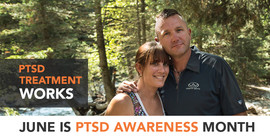
Plan Now for PTSD Awareness Month
PTSD Awareness Month, observed in June every year, is only two months away. We encourage you to start preparing now for ways that you can participate.
The PTSD Awareness section of our website is available all year long and includes a downloadable partner toolkit and other resources to help you explore ideas for doing outreach, sharing information in person or on social media, or providing education to your colleagues and/or community. We even have a slide deck ready to go to help you make presentations that help to spread the hopeful message that PTSD treatment works.
WWW.PTSD.VA.GOV/AWARENESS
|
Free Mindfulness Coach App
Practicing mindfulness means grounding yourself in the present moment. Mindfulness has been shown to be helpful for reducing stress and coping with unpleasant thoughts and emotions. Mindfulness Coach can help with practicing mindfulness meditation.
Features include:
- Education about the benefits of mindfulness
- Mindfulness exercises to practice on one's own or with guidance
- Strategies to help overcome challenges to mindfulness practice
- Log of mindfulness exercises to track progress
- Reminders to support mindfulness practice
LEARN MORE
|
|
 |
|
Our team of expert clinicians is available to consult with any healthcare provider treating U.S. veterans in any setting.
We can discuss assessment, diagnosis, psychotherapy, medications, collaborating with VA care, patient and family education, continuing education, and just about anything else related to veterans and PTSD.
No question is too big or too small.
Contact us at PTSDconsult@va.gov or 866-948-7880.
|
|
|
 |
|
www.ptsd.va.gov/consult |
|
|
|
|
|