a newsletter designed to keep you informed of VA services, upcoming events and any other newsworthy information.
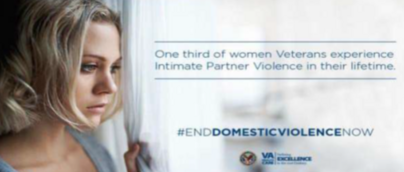
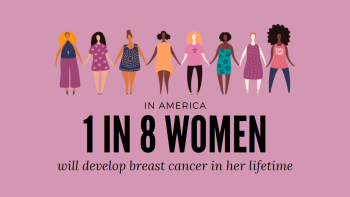
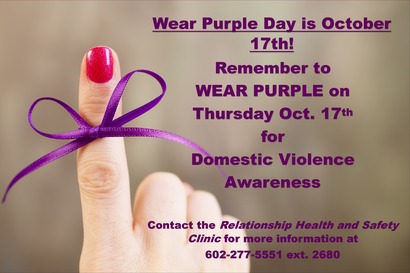
October is both Breast Cancer and Domestic Violence Awareness month. We encourage you to speak with your primary care provider about any concerns you may be experiencing (e.g. breast/chest or nipple symptoms/changes) and when you should start receiving screening mammograms. Your patient aligned care team and mental health providers are also available to assist if you are experiencing difficulties in your intimate relationship(s). The Intimate Partner Violence Assistance Program is also available to help connect you to resources: 602-277-5551 Ext. 2680. Make the Connection (https://www.maketheconnection.net/events/families-relationships/) is another option to help connect you to information and resources.
Thank you to everyone who joined and participated in the tele-town hall and focus groups. Per your request for more information on Military Sexual Trauma (MST), continue reading to learn more about MST and available MST services.
This fall, remember to ask your primary care provider if there are any recommended vaccines or screening tests you need to consider for your health. Learn more about recommended tests based on age and birth sex at: Get Recommended Screening Tests and Immunizations for Women.
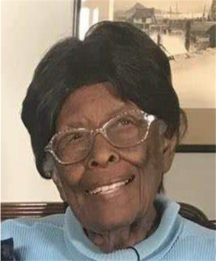
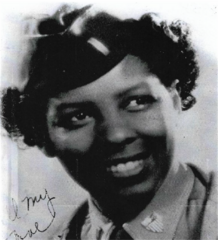
This Veterans Day, and always, we thank you for your dedication, service, sacrifice and commitment to our nation. In recognition of Veterans Day, we feature and honor Major Fran McClendon, who recently celebrated her 104th Birthday!
Wishing you great health!
With gratitude,
Kristen Nordquist, LCSW
Women Veterans Program Manager
Megan Giblin, LCSW
Assistant Women Veterans Program Manager
The Phoenix VA would like to honor and recognize local hero and national treasure, World War II Veteran Maj. Fran McClendon
In 1945, as Allied forces entered Europe, the ever-changing locations of servicemembers hampered the delivery of mail to 7 million U.S. servicemembers. It was predicted that the backlog in Birmingham, England would take six months to process, and the lack of reliable mail service to troops was seriously hurting morale.
The 6888th Central Postal Directory Battalion, nicknamed the "Six Triple Eight", was a predominantly African American battalion of the Women's Army Corps (WAC). The Six Triple Eight had 855 women, amongst whom were three Latinas, both enlisted and officers, and was led by Major Charity Adams. It was the only predominantly Black U.S. Women's Army Corps unit sent overseas during World War II. The battalion’s motto was "No mail, low morale".
In 1944, Dr. Mary McLeod Bethune worked to get the support of First Lady, Eleanor Roosevelt, encouraging the push for a role for Black women in the war overseas. Eleanor Roosevelt and Dr. Bethune were both instrumental in getting the Tuskegee Airmen engaged overseas and pursued efforts for the admittance of African American women into the Women’s Army Corps.
In May 1945, the six triple eight arrived in Birmingham, England to warehouses filled with millions of pieces of mail intended for U.S. servicemembers, government personnel, and Red Cross workers serving in the European Theater of Operations. The women of 6888th created an effective process and filing system to track individual servicemembers, organize undeliverable mail, determine the intended recipient for insufficiently addressed mail, and handle mail addressed to servicemembers who had died. The women of the Six Triple Eight held true to their motto of “No mail, low morale” processing an average of 65,000 pieces of mail per shift and totally clearing the six-month backlog of mail in just three months.
|
The Six Triple Eight was then sent to France to continue their service until the end of the war in Europe and marched in the victory parade through Paris. While the battalion was awarded the Army Meritorious Unit Commendation Ribbon, the Army Good Conduct Medal, the Women’s Army Corps Service Medal, the European African Middle Eastern Campaign Medal, and the World War II Victory Medal for their efforts during the war, they received virtually no public attention or recognition upon their return to Fort Dix, New Jersey in 1946.
On July 31, 2020, former Arizona Governor Doug Ducey signed a proclamation declaring Aug. 15, 2020, the “Six Triple Eight” Central Postal Directory Battalion Day Arizona in Arizona. This historical day recognizes the incredible service of 855 African American women during WWII, including Air Force Maj. (Ret) Fannie Griffin McClendon of Tempe and the late Cpl. Lydia Thornton. The 6888th was composed of both officers and enlisted women that had the distinction of being the only all-black, all female overseas battalion serving in Europe. During World War II, a total of 6,520 African American women served in the Women’s Army Auxiliary Corps (WAAC), later converted to Women’s Army Corps (WAC).
Fran McClendon is an active member of the Archer-Ragsdale Arizona Chapter of Tuskegee Airmen, Inc. and continues to be an inspiration to every generation. What Fran and the 6888th accomplished is a story for the ages. Fran just celebrated her 104th birthday and continues to be active in the community and Veteran Service Organizations. Thank you, Major Fran McClendon for your service to our great nation!
|
New process gives the gynecologists more time to address complex medical and surgical gynecologic needs
As of Oct. 1, the gynecology self-scheduling function has been disabled, meaning a consult from your primary care provider will now be required to make an appointment with the gynecology service. This change gives the gynecologists more time to address complex medical and surgical gynecologic needs of enrolled Phoenix VA women Veterans. The Phoenix VA has over sixty women’s health primary care providers (WH-PCPs) who have experience providing female-specific care and/or have completed training to provide comprehensive female-specific care, including routine gynecologic care. Examples of care your WH-PCP offers includes, but is not limited to:
- Well-woman exams
- Contraception (birth control) management
- Menopause symptom management
- Breast exams
Female-specific healthcare provided by WH-PCPs tends to be more complete, because the PCP is already familiar with the patient and trained to cover all aspects of care in a single visit, thereby improving patient satisfaction and reducing the need for additional visits.
For patients not assigned to a WH-PCP, or to a provider not of their preferred gender, speak with your provider to be referred for gender-specific screening by a female, float, WH-PCP.* If you need a referral to gynecology, speak with your primary care provider to request a consult.
Call the Women Veterans Program with any questions you may have regarding this change at 602-277-5551 Ext. 6764.
* At this time, female float providers are available at the following clinics: Staff Sergeant Alexander W. Conrad VA Health Care Clinic (Southeast), Phoenix 32nd St., Southwest and Northwest VA clinics.
Thank you to everyone who participated in the September 26th tele-town hall and participated in our online polling! For those of you who were unable to attend, you can view the recording from the Phoenix VA Facebook page: https://www.facebook.com/PhxVAHealthcare/.
Below are the results of a series of questions that were asked during the town hall.
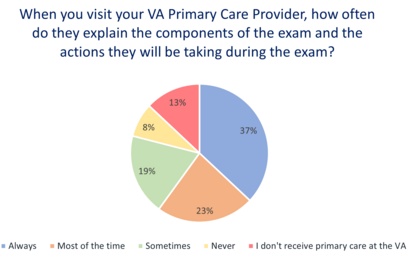 Within the Phoenix VA Health Care System, we work to ensure that staff consider how a history of trauma may impact a patient’s experience of care. With a trauma-informed approach, providers actively take steps to ensure exams feel as comfortable, safe and supportive as possible.
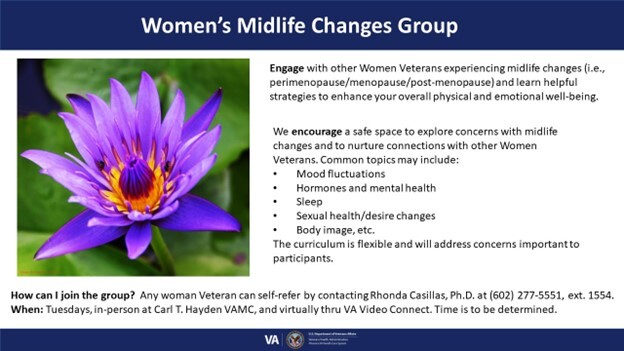 We also asked for your input regarding what time of day works best for you to attend the mid-life changes group, which is for women who are experiencing perimenopause (the transition leading to menopause), menopause (absence of a period for one consecutive year) and post-menopausal.
The results – which indicated most (32%) of you are interested in participating in the afternoon – have been shared with Dr. Casillas. The time is still pending. Please register by calling Dr. Rhonda Casillas at 602-277-5551 Ext. 1554.
Lastly, we asked for your input for town hall topics for spring 2025:
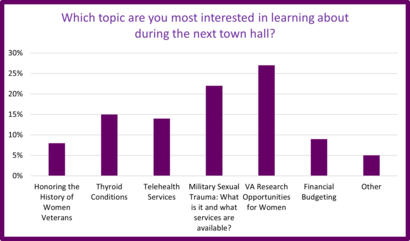 We will consider your top preferences for our next town hall meeting!
When will Fort McClellan be included in the PACT Act? Is my service at Fort McClellan considered as part of my application for service connection?
VA regularly consults with our federal agency partners to understand whether potential public health risks existed at the base and continues to review new information as it becomes available.
VA encourages Veterans who are experiencing health issues believed to be related to their service at Fort McClellan to see their primary care provider. There is no VA environmental health registry associated with service at Fort McClellan.
Veterans may also file a claim for disability compensation. VBA decides these claims on a case-by-case basis. For more information, please visit https://www.publichealth.va.gov/exposures/fort-mcclellan/.
Visit the PACT Act website at https://www.va.gov/resources/the-pact-act-and-your-va-benefits/, to apply today or learn more about what the PACT Act could mean for you or call 1-800-698-2411.
How do I request a new women’s health primary care provider?
To request a new women’s health primary care provider, speak with the Medical Support Assistant for your current Patient Aligned Care Team (PACT) or send a secure message to your PACT. You will need to complete a form to request a new provider, indicating the reason(s) you are requesting a new primary care provider. Please indicate if you have a gender preference for your provider. The clinic has up to 30 days to respond to your request.

-Contributed by Nadia Alexandrova, PsyD., Military Sexual Trauma Coordinator
What is Military Sexual Trauma? - Military Sexual Trauma (MST) is a term used to describe experiences of sexual assault or sexual harassment that occurred during a period of military service. MST can occur on or off base, while an individual is on or off duty, and can be perpetrated by other service members, civilians, friends or significant others. People of all genders, ages, racial backgrounds, sexual orientations and service eras have experienced MST. MST can negatively affect a person’s mental and physical health, even many years later.
Many people who have experienced MST have found healing through treatment. The Phoenix VA is committed to helping survivors recover and offers free services for difficulties related to MST. To learn more about MST, visit www.mentalhealth.va.gov/msthome/index.asp.

MST Clinic - One option for mental health treatment is the MST Clinic. The MST Clinic is a specialty trauma clinic that provides therapy options to reduce trauma symptoms resulting from experiences of MST, including symptoms of post-traumatic stress disorder (PTSD).
Common trauma symptoms include:
- Intrusive memories and nightmares of the event(s)
- Avoiding memories and reminders
- Irritability/anger, fluctuating mood
- Depression and isolation
- Hypervigilance, being easily startled
- Feeling numb or disconnected
In the MST Clinic, we work with you to help improve these symptoms. We help you feel the emotions connected to memories of your MST so that you can fully process these experiences and heal. All treatments offered in the MST Clinic are time-limited, with most treatment lasting 10-15 weeks, and are “evidence-based” meaning they are based on research and scientific evidence. They are proven to work! Trauma-focused treatment means you don't ignore memories of your traumatic experience(s). This can bring on more symptoms for a short period of time. You will need to have some coping skills before starting trauma-focused therapy so that you can get the most out of your treatment.
Your current VA health care provider can discuss available treatment options and help you get connected with the MST Clinic and other services. If you are unsure about what would be best for you, you can also contact the MST hotline at 602-234-7157. We will help you figure out your next steps!
|
The Phoenix VA is proud to partner with Televeda to offer a virtual support group for women who have experienced MST.
The Women’s MST Support Circle offers a safe space for female Veterans to connect, get support from others who have had similar experiences, and foster mutual recovery. The group is held online every Wednesday at 6 pm Arizona time and is free to join!
To reserve your spot, please go to https://live.televeda.com/signup and use Referral Code: AZVETS to sign up.
 -Contributed by Jill Maroscia, LCSW, Acting Intimate Partner Violence Assistance Program Coordinator
Prevalence
- Approximately 1.3 Million women and 835,000 men each year are assaulted by an intimate partner in the United States (Tjaden & Thoennes, 2000).
- More than one in every three women (35.6%) and more than one in every four men (28.5%) in the United States report experiencing rape, physical violence, and/or stalking by an intimate partner in their lifetime (Black, Basile, Breiding, Smith, Walters, & Merrick, 2011).
- Approximately three women are killed every day by an intimate partner in the United States (Catalano, 2007).
- 33% of female Veterans report experiencing intimate partner violence in their lifetime (Gerber, Iverson, Dichter, Klap, & Latta, 2014).
- One in every four children experiences family violence during their childhood (Hamby, Finkelhor, Turner, & Ormrod, 2011, October).
Effects
The impact of intimate partner violence is far reaching and severe. Consequences and outcomes of IPV include:
- Central nervous system problems
- Low birth weight in babies born to those who experienced IPV during pregnancy
- Higher risk contracting Sexually Transmitted Infections
- Mental health issues such as: depression, self-harm, and suicide
- Substance abuse
- Severe injury or death (de Boinville, 2013)
Online Resources
Breast cancer screening could save your life. Breast cancer is the most commonly diagnosed cancer among American women and impacts people of all gender identities and sexual orientations.
Although no direct link has been found between military service and breast cancer, VA continues to study the effects your service may have on your health.
Common risk factors include:
- Gender
- Age
- Race
- Weight
- Alcohol use
VA uses the American Cancer Society's breast cancer screening guidelines and recommends that all women begin getting yearly mammograms by age 45 and every other year at age 55.
You may also choose to start screening with yearly mammograms at age 40, or even earlier, if you have additional risk factors, such as certain genetic mutations, a family history of breast cancer, or other specific concerns.
VA recommends that you take the actions below at each age milestone:
- By age 40: Talk with your VA primary care provider about the right time to begin screening
- By age 45: Begin yearly mammograms
- By age 55: Get mammograms every other year or continue annually depending on your preference and risk factors
- If you served in locations covered by the SERVICE Act, you are eligible for a breast cancer risk assessment and mammography screening for breast cancer if a risk is found. While no direct link has been found between toxic exposure and breast cancer to date, VA is concerned about individual reports and is continuing studies to find out if toxic exposure may be a cause of breast cancer.
- To learn more about SERVICE ACT, visit: VHA-WH-Service-Act-Handout.
To reduce your risk for breast cancer, VA recommends you ...
- Be physically active
- Maintain a healthy weight
- Avoid drinking alcohol or limit your intake
- Quit smoking
- Transgender women have a high prevalence of dense breasts, which is a risk factor for breast cancer and can make it more difficult to detect breast cancer on mammograms;*
- Discuss risk factors with your doctor regularly
- Stay up to date on your breast cancer screening.
Speak with your primary care provider about your individual risk, including your gender identity and sexual orientation, to determine when the right time is for you to start your annual screening. Regular screenings are part of routine VHA care and can lead to early diagnosis and treatment.
If you are over 40 and not experiencing any symptoms, you can self-schedule your screening mammogram by calling: 602-277-5551 Ext. 5498.
*(Deutsch, MD, MPH, M. (2016, June 17). Screening for breast cancer in transgender women. Screening for breast cancer in transgender women | Gender Affirming Health Program (ucsf.edu))
 -Contributed by Mary Chew, MS, RDN, Clinical Nutrition Manager and Rachel Pfeifer, MS, RD, CDCES, Advanced Level Practice Diabetes Dietitian and Certified Diabetes Care and Education Specialist
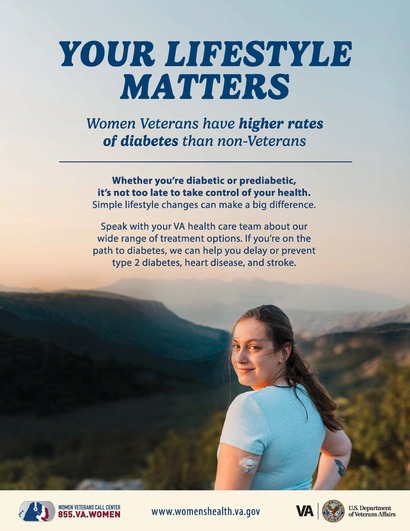
We are excited to introduce the Diabetes Self-Management Education and Support Program. This exceptional opportunity is recognized by the American Diabetes Association (ADA), supported by the Veterans Health Administration (VHA) and the Department of Defense (DOD) and is tailored specifically for Veterans.
What is Diabetes Self-Management Education and Support (DSMES)?
DSMES is a comprehensive, dynamic program designed to provide you with the knowledge, skills, and support needed to manage diabetes effectively. The program's goal is help you achieve your health targets and to enhance your overall quality of life as you navigate the ever-changing demands of daily life.
Benefits of the DSMES Program
Participating in DSMES offers numerous benefits, including:
-
Reduced Hypoglycemia: Minimize the risks associated with low blood sugar levels.
-
Lower A1c Levels: Achieve better long-term blood glucose control.
-
Healthy Lifestyle Behaviors: Promote habits that contribute to overall well-being.
-
Healthy Weight Management: Support balanced weight management strategies.
-
Enhanced Self-Efficacy and Empowerment: Boost your confidence in managing diabetes.
-
Increased Healthy Coping: Develop effective coping strategies.
-
Decreased Diabetes-Related Distress: Reduce the emotional burden of diabetes.
-
Improved Quality of Life: Experience an overall enhancement in your daily living.
Education Topics Covered
Our DSMES program consists of eight essential modules to address various aspects of diabetes management:
-
Diabetes in a Nutshell: Understand the basics of diabetes.
-
Monitoring: Learn effective ways to track your condition.
-
Healthy Coping: Develop strategies to handle the emotional aspects of diabetes.
-
Healthy Eating: Discover how nutrition impacts diabetes management.
-
Taking Medications: Get guidance on the proper use of diabetes medications.
-
Being Active: Embrace physical activity as a crucial component of your health.
-
Reducing Risk: Identify ways to lower your risk of diabetes-related complications.
-
Problem Solving: Enhance your ability to tackle diabetes-related challenges.
Class Details
We are proud to offer a series of classes specifically designed to equip you with essential diabetes self-management skills. These classes aim to empower you to reach your glycemic targets and improve your quality of life. DSMES is open to VA-enrolled Veterans diagnosed with prediabetes or diabetes, as well as adult family members or caregivers.
You will first meet with a Registered Dietitian and Certified Diabetes Education Specialist for a one-on-one appointment. After this appointment you can sign up for our comprehensive 4-week program presented by an inter-disciplinary team of diabetes professionals. Classes are available thru VA Video Connect (VVC) appointments from 10:00 am - 12:00 pm the first 4-weeks of each month.
How to Schedule
To join our DSMES program, you have several options:
-
Ask a clinic MSA/scheduler to sign you up.
-
Call 602-277-5551, option 2 and then 4 and request to be scheduled in clinic: PHX VVC DIAB DSME ASSESS EC.
-
Send a secure message via My HealtheVet to DIABETES EDUCATION PRG.
-
Ask your provider to put in a consult.
Take charge of your diabetes management with the support and resources offered through our DSMES program. We are here to help you achieve your health goals and enhance your quality of life.
 |