|
|
|
Share this email with your colleagues to make sure they get the latest VHA IE news: SUBSCRIBE
|
|
|
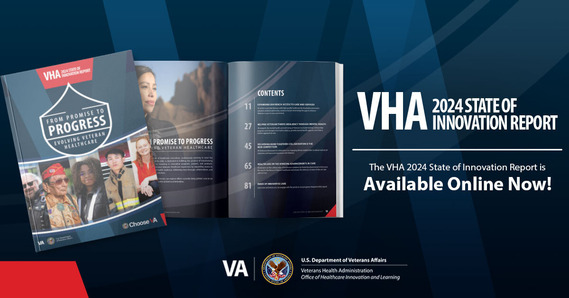 For decades, innovation has fueled VA’s mission to deliver exceptional health care to Veterans. Early inventions like the cardiac pacemaker, recent innovations like the radiotherapy bolus that helps protect cancer patients’ healthy tissue during treatment serve as a testament to VA’s dedication to delivering high-quality health care.
Since 2019, VHA’s Office of Healthcare Innovation and Learning has published an annual report, the State of Innovation (SOI) Report, that highlights notable VA innovations that are advancing the care delivery and experiences for Veterans.
The 2024 SOI Report is now available online, demonstrating VA’s leadership in health care innovation and ensuring that Veterans are informed about the latest advancements we have to offer.
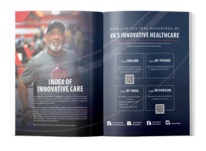
The theme of this year’s report is “From Promise to Progress: Evolving Veteran Health Care”, and it contains 25 feature stories across four core sections. Each section of the report calls attention to the innovative programs and products that support the advancement of Veteran care.
To help connect Veterans to these innovations, the report’s Index of Innovative Care lists the 25 innovations and gives Veteran readers a better understanding of the scale of the program, where it may be available, and where to find more information online. The Index also encourages Veterans to learn more and apply for VA health care.
|

The October edition of The Exchange highlighted key developments in Veteran care and innovation, setting the stage for the upcoming 2024 VHA Innovation Experience (iEX) conference, which will take place October 29-30 in Chicago, IL. iEX showcases innovative solutions and projects that enhance Veteran care, emphasizing fresh perspectives and practical improvements in how VA operates.
This month’s Exchange showcased the following VA panelists who discussed projects that will be featured at iEX, moderated by Matthew Rowley, Community Builder for VHA Innovation Ecosystem
Shannon Teague, LCSW, co-founder of the Veterans Mobile Evaluation Team (VMET) spoke about the program’s partnerships with local law enforcement to provide mental health support during acute crises; a first of it's kind in VA. Teague aims to expand VMET from its current nine locations to across the Nation, focusing on rural areas. “We’re pushing for consistent policies that will help scale our efforts and reach more Veterans in need,” Teague noted.
Mandi Loxterkamp, who was recently named a 2024 VHA Shark Tank Competition finalist, discussed how the Investing in VA Nursing (IVAN) program is addressing critical staffing shortages by training nursing assistants. Since 2022, IVAN has graduated five cohorts, adding 22 permanent nursing assistants. “We’re training our own and focusing on Veteran-centered care,” she said.
Jamie Key served as the 2024 Collaboration Designer for the VHA Innovators Network Greenhouse Initiative and works at Tuscaloosa VA Medical Center as an Innovation Specialist. Key supports collaborations between VA facilities and external health care innovators. “We want to be more proactive,” she said, emphasizing the importance of planning for the long-term needs of Veterans. Successful initiatives that have come through the Greenhouse Initiative include Xander glasses, which convert speech to text for Veterans with hearing loss, allowing them to engage more fully in conversations.

VHA Innovation Ecosystem’s Incubator Series continues this Thursday, October 24, focusing on how to design solutions with inclusive intentionality. Through teaching the basic principles of human-centered design (HCD), Kristi Bellard, iNET’s HCD Lead, will introduce ways to ensure our problem-solving approach is inclusive, diverse, equitable, and accessible, helping learners “design at the margins” for effective solutions that serve all, not just the majority.
If you missed the Incubator’s first session on how to make time for innovation, you can watch the recording here. Panelists discussed the barriers of advocating for innovation time at work and provided tools and advice for overcoming those obstacles. The Incubator series runs through January, each session focusing on a different aspect of the innovation lifecycle, from designing a solution to scaling your innovation. All classes also qualify for TMS credit.
Sign up for any and all classes in the series to join us in creating innovative change across VA to help better the lives of Veterans!
|
Dr. Sandal’s work focuses on addressing systemic challenges, such as transportation barriers that prevent Veterans from attending medical appointments. One of her most impactful projects, the VHA-Uber Health Connect Initiative, offers free rides for veterans to and from their medical visits. This program has provided over 450,000 rides to more than 50,000 Veterans, significantly reducing missed appointments.
|
In addition to VUHC, she’s spearheading innovative collaborations, such as the MIT Hacking Medicine hackathon, aimed at addressing larger systemic problems like Veteran suicide and health inequities. Her dedication to solving practical challenges is reshaping the way Veterans receive care. To learn more about Dr. Sandal’s work and the impact it’s having on Veterans’ lives, check out the full article for more insights.
|
|
|

Veterans face a suicide rate that is 1.5 times higher than overall U.S. population. As a result, VA has made ending Veteran suicide a top priority. Michael Rogers, a health informatics specialist based in Kansas City, and his team developed SAFE-Watch, a tool that identifies Veterans still requiring suicide risk evaluation. By generating real-time reports identifying Veterans with a positive suicide screening within the last 36 hours, SAFE-Watch serves as a safety net for providers by identifying documentation errors, and duplicate or conflicting suicide screening entries in real time. Following regional implementation, the innovation increased the rate of successful suicide screening from 65% in 2021 to over 90% in 2022. To learn more about SAFE-Watch, read a recent highlight in VA News or visit Diffusion Marketplace.
Veterans over 65 are more likely to be readmitted to the emergency department (ED) than younger Veterans. Recognizing the need for an innovative geriatric ED program, Dr. Colleen McQuown developed SCOUTS, a complementary post-ED care program for Veterans at risk for functional decline, institutionalization, falls, or repeat ED visits. SCOUTS enlists Intermediate Care Technicians (ICTs), who are former military medics and corpsmen uniquely positioned to provide care, to conduct a home visit shortly after an at-risk Veteran is discharged from the ED. Between May 2021 and May 2022, SCOUTS lowered the rate of 72-hour ED return visits by 3.7% compared to those not in the program. To learn more about SCOUTS, read a recent highlight in VA News or visit Diffusion Marketplace.
To learn more about VHA Shark Tank and view the full list of 2024 finalists, visit VHA Shark Tank on Diffusion Marketplace.
|
|
|
|
|
|