|
|
|
Share this email with your colleagues to make sure they get the latest VHA IE news: SUBSCRIBE
|
|
|
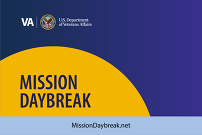
A year after Mission Daybreak, a $20 million grand challenge to reduce Veteran suicide, announced it as a finalist, ReflexAI is using artificial intelligence (AI) to improve trainings and responses at the Veterans Crisis Line.
Since 2007, the Veterans Crisis Line, or VCL, has been providing phone, text and online chat support to Veterans in crisis. As the team has grown, so has their support: to date, trained crisis responders have answered nearly nine million calls, chats, and texts and issued more than one million referrals to local suicide prevention coordinators. As Veterans needs continue to grow and change, VCL has risen to meet this challenge.
|
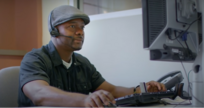
ReflexAI, which uses an artificial intelligence program for simulated crisis line scenarios, offers a new way to train responders. This program provides supplemental skills and experience to responders who are already trained to world-class standards and service provision. This low-risk, high-reward training program has eight simulated AI “personas,” each of which responds differently to trainees based on the motivations and crises they were provided. These personas were refined in collaboration with VCL to reflect the diverse demographics and personal experiences of those calling in. As the responders message with each persona, they learn how to engage with Veterans of different backgrounds, provide crisis intervention and connect with Veterans regardless of background.
|
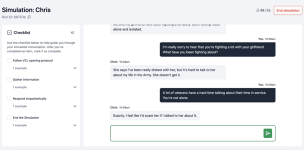
As a training tool for VCL staff, ReflexAI is not used directly with Veterans or their families, nor will it replace the professional and caring VCL operators, a quarter of whom are Veterans themselves. Reducing Veteran suicides is a top priority for VA. As VCL staff expands to 2,000 employees this year, ReflexAI simulations have been incorporated into VCL new employee training.
Mission Daybreak builds off the work that began with last year’s grand challenge. Visit the Mission Daybreak website for more information about the work ReflexAI and other grand challenge winners are doing to address Veteran suicide.
|
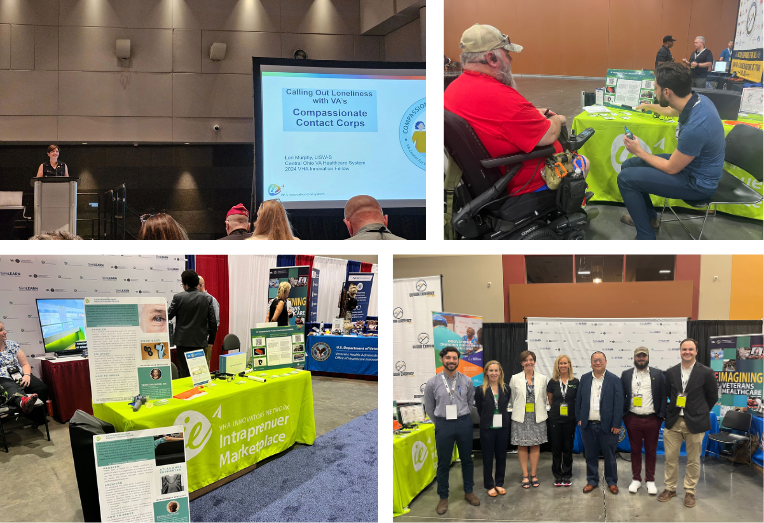 This summer, VHA Innovation Ecosystem employees, alongside colleagues from across VHA’s Office of Healthcare Innovation and Learning, had the opportunity to exhibit at several Veteran Service Organization conventions. These conventions provided thousands of interactions and opportunities for Veterans, Caregivers, and other convention attendees to learn more about the innovative work VA is doing to improve Veteran health care now, and in the future.
Veterans were able to learn about the innovations available to them through the VA Intrapreneurial Product Marketplace – innovations created by VA staff with direct Veteran input. Some highlights included the Xander Glasses’ ability to provide real-time closed captioning, the assistive abilities of the DropEase eyedrop device, and the crucial help of the Atlas Knee Supporter, a supportive device to immobilize Veterans and provide comfort during an otherwise challenging knee pain management procedures. VA innovators Lori Murphy, Indra Sandal, and Matthew Rowley also had the pleasure of presenting to attendees at various conventions.
VHA is dedicated to ensuring that healthcare innovations are being created with the voice of the Veteran at the forefront. Veterans, their caregivers, families and survivors are welcome to attend this year’s VHA Innovation Experience in Chicago October 29-30 to experience VA innovations and provide feedback.
 |
|
Join Dave Brimmer from the VHA Innovation Ecosystem on September 10th as he discusses how innovators can utilize VA Pathfinder to enhance veteran healthcare. VA Pathfinder provides a unique opportunity to work with the VA and bring about meaningful change in veteran healthcare. This efficient platform fosters innovation and collaboration, removing barriers for businesses seeking to collaborate with VA. |
|
|

Originally developed in 2016 at Salem VA Medical Center (VAMC), HAPPEN is an oral care initiative that reduces harm and loss of life by educating VA staff about consistent oral care to prevent non-ventilator-associated pneumonia (NV-HAP) among hospitalized Veterans and long-term care residents. HAPPEN entered the second VHA Shark Tank Competition in 2016, earning the opportunity to replicate at Houston VAMC, and completed expansion to all 155 VAMCs in July 2021. VA facilities that implement HAPPEN report an average 40-60% decline in NV-HAP cases, reducing the need for long-term care and shortening the length of stay for Veterans. Learn more about HAPPEN on Diffusion Marketplace.
|
MLMS honors the voices and individual lived experiences of Veterans, including what matters to them, the places they’ve been, and the people they love, by conducting interviews and writing short stories about their lives. With permission, program staff share a Veteran’s story with their VA care team. After successfully launching in 2013 at the William S. Middleton Memorial Veterans’ Hospital in Madison, Wisconsin, MLMS entered the 2016 VHA Shark Tank Competition and was selected as a winner to replicate at Durham VAMC and Atlanta VAMC. MLMS has spread to more than 70 VA hospitals across the U.S., amplifying over 9,000 Veteran stories. Learn more about MLMS on Diffusion Marketplace.
To learn more about VHA Shark Tank and view the full list of 2024 finalists, visit VHA Shark Tank on Diffusion Marketplace.
|
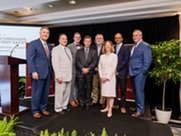
Providing Veterans with necessary risk information for making surgical decisions is a mission that Dr. Daniel Hall, a staff surgeon at Pittsburgh VA, says improves outcomes and saves lives.
Aiming to educate Veterans of the potential risks of surgery, Dr. Hall and his team created The Surgical Pause, a program that screens for frailty and flags high-risk Veterans so surgical teams can ensure any proposed treatment plans effectively mitigate risks and align with a Veteran’s overarching life goals.
The Surgical Pause provides an empirical way of assessing the risk level of a given surgical procedure. Employing the Risk Analysis Index (RAI), a series of 14 questions, provides a validated measure of surgical frailty.
The Surgical Pause has proven to be an effective measure of determining surgical outcomes, reducing six-month post-operative mortality rates among frail Veterans from 25% to 8% at Omaha VA Medical Center. The success has led to the Surgical Pause expanding to over 50 VA facilities across the country and several civilian facilities, including the University of Pittsburgh Medical Center.
The Pittsburgh-Post Gazette recently highlighted The Surgical Pause and the impact it has made in the medical community to improve care for Veterans and civilian patients.
"The Surgical Pause is a game-changer for the care of our older patients,” said Benjamin Reynolds, UPMC chief advanced practice officer and clinical assistant professor of surgery at the University of Pittsburgh Medical School. “Older patients are particularly vulnerable. We know that frailty can increase the risk of postoperative complications and mortality by up to four times. By using the Surgical Pause, we can tailor their care, reduce their risk of death, and give them the best opportunity for a successful outcome."
Originally developed in 2011 at Omaha VA Medical Center, The Surgical Pause practice received the 2023 John M. Eisenberg Patient Safety and Quality Award for National Level Innovation in Patient Safety and Quality and was also a 2019 VHA Shark Tank Competition winner. To learn more about The Surgical Pause, visit Diffusion Marketplace.
|
|
|
|
|
|