CDFI Fund Speeches: Keynote Address by Director Annie Donovan at the 2015 OFN Conference
CDFI Fund, US Department of the Treasury sent this bulletin at 11/12/2015 07:11 PM EST

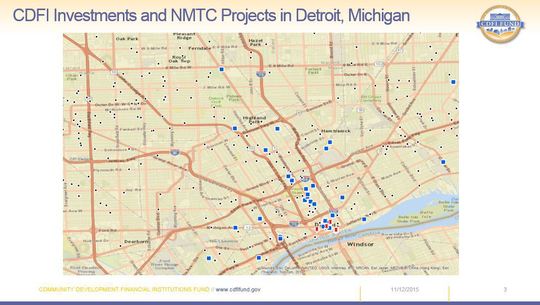
This map of Detroit shows CDFI and CDE activity from 2003 - 2013. I’d like to highlight a few things. First, you can see that CDFIs have been busy. Certified CDFIs, both in-state and out-of-state combined, made 295 loans in Detroit totaling $54 million through the core CDFI Program. Through the New Markets Tax Credit Program, local, state and national CDEs invested approximately $400 million in Detroit over the same period. When compared to other cities, Detroit ranks 4th in per capita investment through the NMTC Program and 15th in per capita investment through the CDFI Program. Next, you can see a clustering of deals, especially NMTC transactions, along the Woodward Corridor. This shows the alignment of CDFI investments with the City of Detroit’s redevelopment plan to anchor activity along a commercial corridor that connects downtown to Midtown and the neighborhoods radiating out from the core. The M1 Line, the light rail project that is a centerpiece of the redevelopment plan, received a boost from the NMTC Program with an investment made by the Local Initiatives Support Corporation, a CDFI and CDE.
Let’s take a look at some of the other transformative investments CDFIs have made. One example is the renovation of the old Argonaut Building in Midtown.
Built in 1928, the Argonaut served as General Motors’ automotive design center—the first automotive design center in American history—until 1956, when the company moved its headquarters to the suburbs. The 11-story building housed other GM departments for another 30 years but stood vacant by 1999.
In 2007, GM donated the Argonaut to the College for Creative Studies, a leading institution for art and design education. Over the next few years, thanks to a partnership involving JP Morgan Chase, US Bank, Thompson Educational Foundation, Capital Impact Partners, Enterprise Community Partners, Local Initiatives Support Corporation, and the National New Markets Fund, the Argonaut was transformed into the Alfred Taubman Center for Design Education, which is home to several of the College for Creative Studies’ undergraduate and graduate departments. The Taubman Center also houses a creative business accelerator, an auditorium, a dining hall, and a charter school, and has become one of the centerpieces of Detroit’s new creative economy.
Another innovative partnership—this one involving the CDFIs Invest Detroit, Partners for the Common Good, and Capital Impact Partners, as well as JP Morgan Chase, Living Cities’ Integration Initiative, Ford Foundation, and Midtown Detroit—helped transform a vacant and blighted property into the Auburn, a new mixed-use commercial and residential development designed to meet the need for high quality, affordable rental housing in the heart of Midtown. The Auburn offers 58 market-rate rental units with on-site parking, as well as 9,000 square feet of ground floor retail space.
This new development is located a block west of Woodward Avenue. The neighborhood is home to Wayne State University and the College for Creative Studies, as well as three major hospitals and several museums and entertainment venues. The Auburn has become a neighborhood hub, providing services to the young people and students who are making Midtown one of the city’s most vibrant areas.
Both of these projects were financed in part by using the New Markets Tax Credit Program, and they are just two examples of the great work that CDFIs are doing in Detroit in collaboration with each other.
The revival of Downtown and Midtown is absolutely inspiring and transformative. But, that cannot be where this story ends. There is still so much more to be done, so much for us to get right, especially in terms of equitable development. The theory of change in Detroit holds that the redevelopment of Downtown and Midtown—the urban core, the spine of the city—will ripple out into the neighborhoods. But we cannot assume that such an outcome is bound to happen. So CDFIs have to put two questions on the table: 1) Is momentum from economic development in the core enough on its own to spur development in neighborhoods like the North End and Southwest Detroit? If not, what more must be done? 2) Is opportunity being created for the people in those neighborhoods that have lived through the hard times, or will they be displaced by new developments?
These are fundamental questions. For CDFIs, just revitalizing a place is not enough if the opportunities created don’t accrue to the people who have survived the tough years in the neighborhoods hardest hit by economic collapse. CDFIs work at the intersection of people and place, and if our work results simply in the redevelopment of a place without also alleviating poverty and creating upward mobility for people, we will not accomplish our mission.
Revitalization without displacement is no easy task; there is a dearth of effective models and there is certainly no rule book to follow. In my recent conversation with Lauren Hood of Live 6, she posed the question, “whose job is it to ensure that displacement does not occur?” This is a profound question for all of us to ponder.
Recently, I had the great pleasure of meeting Dr. Raj Chetty, a Professor of Economics at Stanford University, a recipient of a MacArthur “genius award,” and a path-finding researcher whose work combines empirical evidence and economic theory to help design more effective government policies. His work offers some valuable insights for those of us working to create change at the intersection of people and place.
Dr. Chetty’s most recent research focuses on equality of opportunity, specifically on how neighborhoods affect upward mobility and how government can create policies that give children from disadvantaged backgrounds better chances of succeeding. He is co-author of a national quasi-experimental study of five million families using big data, as well as a recent re-analysis of the Moving to Opportunity experiment. Both studies found causal effects between where one lives and how much economic mobility one experiences.
Many of you are probably familiar with the Moving to Opportunity experiment. In the 1990s, the U.S. Department of Housing and Urban Development offered randomly selected families living in high poverty housing projects housing vouchers to move to low-poverty neighborhoods. Original research showed positive mental and physical health impacts as well as improvements in personal safety for those who moved; however, it did not show significant impact on earnings and employment rates of adults. Dr. Chetty’s re-analysis parsed the data further and found positive, causal effects for children who move to higher income neighborhoods before the age of 13. Specifically, he found that every year of exposure improves outcomes such as college attendance and long-term earnings.
Dr. Chetty and his colleagues found that the five strongest correlates of upward mobility are:
Dr. Chetty’s work provides empirical evidence that confirms that place matters and that mixed income communities create economic opportunity. The first thing Dr. Chetty said when I met him was, “of course we can’t all move to opportunity and we can’t just abandon places. What this work shows is that place matters.”
Those insights define the challenge for our industry. If we know that these things do in fact matter, we must design integrated solutions that address them. So far, there is no evidence that the market, left to its devices, will produce the kind of equitable outcomes we seek. Which brings us back to Lauren Hood’s question, whose job is it to ensure that displacement does not occur? Certainly, policymakers and community development practitioners must be intentional about creating economically and racially diverse places.
While we may have yet to discover the full solution to equitable development, an important first step is to ensure that our work connects to the efforts of local civic organizations, like Live 6, that share our community development goals. Let’s ensure that community leaders are at the table, that their voices are heard and that the solutions we design include them. Otherwise, we risk that our efforts here in Detroit and elsewhere across the country will end up being a frustrating game of whack-a-mole. We will achieve transaction-level success without accomplishing the ultimate mission of social and economic transformation.
Now, I have spoken about what the CDFI industry needs to do to achieve this kind of transformation. But what about the CDFI Fund? What are we going to do to deepen our commitment to achieving greater outcomes in underserved communities?
Of course, one of the first things we are going to do is to continue administering all of the programs we provide to build the capacity of CDFIs. To that end, we have had a very busy year. In FY 2015 the CDFI Fund:
We also:
These are all very important accomplishments. But the even bigger story is that we also have been focused on the future and have been working hard to create a pathway for the CDFI Fund. The CDFI Fund is currently creating what we are calling a Framework for the Future. The Framework is a five-year strategy for accelerating the CDFI Fund’s pace of progress toward achieving its mission.
The first step in building the Framework has been to understand the world from the point of view of our stakeholders. To that end, this spring we gathered together the CDFI Fund’s Community Development Advisory Board in Washington, D.C., to begin a discussion around six areas of inquiry. They were:
The minutes of that meeting are on the CDFI Fund’s website.
From there, we took our questions on the road for a five-city national listening tour this summer. More than 320 people attended the tour, representing CDFIs, funders, investors, local and state government officials, researchers and other community development practitioners. More than 70 others joined me on two conference calls for those serving rural communities in the continental U.S. and in Hawaii, Alaska, and the territories. We also put our questions out in the form of an electronic survey and nearly 300 additional individuals and organizations responded online. To all of those who participated in the process, THANK YOU!
Here’s a preview of what we heard for each of the six areas of inquiry:
I would like to share with you a brief story about what was for me and my CDFI Fund colleagues a very poignant moment on the listening tour. We were at our first stop, in San Francisco. If you attended one of the listening sessions, you know that we designed them to be very interactive and to allow the participants to do most of the talking. There were lots of small group discussions and report outs organized around the six areas of inquiry.
During this session in San Francisco, a participant from East Oakland stood up to report his table’s comments on the topic of access. His organization, Allen Temple Housing and Economic Development Corporation, is a faith-based CDC and a CDE but not a certified CDFI. He talked about the struggles in his highly distressed African American community to gain access to capital and he clearly felt disconnect from the CDFI world. This participant said, “All the CDFIs that said you are located in Oakland, we don’t know any of you…We’re serving the low-income community and I just don’t see you.” The comment caused me to think more deeply about the importance of connecting with local community leaders, especially in minority communities. Our business is driven by relationships.
I know that many CDFIs do connect their strategies with many community stakeholders, but let’s make sure we aren’t leaving out the important voices of the people who live in the communities we serve. If we are to deepen our impact and increase economic opportunity, we must know and serve our target markets from the bottom up.
So what are we going to do with all the input we’ve gathered? We are in the process of shaping strategic objectives en route to developing our Framework for the Future. While it will take us a little more time to finalize the strategic objectives, I can give you a sense of the themes we are working with:
We expect to have the Framework for the Future completed in early 2016. Stay tuned!
The work you are doing to create an inclusive economy for those on the margins and those in need of greater opportunity ennobles this country. As you are doing here in Detroit, CDFIs have always led the way, demonstrating to mainstream investors that there are opportunities in communities that have been overlooked, or judged to be too risky. If mainstream financial institutions move into markets behind us, we must continue to blaze new trails, to find the next community that is even harder to serve than the last one. Let’s move forward together until we achieve our collective vision of an America in which all people and communities have access to the investment capital and financial services they need to thrive.
Thank you again for giving me this opportunity to speak. And thank you, Detroit, for showing the world what it means to be resilient.
| You can update your subscriptions, modify your password or e-mail address, or stop subscriptions at any time through your Subscriber Preferences Page. You will need to use your e-mail address to log in.
If you have questions or problems with the subscription service, please e-mail support@govdelivery.com.
This service is provided to you at no charge by CDFI Fund, US Department of the Treasury. The CDFI Fund is an equal opportunity provider.
Reasonable Accommodations: Requests for reasonable accommodations under section 504 of the Rehabilitation Act should be directed to Michael Jones at 202-653-0300. |