|
|
A Message from CISE Leadership
Dear CISE community.
I want to start our first newsletter of the new calendar year by wishing you a happy New Year on behalf of everyone in CISE. We look forward to a year full of new opportunities to engage with our scientific community, and to share information on our many initiatives and programs to ensure equitable access to the grants that will support your research for the years to come.
Kicking off the new year, I want to make sure to get the word out broadly about our newly revamped CISE Large Core program solicitation. Previous CISE Large opportunities focused within a single division. With this reframing, this opportunity calls for proposals seeking major scientific discoveries through fundamental research within scope of one or more of the participating CISE divisions core programs. Specifically, I encourage you to seek out partnerships across topic areas, and across many diverse institutions to produce innovations, and transform and advance our field of computing and information science and engineering. The deadline window is February 14-28, 2023, so please consider submitting.
Next, I want to bring your attention to the recent release of the Roadmap for Researchers on Priorities Related to Information Integrity Research and Development. This comprehensive document developed by Federal agencies and the Office of Science and Technology Policy aims to identify gaps in today's scientific knowledge in this very important area of research, and equip research communities with a shared understanding of Federal research priorities for the future. From deepfakes to machine-generated text, the notion of information integrity is so timely, and further research is so important. I encourage you to take a moment to read this document, and consider how it might offer a roadmap for your own research and education plans.
We hope you enjoy this month’s newsletter and please continue to share it with your networks.
Sincerely,

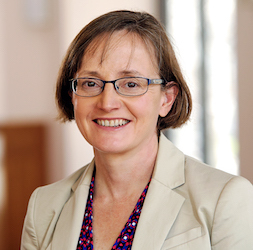
Margaret Martonosi
NSF Assistant Director for CISE
|
|
Funding Opportunities and Deadlines |
|
News & Announcements

This document requests public comments to help identify priorities for research and development related to digital assets, including various underlying technologies such as blockchain and cybersecurity.
|
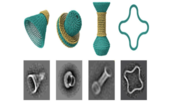
NSF-funded researchers developed a new open-source software that lets users take drawings or digital models of rounded shapes and turn them into 3D structures made of DNA.
|

The U.S. National Science Foundation supports multiple programs for high school, undergraduate and post-baccalaureate students to help fund research opportunities.
|

The NSF-led ExpandAI program aims to significantly broaden the participation of minority serving institutions in artificial intelligence research, education and workforce development through capacity development projects and partnerships within the NSF-led National AI Research Institutes ecosystem.
|

A team of NSF-funded researchers report that maintaining an indoor relative humidity between 40% and 60% is associated with relatively lower rates of COVID-19 infections and deaths, while indoor conditions outside this range are associated with worse COVID-19 outcomes.
|

The Platforms for Advanced Wireless Research (PAWR) Project Office announced $2.8 million in new NSF funding to accelerate wireless innovation through the shared resource of advanced network testbeds.
|
Get more NSF News
|
|

Aravindan Vijayaraghavan, Ph.D., is an associate professor in the Computer Science (CS) department, and by courtesy the Industrial Engineering and Management Sciences (IEMS) department at Northwestern University. He obtained his Ph.D. in CS from Princeton University in 2012, and his bachelor's degree in CS from the Indian Institute of Technology Madras in 2007. Aravindan was also a Simons Postdoctoral Research Fellow for two years with the Algorithms & Complexity Theory group at Carnegie Mellon University, followed by a year with the Simons Collaboration on Algorithms and Geometry at the Courant Institute of Mathematical Sciences at New York University (NYU).
Aravindan’s research interests include the areas of combinatorial optimization, data science, machine learning and more recently, quantum information. An overarching theme in his research is using paradigms that go beyond traditional worst-case analysis to prove stronger algorithmic guarantees for computational problems that are intractable in the worst-case.
He has received several NSF awards including an NSF CAREER grant in approximation algorithms and machine learning, and a Transdisciplinary Research In Principles Of Data Science (TRIPODS) grant. Aravindan is one of the directors for the Institute for Data, Economics, Algorithms and Learning (IDEAL)—an Institute which was funded through the TRIPODS grant across Northwestern University, Toyota Technological Institute at Chicago, University of Illinois Chicago, University of Chicago, and Illinois Institute of Technology. IDEAL involves more than 60 researchers working on key aspects of the foundations of data science across computer science, electrical engineering, mathematics, statistics, and fields such as economics, operations research and law.
“I am very grateful for the NSF awards I have received over the years. They have played a crucial role in enabling and supporting my research at different stages of my academic career. The NSF CAREER grant was tremendously helpful in kick-starting my research group during the early stages of my faculty position at Northwestern. A collaborative NSF grant that was funded by the Algorithms in the Field program enabled a fruitful long-term collaboration with David Sontag (MIT), who is a leading machine learning researcher. Finally, the IDEAL institute that was funded by the NSF HDR TRIPODS program has led to substantial research activity on data science foundations in the broader Chicago-area, by bringing together exceptional inter-disciplinary expertise related to data science foundations. This has greatly benefited my students, postdocs, and my own research – in fact, many of my research projects in the last three years have been in new research areas that I got introduced to through the various activities in the institute.”
|
|
|
Office of Advanced Cyberinfrastructure (OAC)
OAC supports and coordinates the development, acquisition and provision of state-of-the-art cyberinfrastructure resources, tools and services essential to the advancement and transformation of Science and engineering.
|
|
|
|
|