NOAA launches Cooperative Aviation Centers across the nation
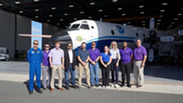
To meet growing demand for specialized aviation professionals, the NOAA Corps is teaming up with three leading flight institutions to build a pipeline for STEM-educated pilots. Through NOAA’s newly formed Cooperative Aviation Centers, students at these universities will gain direct access to summer internships at the Aircraft Operations Center, hands-on cockpit experience, and a clear career pathway into the NOAA Corps. Explore the participating universities and student opportunities here.
|
NOAA aircraft collect vital data in hurricanes
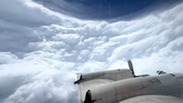
While Atlantic storm activity had a quiet start compared to an active Pacific season, our operations recently covered Hurricane Isaias as it became the season’s first Atlantic hurricane prior to its landfall in the Florida Panhandle. Supported by both NOAA P-3s and the Gulfstream IV-SP, with missions reaching as far as Hawaii, our crews have logged over 440 flight hours across 70 missions so far this season. In total, we have launched more than 1200 expendable instruments including dropsondes across eleven named storms. Ever wondered what it looks like inside the eye of a hurricane? Check out this video.
|
NOAA King Air gathers damage assessment imagery after Hurricane Isaias
Our work doesn’t stop when the storm passes. Following Hurricane Isaias, a NOAA King Air completed multiple aerial survey missions to gather critical imagery for emergency response. This high-resolution imagery helps determine the extent of the damage and provides support for disaster response and recovery efforts. All survey data is free and accessible to the public.
|
Twin Otter & NOAA Ship Gordon Gunter join forces to track endangered marine mammals
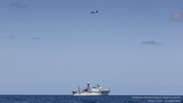
Protecting marine mammals requires all hands on deck, both at sea and in the sky. During a survey in the Gulf of America, a NOAA Twin Otter and NOAA Ship Gordon Gunter joined forces to track and study marine mammals. By aligning survey paths and using real-time radio communication, the aerial team guided the ship directly to target areas, where small boats could then deploy for close-range photo identification and biological sampling. This integrated approach boosts survey efficiency and provides vital data for long-term ocean conservation.
Learn more about this air-and-sea collaboration in this article, and watch this video overview to see why the Twin Otter is an ideal aircraft for low-altitude marine surveys.
|
NOAA Twin Otter tracks urban air quality ahead of 2026 FIFA World Cup
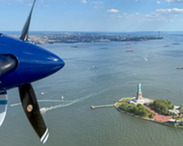
NOAA deployed an instrument-packed Twin Otter across the Northeast Corridor for the The Study of Urban Chemical Composition and Emissions Research – Air Quality (SOCCER-AQ) project to study urban air pollution, ozone formation and satellite accuracy ahead of the 2026 FIFA World Cup. These flights supported the White House Task Force on the 2026 FIFA World Cup. Ultimately, this research provides actionable science to guide air quality management, emergency response and public health decisions.
|
NOAA P-3 tracks air pollution in Texas
The NOAA Aircraft Operations Center deployed a specialized P-3 aircraft and crew to support the Airborne and Remote Sensing Multi Air Pollutant Survey (AiRMAPS) in Texas. Outfitted with a high-tech suite of air-sampling sensors, the plane flew across the Greater Houston and Dallas–Fort Worth areas to measure greenhouse gases, urban smog and emissions. The mission gathered crucial real-time data to see how Texas air quality has improved and to help sharpen NOAA’s everyday air quality forecasts. |
|
 |
Heritage: On the Heritage Trail at the Aircraft Operations Center
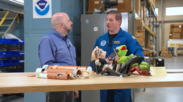
In this episode of On the Heritage Trail, NOAA Heritage curator Mark Weber visits the Aircraft Operations Center to uncover the historic artifacts and origin story of the famous P-3 "Hurricane Hunters," Kermit and Miss Piggy. The feature highlights rare items from NOAA's past, including the original 1975 aircraft acceptance photo album, iconic Muppet mascot seat displays, and early storm-sensing dropsondes.
|
Featured Photo
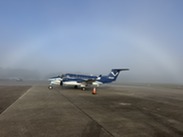
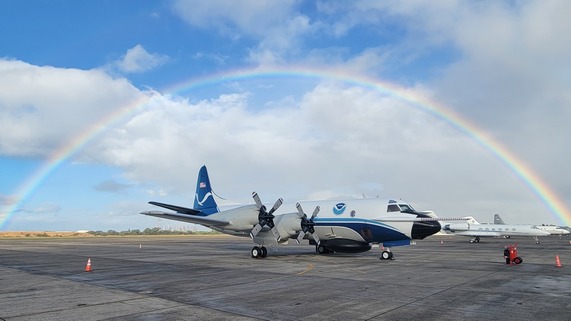 NOAA’s P-3 "Kermit" framed by a rainbow while on the ramp in Hawaii for missions to Hurricane Lala. (Photo Credit: Damon Sans Souci/NOAA)
On the Radar
Looking ahead, our aircraft teams will stay busy with a wide range of missions. Hurricane season operations will continue, with crews and aircraft ready to support as new storms develop.
Twin Otters will conduct marine mammal surveys, including work focused on the North Atlantic right whale and other protected species in the Gulf of America.
The NOAA King Air and Twin Otters will continue snow survey missions across the country.
Additionally, we will have our annual Safety Conference in December. This is a week-long effort where all personnel undergo critical training to keep our aircraft and crews safe.
Finally, we continue to celebrate the 50th anniversary of NOAA’s P-3s and honor their years of service. Visit our P-3 50th anniversary page to explore stories celebrating the people, aircraft, and stewardship that have made these aircraft an enduring part of NOAA’s mission.
We look forward to sharing accomplishments from the fall with you in the next issue of Flightlines. Subscribe to the newsletter by signing up here, and be sure to follow us on social media! You can find us on Facebook, X, and Instagram.
|