|
|
Greetings!
We’re thrilled to be able to hire professional mariners again. The entire Marine Operations team is supporting the hiring process and processing both internal Vessel Merit/Vessel Assignment applicants and external applicants. If you are interested in applying, please visit omao.noaa.gov/sailnoaa. Our ships and the missions we support depend on this workforce.
Our ships have been keeping busy this summer, working from Palau to New England. Some of the highlights are below. We also marked a milestone in the construction of the newest ships being built for NOAA with a keel-laying. See the story below.
In our winter issue, we shared the story of NOAA Corps Capt. Leonard (Sam) Baker, and his four decades of service to the nation with the NOAA Corps and its predecessors. Sadly, Capt. Baker passed away on June 8. Fair winds and following seas, Capt. Baker.
We also lost two members of the Marine Operations family recently. Andrew Ellis was an electronics technician assigned to NOAA Ship Oscar Dyson. He worked for NOAA since 2019 and previously served his country in the Navy for nearly 14 years. Robert Edwards, a longtime NOAA employee and member of the Marine Operations engineering team, began his NOAA career in Newport, Oregon, as a port engineer and was recently selected to be Oceanographer’s port engineer. Rob also served in the Navy for nearly five years.
As a reminder, anyone can subscribe to Shipshape by clicking here.
Take care of your shipmates!
Capt. Jesse Stark, NOAA Corps
Director of Marine Operations
NOAA Marine and Aviation Operations
|
|
On Aug. 14, NOAA leadership celebrated the keel-laying for Surveyor, a new charting and mapping vessel being constructed for NOAA. Thoma-Sea Marine Constructors, LLC., in Houma, Louisiana, is building the vessel. The keel-laying is a centuries-old maritime tradition that formally recognizes the start of a ship's construction. During the ceremony, the initials of the ship’s sponsor were welded onto a steel plate that will be incorporated into the ship during construction.
|
NOAA Corps officers and professional mariners must maintain high levels of readiness when operating NOAA vessels at sea. Read more about their preparation for underway missions during Operational Readiness Training, where they gain familiarity with general ship operations and emergency response procedures.
|
This past spring, NOAA Ship Fairweather conducted an underwater survey in Alaska at the request of the U.S. Coast Guard. The survey supported the Coast Guard’s efforts to locate the wreckage of the F/V Wind Walker, which sank on Dec. 1, 2024 with five people aboard in the vicinity of Point Couverden, Alaska. NOAA regularly receives requests from other agencies to provide ocean mapping experts and expertise in recovery efforts.
|
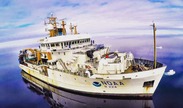
NOAA has awarded $95,408,666 to JAG Alaska, Inc. from Seward, Alaska, to complete expanded upgrades and maintenance on NOAA Ship Oscar Dyson. NOAA is working to maximize the service life of each of its vessels through long-term maintenance planning and tracking.
|
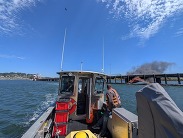
Over the summer, a crew of NOAA scientists and NOAA Corps officers were onsite to help a distressed recreational vessel in Oregon. After assessing the situation, they helped the passengers off the vessel, on to a NOAA research vessel and away from the fire. They remained on scene to await the arrival of a U.S. Coast Guard lifeboat and local emergency services. |
|
 |
Meet the Crew
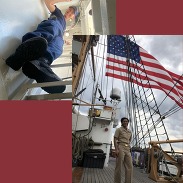
The NOAA Commissioned Officer Corps is one of the nation’s eight uniformed services. With approximately 370 officers, the NOAA Corps supports nearly all of NOAA’s programs and missions, and are an integral part of NOAA’s marine operations. Meet some NOAA Corps officers who support marine operations:
|
Heritage
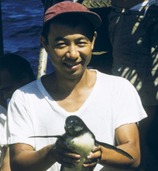
In 2007, NOAA ran a contest for 6th through 12th graders to name NOAA’s newest ship. Five students from Marina High School in Marina, California and their biology teacher submitted a moving essay detailing why they thought Dr. Bell M. Shimada deserved this honor. Their submission was chosen from 160 entries.
|
Featured Photo
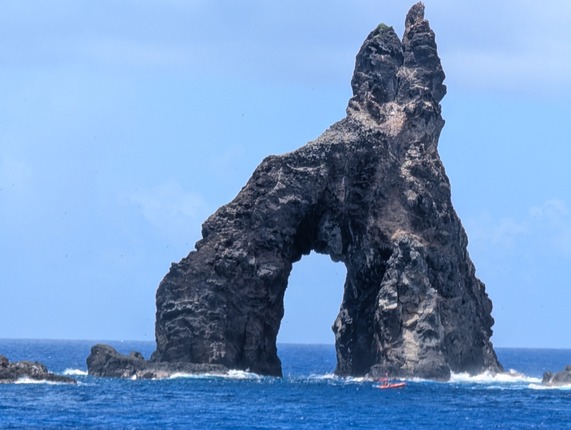 NOAA Ship Oscar Elton Sette spent several months working on ecosystem research in the reefs of the Northern Mariana Islands. Deploying several small boats from the ship on a daily basis (one seen here at the base of the arch) allowed the scientists to look at fish, water quality, corals, invasive species and other benthic (seafloor) communities providing a window on the health and diversity of the reefs. Credit: NOAA Marine and Aviation Operations/LCDR Kell Bliss
|
|
|
|