|
June/Junio 2024
NOAA MDP - Caribbean
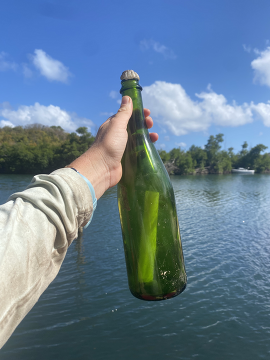 Is this a message in a bottle? This item was one of the cool finds in Bovoni Cay, St Thomas during the April cleanup(Photo credit: UVI).
|
In this issue / En esta edición
Message in a Bottle
Comida sin huella: conoce a los participantes de esta iniciativa
Looking for fun educational activities to keep your kids entertained in the summer? (Disponible en español)
Funding Opportunity- Hurricane Fiona Marine Debris Removal for Puerto Rico
Funding Opportunity- Abandoned Vessels Removal
Funding Opportunity: USDA Composting and Food Waste Reduction Pilot Project
What’s new / Novedades - TIPS for Marine Debris Webinar Series (Disponible en español)
Be part of the solution!
Please take a look at the U.S. Virgin Islands Marine Debris Action Plan and the Puerto Rico Strategic Plan to Reduce Aquatic Debris to learn more about the unique marine debris challenges and actions you can help with!
|
|
Message in a Bottle
by Lila Uzzell, Master’s of Marine & Environmental Science student, University of the Virgin Islands
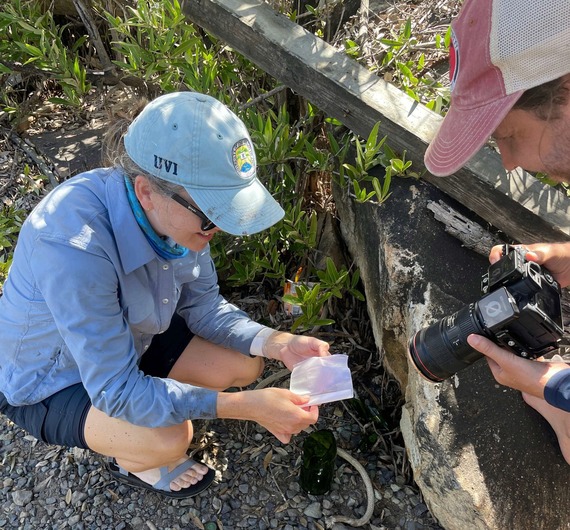 The University of the Virgin Islands Team tried to decipher the message. (Photo credit: UVI)
|
|
|
I think it’s safe to say that almost everyone secretly wishes they’d find a message in a bottle. It only takes watching a pirate movie or two as a kid to become fascinated by the concept. Will it hold a glimmer of someone’s last S.O.S. hope? A love letter? A map to a buried treasure? Perhaps equally as important a question as the message itself: Who will be the one to find it, and how far into the future?
On Thursday, April 4th, 2024, Dr. Kristin Wilson Grimes was sifting through marine debris during an offshore cleanup on Bovoni Cay, St. Thomas, when she picked up a glass bottle and noticed a small, perfectly rolled note inside. She couldn’t believe her eyes, a true message in a bottle! She quickly set it aside so that everyone participating in the cleanup would get to experience the joy of finding what it had to say at the end of the day.
Once the cleanup was complete, the crew huddled around Dr. Grimes and the bottle. The first obstacle they faced was how to open it. The seal was waxed over, so without any other option left, they gently broke the bottle on a rock (don’t worry, we picked up all the pieces). The message inside was soaking wet from water getting through the waxed cork. And it SMELLED. Bad. So far, not as romantic an experience as one may have thought.
Dr. Grimes carefully unraveled the note only to find… a blank sheet of paper!. The crew assumed that its owner likely wrote in pen or pencil. Over time, the message probably washed away long before it fell in the cleanup crew’s hands.
With the weekend coming up, one of the crew members, Lila, was planning a little craft day with friends. She decided to keep the wet, stinky sheet of paper. Her plan was to let it dry, then use it in her crafts or re-create her own message in a bottle.
The following day, Lila picked up the sheet of paper and noticed some slight indentations in the paper. She held it up to the light and could faintly make out a few words and figures. What she found was the word “concern” at the top of the page (perhaps it was part of the phrase “To Whom it may Concern”). She also noticed a smiley face written in text-message form: =). And lastly, an acrostic:
Wrens (maybe? This word was difficult to read)
Are
Real
After her discovery, Lila turned toward social media to inquire with others about how she could possibly uncover more of the note. She got bombarded with comments such as “It’s invisible ink!” “Try a blacklight,” “Use lightly pressed charcoal,” and lastly “Uncover it the National Treasure way” (which is using lemon and heat for those unfamiliar with the movie). Alas, after all the clever feedback and excitement for the message, Lila ended up misplacing the sheet of paper during her craft night! We can only hope that one of her friends made the message into a beautiful collage, or who knows, maybe it will pop up in her craft supplies one day. As for now, the mystery of the message in the bottle remains unsolved.
|
|
Comida sin huella: conoce a los participantes de esta iniciativa
Por Glenis Padilla, Alelí Environmental
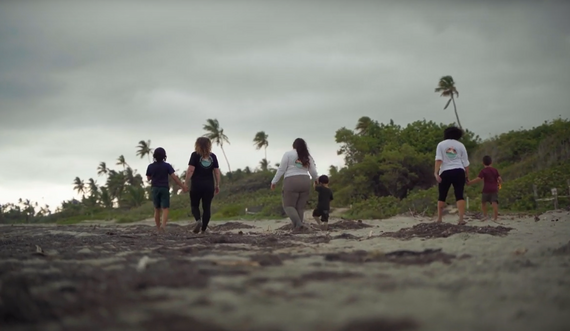 Por un mejor futuro, un verano sin huella. (Crédito: Imagen extraída de video del proyecto)
Es con mucha alegría que el equipo de Alelí Environmental desea anunciar el comienzo de nuestra campaña de verano en Guánica, Puerto Rico, titulada Comida sin Huella. ¿De que se trata Comida sin Huella? Es un esfuerzo único de alianza de restaurantes en el pueblo de Guánica, Puerto Rico, que tendrá lugar de abril a agosto de 2024 en beneficio de nuestros ecosistemas costeros. Accede a este video para conocer más de nuestra iniciativa.
 |
|
El proyecto evalúa las necesidades de los comercios participantes y aunque fomenta principalmente el uso de reutilizables, ofrece orientación en productos alternativos. (Crédito: Imagen extraída de video del proyecto) |
Cuatro restaurantes diversos han dicho que sí a reducir el plástico de un solo uso en sus establecimientos. Les presentamos a Tamara, dueña de Bocados Tamara y Algo Más. Conozcan a Carol dueña de Al Son de Carol Bar and Restaurant. En el Desafío Bar and Grill contamos con el liderazgo de Ángel y Damaris, conócelos aquí. También contamos con Emmanuel y su familia en Jenus’ Pizza. Únete, visita nuestros restaurantes, trae tus utensilios reusables y degusta Comida sin Huella. Esta campaña también cuenta con el apoyo de la Universidad de Villanova, la Universidad de Syracuse, el Marine Debris Foundation y grupos comunitarios.
|
|
Looking for fun educational activities to keep your kids entertained in the summer?
Yes! It is summertime, and we know it: warm weather, beach time, and… kids out of school! If you are searching for activities that will keep their brains active while learning how to keep our beaches free of debris, we have the solution. Please take a look at the following materials from the NOAA Marine Debris Program, the Virgin Islands Marine Advisory Service and the Puerto Rico Strategic Plan to Reduce Aquatic Debris partners:
English: Understanding Marine Debris: Games and Activities for Kids of All Ages - USVI Adaptation
English: Understanding Marine Debris: Games and Activities for Kids of All Ages - Original Version
Spanish: Manual de Arte y Actividades: Reutilizando Materiales Reciclables -Product from a Collaboration within the Puerto Rico Strategic Plan.
You can also take a look at the “For Kids and Families” section on the NOAA MDP Education page for additional resources.
¿Buscando actividades educativas divertidas para entretener a sus pequeñines en el verano?
Sí, es verano y lo sabemos: tiempo cálido, playa y... ¡estudiantes fuera de la escuela! Si estás buscando actividades que mantengan sus cerebros activos mientras aprenden a mantener nuestras playas libres de desechos, tenemos la solución. Por favor, eche un vistazo a los siguientes materiales de los socios del Programa de Desechos Marinos de NOAA, el Marine Advisory Service de las Islas Vírgenes y el Plan Estratégico de Puerto Rico para Reducir los Desechos Acuáticos:
Inglés: Understanding Marine Debris: Games and Activities for Kids of All Ages - adaptación de USVI
Inglés: Understanding Marine Debris: Games and Activities for Kids of All Ages - Versión original
Español: Manual de Arte y Actividades: Reutilizando Materiales Reciclables -Producto de una colaboración dentro del Plan Estratégico de Puerto Rico.
También puede consultar la sección “For Kids and Families” de la página de educación del NOAA MDP para obtener más recursos.
|
|
Funding opportunity - Hurricane Fiona Marine Debris Removal for Puerto Rico
On April 23, the National Fish and Wildlife Foundation (NFWF), in partnership with the National Oceanic and Atmospheric Administration Marine Debris Program, announced a request for proposals under the Hurricane Response Marine Debris Removal Fund.
The fund will invest approximately $6 million in grants for marine debris assessment, removal, restoration, and disposal activities in coastal communities in Alaska, Florida, Georgia, Puerto Rico, and South Carolina impacted by the 2022 hurricane season. The Hurricane Response Marine Debris Removal Fund will support projects that address marine debris that was caused by or moved by Hurricanes Fiona, Ian, Nicole, and Typhoon Merbok. Projects will prevent further damage to sensitive coastal habitats and species and reduce the impacts of marine debris on communities’ infrastructure, assets of economic importance, and navigation safety.
Funding was appropriated in the Consolidated Appropriations Act, 2023 (Pub. L. 117-328) and will help coastal communities in Alaska, Florida, Georgia, Puerto Rico, and South Carolina.
Full proposals are due on Friday, July 26, 2024 11:59 PM EDT. An informational webinar for potential applicants will be held by NFWF on Thursday, May 9th, 2024 3:00pm EDT. More information is available on the NFWF website.
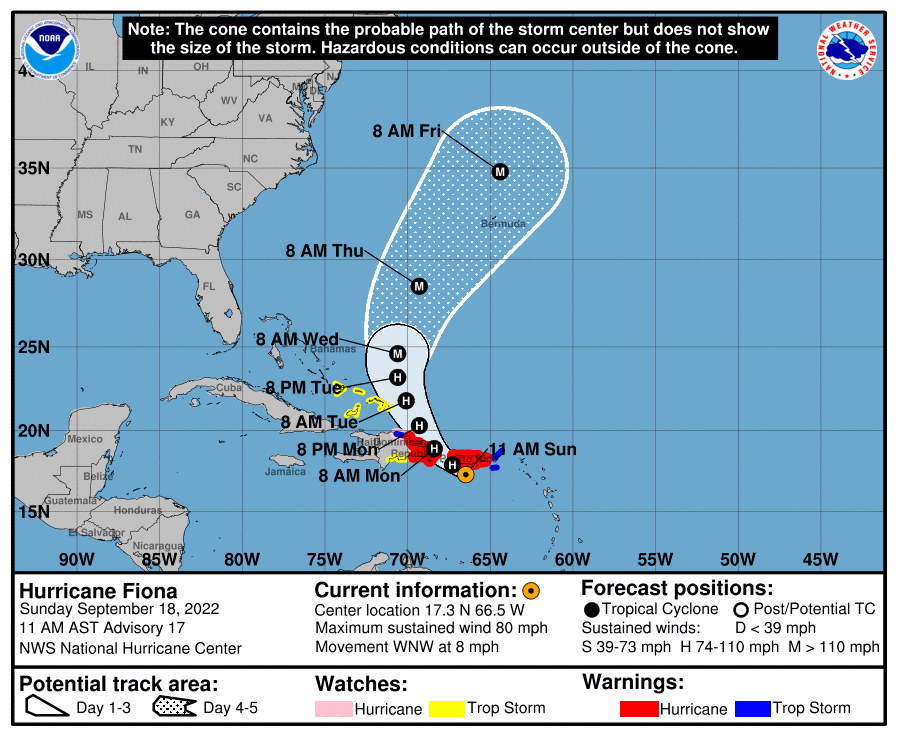 Hurricane Fiona struck Puerto Rico in September 2022. (Image credit: NOAA)
|
|
Funding- Abandoned and Derelict Vessels Removal |
|
|
The BoatUS Foundation, in partnership with the National Oceanic and Atmospheric Administration (NOAA) Marine Debris Program, is soliciting applications under their Abandoned and Derelict Vessel Removal Grant Program.
Using funding from the NOAA Marine Debris Program provided by the Bipartisan Infrastructure Law, the BoatUS Foundation will award up to $7.5 million in grants to remove abandoned and derelict vessels (ADVs) across coastal and marine areas of the United States. Projects may range from $50,000 to $1 million. Through a streamlined application process, this competition aims to lower the administrative burden on applicants and allow more organizations to access funds for ADV removal.
Priority will be given to projects that include input from and benefit underserved, low-income, or tribal communities; demonstrate strong community support; benefit marine animals and their habitats, local coastal communities, or local economies; and include local outreach and education activities directed toward the boating community and general public to prevent abandoned and derelict vessels. Projects throughout the coastal United States, Great Lakes, United States territories, and Freely Associated States are eligible for consideration.
Letters of intent are due on August 12, 2024 11:59 PM EDT. To apply, please visit the BoatUS Foundation website for eligibility and submission information.
|
|
Funding Opportunity: USDA Composting and Food Waste Reduction Pilot Project
This program provides financial assistance to municipalities, school districts, counties, local governments, special district governments, tribal governments (State-designated Indian Tribes, Federally Recognized Indian Tribal Governments), or tribal organizations to carry out food waste reduction and composting objectives. Grant awards up to $400,000. Visit the website for more information.
Applicants must submit their applications via Grants.gov by 11:59 pm Eastern Time on September 4, 2024. For technical issues with Grants.gov, contact Grants.gov Applicant Support at 1-800-518-4726 or support@grants.gov.
What’s new / Novedades - TIPS for Marine Debris Webinar Series
|
|
|
We’re excited to announce our new bimonthly virtual webinar series, Tropical Islands Partnering on Solutions (TIPS) for Marine Debris. The goal of the series is to help island communities connect and share perspectives from across the tropics on common marine debris issues and proposed solutions. Each webinar will feature stakeholders from federal, state/territorial, and local governments, nongovernmental organizations, universities, and industry. Discussions will include topics such as outreach and education, policy, debris management and successes as well as challenges under normal and storm conditions. To learn more and see a schedule of upcoming webinars, please visit the Tropical Islands Partnering on Solutions for Marine Debris webinar series webpage and subscribe to the newsletter for updates.
Next webinar: August 13, 2024 at 6:00PM
Back to School
You will have the opportunity to learn about the different education resources from our partners from the island.
español
Nos complace anunciar nuestra nueva serie de seminarios virtuales bimensuales, Tropical Islands Partnering on Solutions (TIPS) for Marine Debris. El objetivo de esta serie es ayudar a las comunidades insulares a conectarse y compartir perspectivas sobre problemas comunes en zonas tropicales relacionados con los desechos marinos y conocer soluciones propuestas. Cada seminario contará con la participación de representantes de las administraciones federal, estatal y local, organizaciones no gubernamentales, universidades e industria. Se discutirán temas como la divulgación y la educación, la política pública, manejo de los desechos y los éxitos, así como los retos en condiciones normales y de tormenta. Para obtener más información y consultar el calendario de los próximos seminarios en línea, visite la página de la serie de seminarios en línea Tropical Islands Partnering on Solutions for Marine Debris y suscríbase al boletín para estar al día.
Próximo webinar: 13 de agosto de 2024 a las 6:00PM
Regreso a clases
Tendrás la oportunidad de aprender sobre los diferentes recursos de nuestros socios de las islas.
|
|
|
|
|