|
SEPTEMBER/SEPTIEMBRE
2023
Please subscribe to this Newsletter on this link
Take a look at the June and March issues
We also invite you to subscribe to the NOAA Marine Debris Program Blog and Newsletter
Please address questions to yaritza.rivera@noaa.gov
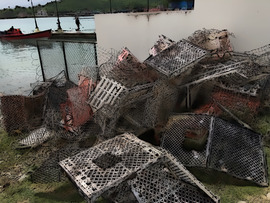 Arte de pesca perdido o abandonado que fue recuperado por pescadores de Naguabo en colaboración con Conservación ConCiencia. Para conocer más, puedes echar un vistazo al reportaje incluido. (Crédito foto: NOAA)
|
|
In this issue / En esta edición:
Esfuerzo comunitario para la remoción segura de nasas perdidas o abandonadas
Evaluation of marine debris within the Guánica Biosphere Reserve and La Parguera Natural Reserve, Southwest Puerto Rico (disponible en español)
Characterization of trash from Two Flood Control Pump Stations (disponible en español)
Back to School Resources from the NOAA Marine Debris Program
Mangroves, Marine Debris, and MMM6: sharing my research in Cartagena, Colombia.
Community Collaboration Triumphs: Removing a Massive Net on St. Croix's Shore
Preschoolers making a difference for the International Coastal Cleanup Day (disponible en español)
Funding Opportunities/ Oportunidades de Fondos
- NOAA Marine Debris Program - Webinars recording available!
- National Sea Grant
Próximamente/ Coming Soon
- Cleanups/limpiezas & Monitoring/Monitoreo
|
|
Esfuerzo comunitario para la remoción segura de nasas perdidas o abandonadas
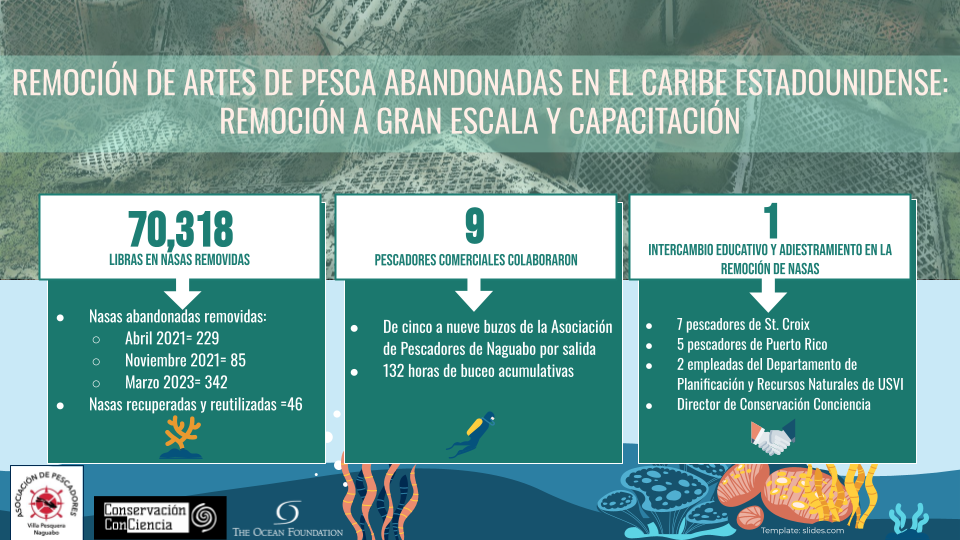
Gráfico revisado por Raimundo Espinoza de Conservación Conciencia
The Ocean Foundation, Conservación ConCiencia y la Asociación de Pescadores de la Villa Pesquera de Naguabo, completaron durante marzo un proyecto apoyado por el Programa de Desechos Marinos de la NOAA en el que removieron nasas del fondo marino y adiestraron pescadores en la remoción segura de las mismas. En este proyecto , ¡lograron remover 55% por encima de la meta originalmente propuesta! Como parte de sus iniciativas, realizaron un intercambio educativo en St. Croix en donde entrenaron a pescadores locales en las mejores prácticas para la remoción de nasas mientras aprendían sobre los retos particulares de la zona. Este tipo de esfuerzos benefician a los ecosistemas y organismos sensitivos en el área, mientras apoyan la economía de comunidades costeras. Échale un vistazo al infográfico en donde se resumen los resultados de este proyecto.
|
|
Evaluation of marine debris within the Guánica Biosphere Reserve and La Parguera Natural Reserve, Southwest Puerto Rico
by: Sahara Ríos
(Español adelante)
Pictures provided by the author
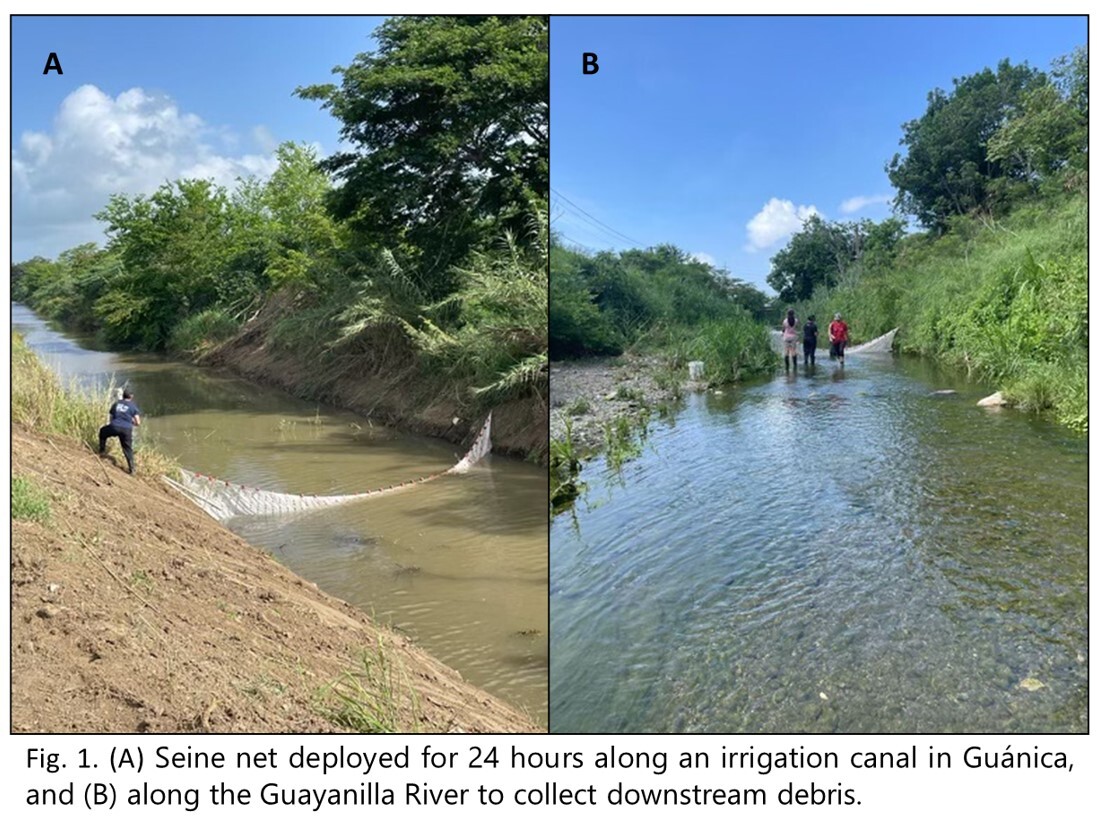 Villanova University in Pennsylvania has joined efforts with NOAA's Marine Debris Program to study the issue of marine debris and plastic pollution within the coastal region of southwest Puerto Rico. The study has a multi-ecosystem approach where we are adapting the Marine Debris Monitoring and Assessment Project (MDMAP) Shoreline Survey Guide protocol to evaluate the transport and deposition of waste from inland sites like rivers and irrigation canals to coastal environments such as mangroves and beaches. Assessments are conducted twice each year during the wet and dry season beginning in May 2022 with a focus on locations that drain into two marine protected areas.
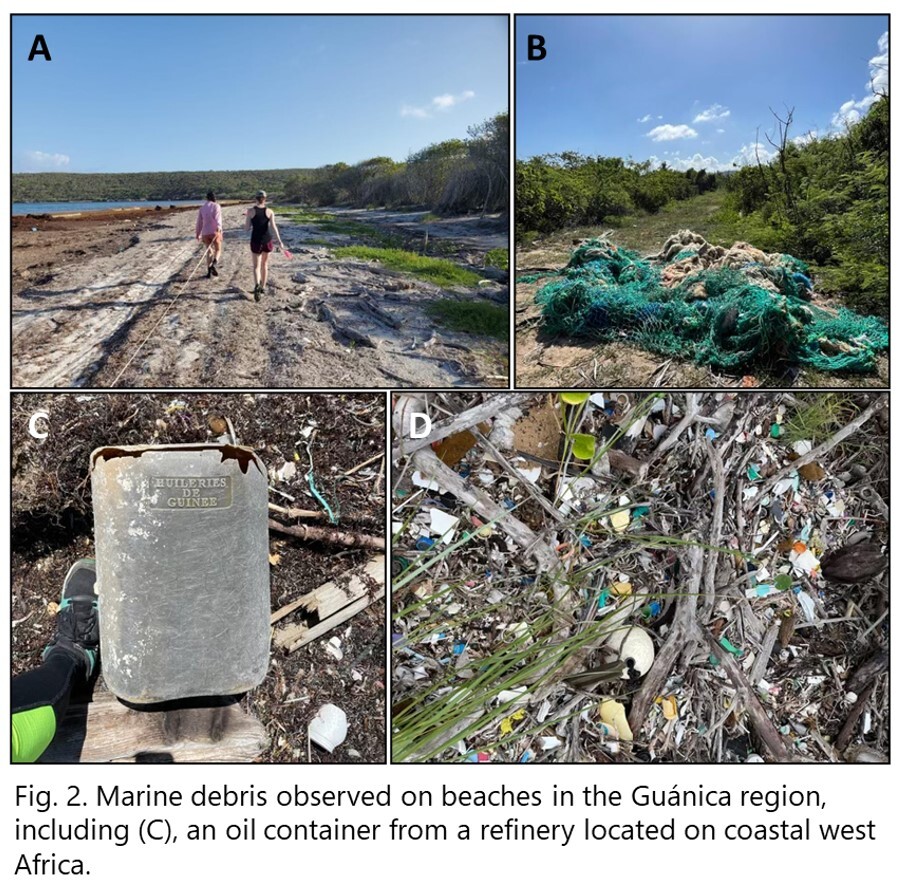
Our most recent sampling was conducted in June 2023 (during the dry season) with the help of the community of Guánica and partnerships with two local organizations, Alelí Environmental Inc., and Protectores de Cuencas. For upstream locations, plastic was the most predominant type of trash, especially when being transported by rivers (representing more than 80% of all debris collected). Compared to debris transported in the river channel, we found a greater variety of debris deposited along the riverbanks including glass, fabric, rubber, metal, and paper (Fig. 1). In coastal environments, we found mostly plastic and fishing equipment (e.g., fishing line, nets, microfibers, buoys) as the predominant type of marine debris. Some items provide clues about their source and the potential for long-distance dispersal for marine debris: on the Puerto Rican southwest coast, we found an oil container from the oil refinery Huileries de Guinee on Conakry, Guinea, which is approximately 5,800 km away from Playa Las Ballenas (Fig. 2, C)! From the dry season assessment, we collected a total of 259 items for upstream sites, and 716 items for coastal locations, a total of 975 items, mostly plastic. Stay tuned for our next blog update in December where we will share our wet season assessment results planned for October 2023.
 Evaluación de desechos marinos dentro de la Reserva de la Biosfera de Guánica y la Reserva Natural La Parguera, suroeste de Puerto Rico
La Universidad Villanova en Pensilvania ha unido esfuerzos con el Programa de Desechos Marinos de la NOAA para estudiar los desechos marinos en la región costera del suroeste de Puerto Rico. El estudio tiene un enfoque multi-ecosistémico en el cual estamos adaptando el protocolo “Marine Debris Monitoring and Assessment Project (MDMAP) Shoreline Survey Guide” para evaluar el transporte y la deposición de desechos desde zonas tierra adentro como son ríos y canales de riego, hasta los entornos costeros como manglares y playas. Estas evaluaciones las realizamos dos veces al año durante la temporada seca y húmeda a partir de mayo del 2022 con un enfoque a localizaciones que desembocan en dos reservas marinas.
Nuestro más reciente muestreo fue realizado el pasado junio con la ayuda de la comunidad de Guánica y la asociación con dos organizaciones locales, Alelí Environmental Inc. y Protectores de Cuencas. Para ríos y canales de riego, el plástico fue el tipo de basura más predominante, especialmente durante su transporte en agua (representando más del 80% de todos los desechos recolectados). No obstante, una mayor variedad de tipos de basura fue hallada depositada a lo largo de los bancos del río/canal, incluidos: vidrios, telas, caucho, metal y papel (Fig. 1). En ambientes costeros, predominó el plástico y equipos de pesca (ej., sedal, redes, microfibras de soga, boyas) como desechos marinos. Algunos artículos hallados nos brindan pistas sobre su origen y el potencial de dispersión a larga distancia de los desechos marinos. Por ejemplo, en Playa Ballenas encontramos un contenedor de petróleo de la refinería Huileries de Guinee proveniente de Conakry, Guinea, la cual está una impresionante distancia de aproximadamente 5,800 km (Figura 2, C) del suroeste de Puerto Rico. En la última temporada seca recolectamos un total de 259 artículos en ríos/canales, 716 artículos en localizaciones costeras, para un total de 975 artículos, en su gran mayoría plástico. Estén pendientes a nuestra próxima actualización en diciembre donde compartiremos los resultados de la evaluación de la temporada de lluvias prevista para octubre del 2023.
|
|
Characterization of trash from Two Flood Control Pump Stations
by Evelyn Huertas, U.S. EPA
(Español adelante)
The U.S. Environmental Protection Agency (EPA) commissioned a $25,000 grant to the University of Puerto Rico- Mayagüez (UPR-M) campus from the Trash Free Waters Program for a study titled “Puerto Rico Integration Trash Free Water Project Floatable Characterization at Two Flood Control Pump Stations.” This project aims to characterize the floatables reaching two Department of Natural and Environmental Resources flood control pump stations (FCPS) and develop a mitigation plan and with management and implementation alternatives. The targeted FCPSs are San Fernando, within the San Juan Bay Estuary study area in the Cataño municipality on the north coast, and Pichingo in Salinas, located on the south coast of Puerto Rico. The sampling is carried out by volunteers and students trained in the sampling protocols by the UPR-M principal investigator. The study is expected to be completed by December 2023. For information please contact Evelyn Huertas at the email address Huertas.Evelyn@epa.gov.

|
|
Caracterización de basura en dos estaciones de control de inundaciones
(español)
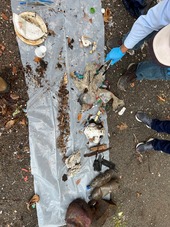 Vista aérea del trabajo completado. (Crédito de la foto: autora)
|
La Agencia de Protección Ambiental de los Estados Unidos (EPA, por sus siglas en inglés) comisionó una subvención de $25,000 del Programa de Aguas Libres de Basura al Recinto de Mayagüez de la Universidad de Puerto Rico (UPR-M) para un estudio titulado "Caracterización de Flotantes del Proyecto de Integración de Aguas Libres de Basura de Puerto Rico en dos Estaciones de Bombeo para el Control de Inundaciones". Este proyecto tiene como objetivo caracterizar los flotantes que llegan a dos estaciones de bombeo para control de inundaciones (FCPS) del Departamento de Recursos Naturales y Ambientales y desarrollar un plan de mitigación y con alternativas de manejo e implantación. Las FCPS objeto del estudio son San Fernando, dentro del área de estudio del Estuario de la Bahía de San Juan en el municipio de Cataño en la costa norte, y Pichingo en Salinas, localizada en el área sur de Puerto Rico. El muestreo se lleva a cabo por voluntarios y estudiantes adiestrados en los protocolos de muestreo por el investigador principal de la UPR-M. Se espera que el estudio finalice en diciembre de 2023. Para más información, favor de contactar a Evelyn Huertas en el correo electrónico Huertas.Evelyn@epa.gov. |
|
Back to School Resources from the NOAA Marine Debris Program
By: Alexandria Gillen, Education Specialist
NOAA Marine Debris Program
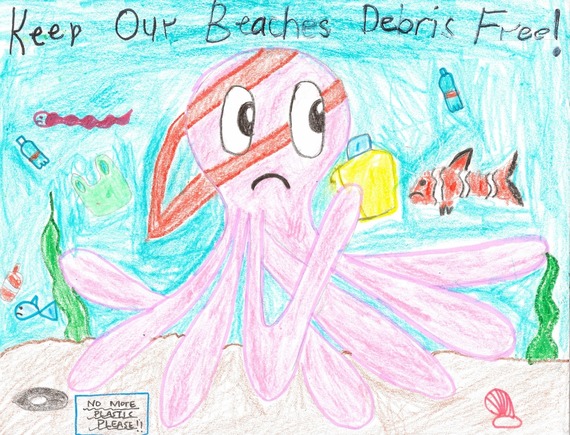 Artwork by K'Moya S. (Grade 3, U.S. Virgin Islands), winner of the Annual NOAA Marine Debris Program Art Contest.
|
|
|
If you’re heading back to school this fall, the NOAA Marine Debris Program is here to help! There are all kinds of resources for students, educators, and even adults and professionals on the Marine Debris Program website. Here are a few highlights:
- Share marine debris facts with your community using our Fact Sheets! Several are available in both Spanish and English, including marine debris (español), garbage patches (español), and storm preparedness (español).
- Get middle and high schoolers engaged with project-based learning through the Keeping Our Coastlines Clean curriculum. This series of 11 lessons was co-created with the input of educators from USVI who participated in workshops and provided input following in-class use. The curriculum also includes 15 spotlights, which highlight USVI-specific marine debris research, local researchers, community-led prevention efforts, and natural disaster impacts from marine debris.
- For younger students, try the Understanding Marine Debris - U.S. Virgin Islands Edition activity book! This assortment of puzzles, brain-teasers, and coloring activities has been adapted for use in the U.S. Virgin Islands. It helps children understand the local problem of marine debris while having fun at the same time.
- Find lessons for students of any age with the Educator’s Guide to Marine Debris, available in English and Spanish. Designed as a stand-alone teaching tool or to supplement lessons for educators in both formal and informal settings, this collection is appropriate for students grades K-12, with a focus on STEM (Science, Technology, Engineering, Mathematics) objectives.
- Or if you’re looking to support learning throughout the year, check out One Cool Earth’s Earth Genius lesson plans. Follow along with this full curriculum focused on schoolyard gardens, with three lessons highlighting marine debris. Spanish lesson plans are available on the One Cool Earth website.
- And this fall, enter the NOAA Marine Debris Program Art Contest! The contest opens October 16, and is open to students in grades K-8.
For more information, please contact Alexandria.Gillen@noaa.gov.
|
|
Mangroves, Marine Debris, and MMM6: sharing my research in Cartagena, Colombia.
By Allie Durdall MSc., Watershed and Marine Research Specialist, Center for Marine and Environmental Studies
|
|
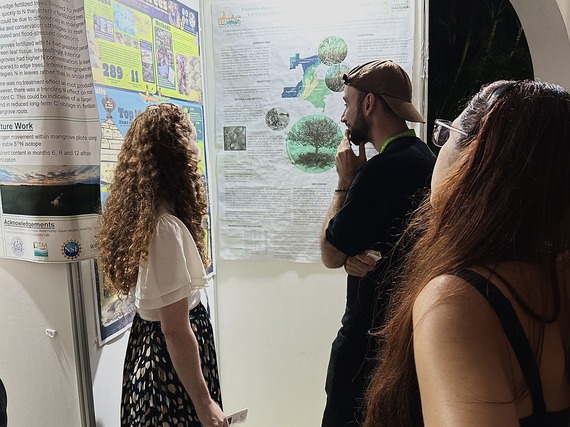 Allie Durdall presenting her NOAA MDP research at the MMM6 poster session. (Photo credit: University of the Virgin Islands)
Thanks to NOAA Marine Debris Program (MDP) funding and support, I got another stamp in my passport as I journeyed to the Mangroves, Macrobenthos, and Management 6 Conference (MMM6) in Cartagena, Colombia. There, I had the privilege of presenting my research from our NOAA MDP funded project: Out of Sight, Out of Mind - Forgotten Shorelines of the U.S. Virgin Islands: Marine Debris Removal of Offshore Cays and Mangroves.
MMM6 gathered hundreds of esteemed mangrove research experts from around the world, providing a platform to exchange knowledge and ideas. It was a melting pot of expertise and enthusiasm, covering mangrove topics of all kinds. My contribution to the conference was a poster presentation titled "Debris in the Trees: A Comparison of U.S. Virgin Islands Mangrove and Beach Clean-Up Data Collected by Citizen Scientists." The engagement and discussions around my poster illustrated the general excitement about the possibilities of using citizen science to bolster data collection efforts across shorelines worldwide. I was proud to represent the unique perspectives and work of our U.S. Virgin Islands team, and showcase data from our dedicated citizen scientists.
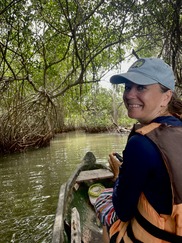
Of course, no scientific journey is complete without some exploration. Our group, composed of five women researchers from the University of the Virgin Islands (hooray for women in STEM!), took time to immerse ourselves in Cartagena's rich culture and natural beauty. Beyond the conference, we explored Cartagena’s colorful walled city, tried some new foods (would recommend granadilla: like passionfruit, but different), saw a cute sloth family, and took a field trip to explore Colombian mangroves. Did you know that on its Pacific coast, Colombia has some of the tallest mangrove trees in the world, with some reaching over 150 feet?
Yet, the most cherished aspect of this journey was the bonds formed among our team and the connections made with colleagues from diverse backgrounds. The shared passion for mangrove research and the collective commitment to protect an ecosystem we all love created a sense of global solidarity among attendees. Participating in the MMM6 Conference in Cartagena was an unforgettable experience. The knowledge gained, the perspectives shared, and the relationships forged have left an indelible mark on my scientific journey.
In conclusion, while this adventure was marked by learning and discovery, it was also a testament to the significance of collaboration in addressing pressing environmental issues. If ever you have the chance to participate in a global conference, seize it. It's an opportunity not only to advance your own knowledge but to contribute to a collective effort toward a brighter future for our planet.
|
|
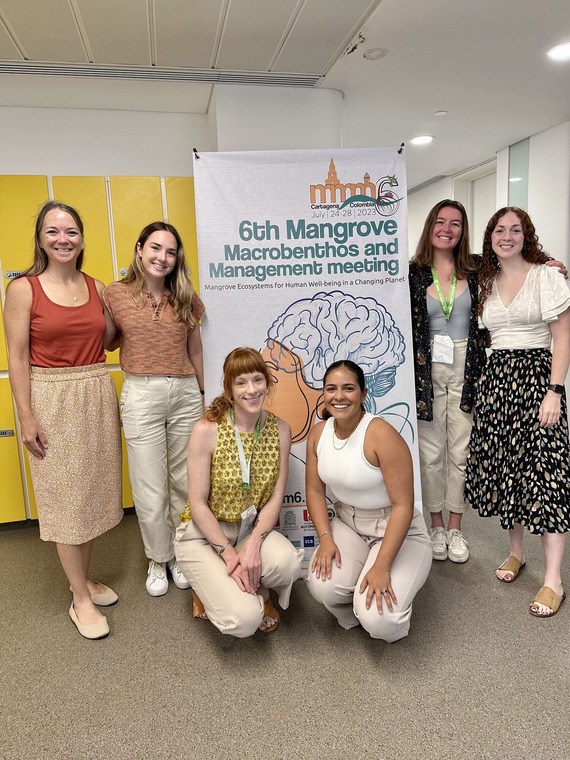 The University of the Virgin Islands (UVI) crew representing at the MMM6. (Photo credit: UVI)
 |
|
Allie Durdall and Dr. Kristin Wilson Grimes, co-lead on the NOAA MDP funded Project, were able to explore the Colombian mangroves. (Photo credit: UVI)
|
|
|
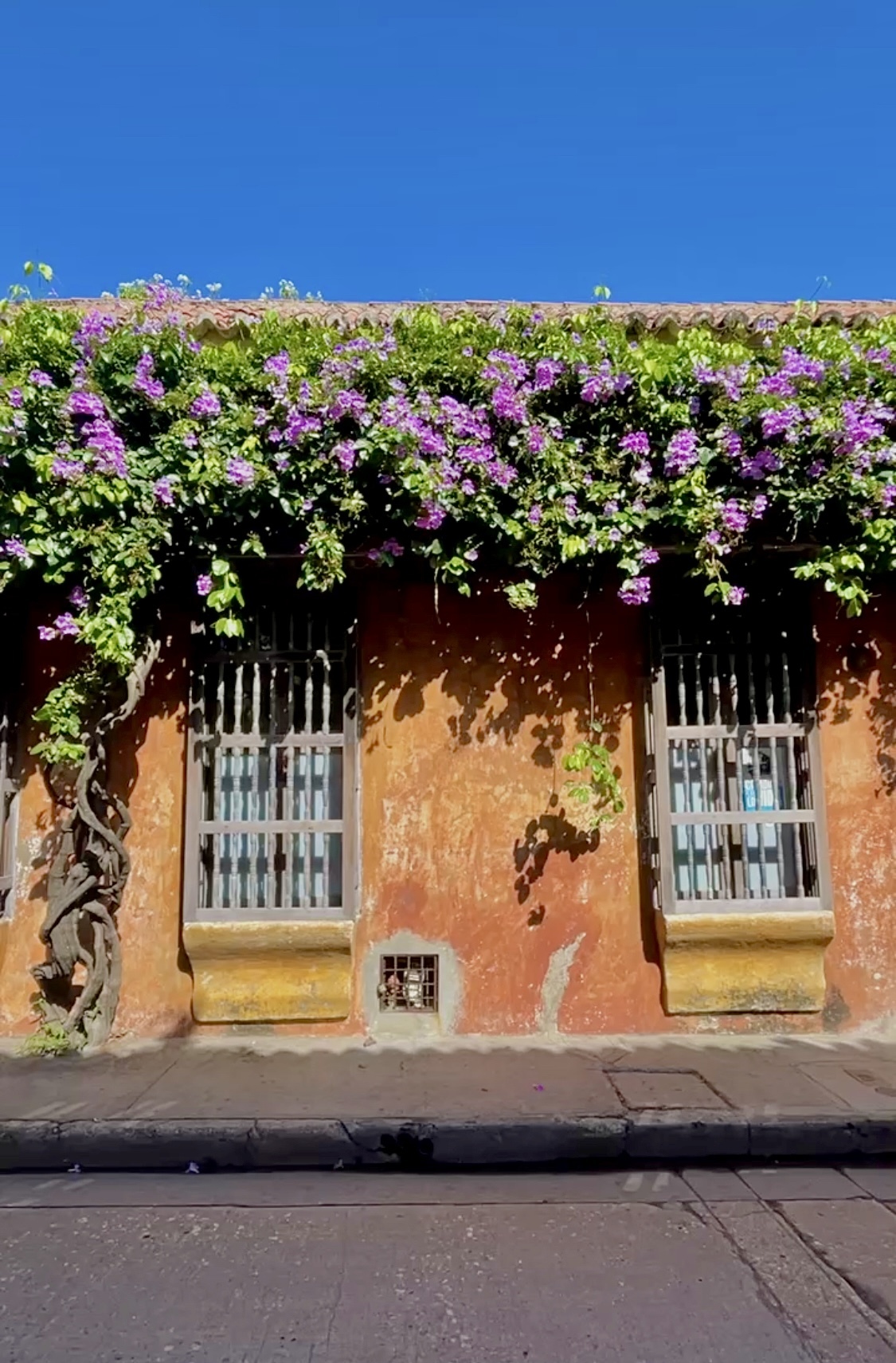 The colorful streets of Cartagena's walled city. (Photo credit: author)
|
|
Community Collaboration Triumphs: Removing a Massive Net on St. Croix's Shore
Authors: Zola Roper and Kelcie Troutman
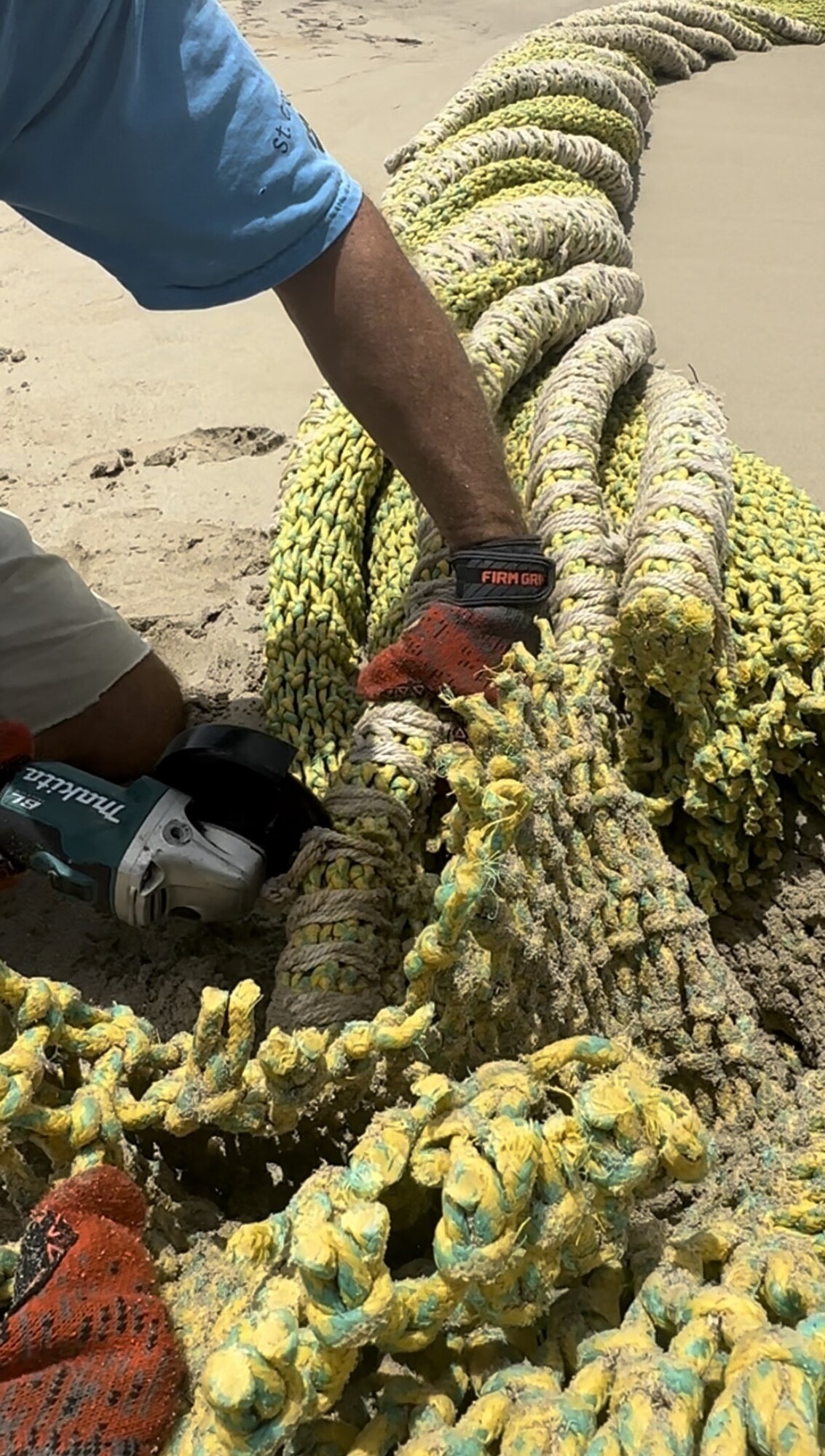 Cutting the net required special tools and community involvement. (Photo credit: Zola Roper)
|
|
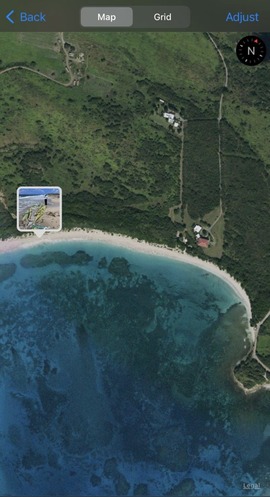 Location of the net. (Photo credit: Zola Roper)
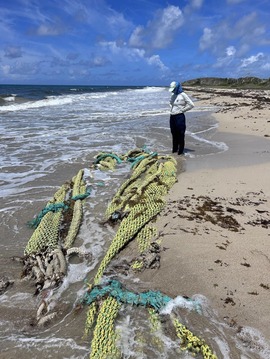 Figuring out how to do the job! (Photo Credit: Zola Roper)
Please reach out Zola for any questions at zola.roper@dpnr.vi.gov
|
|
In late June, the Virgin Islands Department of Planning and Natural Resources (DPNR) received an urgent alert through their Tip 411 anonymous hotline. A colossal commercial net had washed ashore Ha'Penny Beach on the south shore of St. Croix, U.S. Virgin Islands. When large nets are abandoned or lost at sea, they pose a grave threat to marine life and the delicate coastal ecosystems, both above and below the water's surface. This monster of a net, stretching approximately 65 feet in length, demanded immediate attention. The magnitude of the task at hand was evident. The net had to be skillfully disassembled into smaller, more manageable pieces and carefully pulled above the waterline. The goal was clear: to ensure its removal without further harm to the marine environment. With the concerted efforts of dedicated community members, alongside the invaluable support of the Virgin Islands Department of Public Works and members of DPNR staff, this monumental net was ultimately conquered. Together, all these entities demonstrated the power of teamwork and unwavering determination. This serves as a testament to the indomitable spirit of smaller Caribbean islands and a reminder of the importance of safeguarding our oceans and coastal environments.
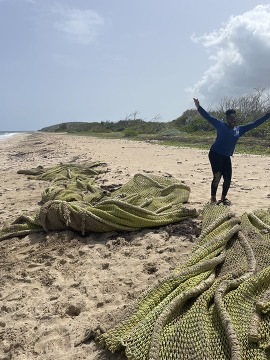 The net was successfuly cut down for disposal (Photo Credit: DPNR)
|
|
Preschoolers Making a Difference in the International Coastal Cleanup Day
By Dr. María Vega Rodríguez, Department of Natural and Environmental Resources
|
|
|
Scuba Dogs Society joined the 21st International Coastal Cleanup organized by Ocean Conservancy on Saturday, September 16, 2023, in Puerto Rico. Through its Call to Action, the Society was successful in organizing over 4000 volunteers island-wide. Among those, were the preschool and elementary students of a small eco-school located in the Guasábara Sector in Caguas, Puerto Rico. La Escuela Nueva Pedagogía has a human-centered academic curriculum based on the principles of peace, social/cultural and ecological awareness. A week prior to the Coastal Cleanup, students were immersed in creating signs and drawings with recyclable materials that were placed around the school as reminders of the activity but also the importance of maintaining clean beaches. On September 16th , preschoolers (and their parents) from the Escuela Nueva Pedagogía joined forces at the Escambrón Beach, San Juan, Puerto Rico to help with the beach cleanup. They were given gloves, sand sieves, and shovels (a bit too big for tiny hands, but useful, nonetheless). In just over 1.5 hours, volunteers stationed at the beach collected over 1000 cigarette butts and 12 needles (not managed by the kids!) among other plastic-derived debris. It's schools like this that make a big difference for the conservation of our natural resources.
Note: Please stay tuned for the December issue where we will be sharing results from the ICC related events in the Caribbean!
|
|
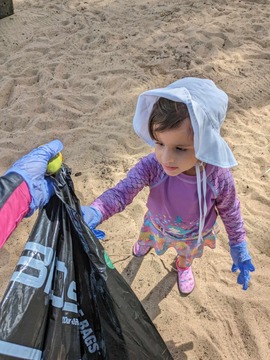 Preschooler (Gaia Victoria Quiles Vega) helping with the beach cleanup (Photo credit: author)
|
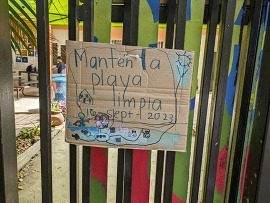 Hand-drawn sign placed on the gate of the school’s entrance. (Photo credit: author)
|
|
|
(español)
Preescolares marcan la diferencia en el Día Internacional de Limpieza de Costas
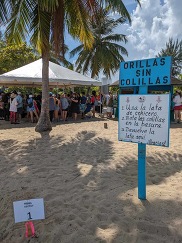
Scuba Dogs Society se unió a la 21ª Limpieza Internacional de Costas organizada por Ocean Conservancy el sábado 16 de septiembre de 2023 en Puerto Rico. A través de su Llamado a la Acción, la Sociedad logró organizar a más de 4000 voluntarios en toda la isla. Entre ellos, se encontraban los estudiantes de preescolar y elemental de una pequeña eco-escuela ubicada en el Sector Guasábara en Caguas, Puerto Rico. La Escuela Nueva Pedagogía tiene un currículo académico centrado en el ser humano y basado en los principios de paz, conciencia social/cultural y ecológica.
|
Una semana antes de la Limpieza Costera, los estudiantes estuvieron inmersos en la creación de letreros y dibujos con materiales reciclables que fueron colocados alrededor de la escuela como recordatorios de la actividad, pero también de la importancia de mantener las playas limpias. El 16 de septiembre, los alumnos de preescolar (y sus padres) de la Escuela Nueva Pedagogía unieron sus fuerzas en la playa del Escambrón, en San Juan, Puerto Rico para ayudar en la limpieza de la playa. Se les dieron guantes, cernidores de arena y palas (un poco grandes para manos pequeñas, pero útiles, no obstante). En poco más de hora y media, los voluntarios estacionados en la playa recogieron más de 1.000 colillas de cigarrillos y 12 agujas (¡No manipuladas por los niños!), entre otros desechos plásticos. Escuelas como ésta son las que marcan una gran diferencia en la conservación de nuestros recursos naturales.
Nota: Manténganse atentos a la edición de diciembre, en el que compartiremos los resultados de los eventos relacionados con la Limpieza Internacional de Costas en el Caribe.
*foto: Voluntarios en la Playa Escambrón, San Juan, Puerto Rico (Crédito de la foto: autora)
|
|
Funding Opportunities/ Oportunidades de Fondos
NOAA Marine Debris Program
All NOAA MDP funding opportunities are announced on this link. Stay tuned for upcoming announcements.
- In a special edition of the Marine Debris in the Caribbean newsletter published on August 28, we announced that the NOAA Marine Debris Program will award up to $28 million across two funding opportunities and through the Bipartisan Infrastructure Law for projects that remove marine debris to benefit marine and Great Lakes habitats and communities. Funding will be administered through two competitions:
-
Fiscal Year 2024 NOAA Marine Debris Removal under the Bipartisan Infrastructure Law with Letters of Intent due on October 27, 2023, 11:59 p.m. Eastern Time.
-
Fiscal Year 2024 NOAA Marine Debris Interception Technologies under the Bipartisan Infrastructure Law with Letters of Intent due on November 15, 2023, 11:59 p.m. Eastern Time.
- Please take a look at the resources that will help you in the application process.
National Sea Grant
Please visit the Sea Grant Funding page for specific details on the following opportunities:
- Marine Debris Community Action Coalitions
- The National Sea Grant Office anticipates approximately $3,000,000 in FY 2024 and 2025 federal funds will be available to individual Sea Grant programs in order to support approximately 10-20 Marine Debris Community Action Coalitions. This competition is open to all Sea Grant programs. Matching funds will not be required for this competition.
- Marine Debris Challenge Competition
- Sea Grant anticipates approximately $16,000,000 in FY 2024 and 2025 federal funds will be available to support innovative, transformational research to application projects that will address the prevention and/or removal of marine debris. Approximately 5-12 projects of up to three years duration may be funded. Matching funds will not be required for this competition
|
|
-
10 de noviembre: monitoreo en Nuevo Milenio Guanajibo, Mayagüez PR - Contacto: yaritza.rivera@noaa.gov
|
|
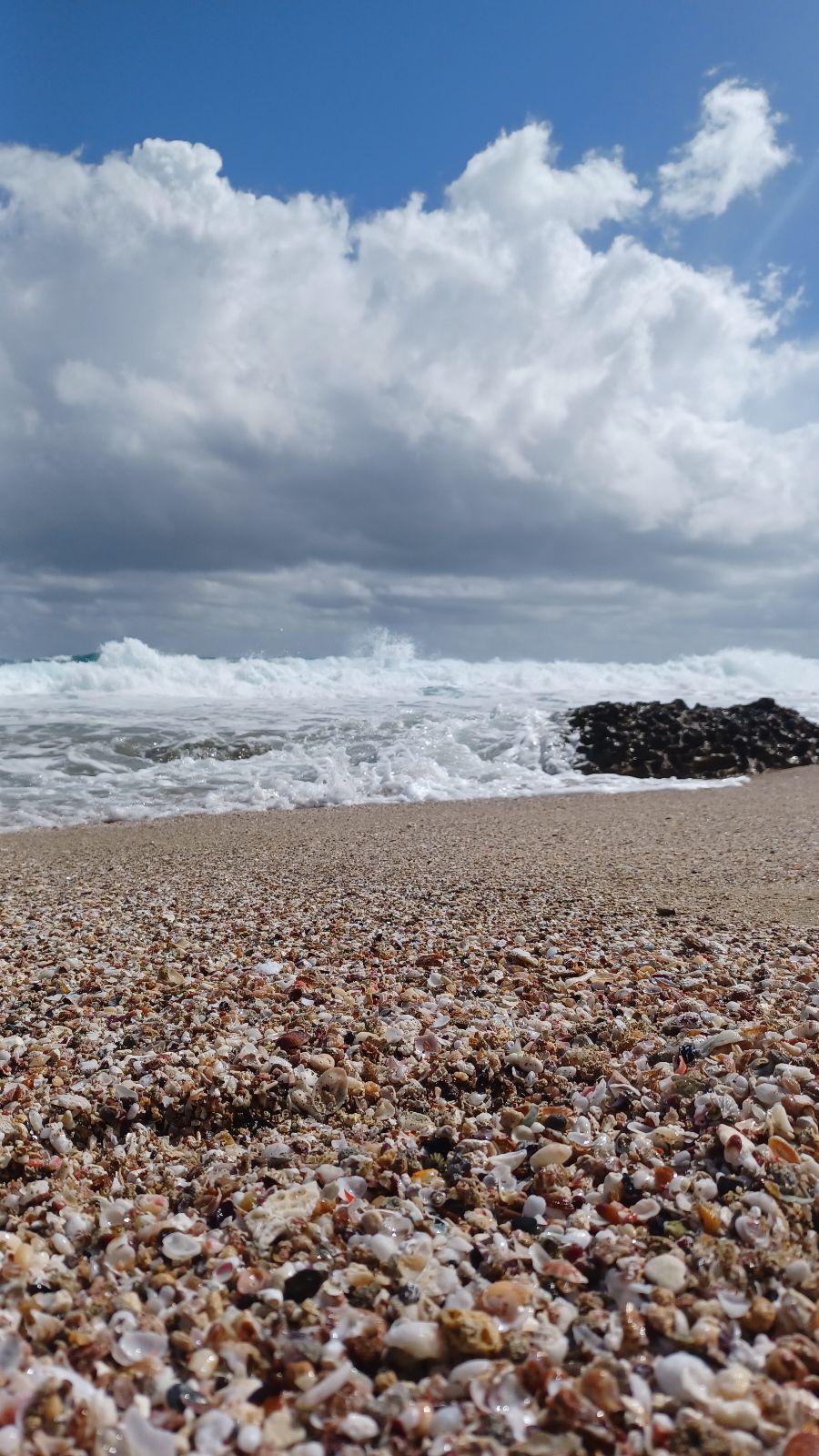 Quebradillas, Puerto Rico (Photo credit: NOAA)
|
|
|
|
|