|
HHS Roadmap Released: Operation Trialblazer Seeks to Maintain US Leadership in Early Clinical R&D
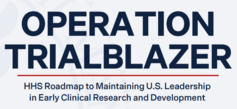
The U.S. Department of Health and Human Services (DHHS) released a strategic set of initiatives and reforms designed to modernize and accelerate all stages of medical product development, from target and treatment identification, initial planning, through the transition into Phase 2 clinical studies, and beyond.
Operation Trialblazer addresses issues at the Food and Drug Administration, NIH, and other DHHS components intended to foster a clinical research economy that delivers timely, safe, and effective medical products to support a healthy America.
Read the Roadmap.
|
Science: A New Golden Age – New Report Released by White House
Assistant to the President and Director of the White House Office of Science and Technology Policy (OSTP) Michael Kratsios published a new report to chart a course to revitalize American research and development (R&D). The report, entitled Science: A New Golden Age, makes recommendations to government, industry, academia and philanthropy.
Read Science: A New Golden Age.
|
Military Aviators Cancer Study

The research community can request data and serum samples from the Military Aviators Cancer Study (MACS) by submitting a project proposal using the Cancer Data Access System website. MACS investigates cancer incidence among military aviators and aviation support personnel.
Learn more about MACS and request data on the Cancer Data Access System Website.
|
|
|
Building Bridges in Cancer Symptom Science: Leveraging Translational Models to Advance Cancer Symptom Research

Date: Tuesday, August 18, 2026
Time: 3:00PM – 4:00 PM ET
Advance registration is required for this free webinar.
Presenters
- Sandra Rieger, Ph.D., Sylvester Comprehensive Cancer Center,
University of Miami
- Grace Ji-eun, Ph.D., Comprehensive Cancer Center, The Ohio State University
|
Abstract Deadline for the 4th Annual NCI Annual Data Sharing Symposium is September 1

The NCI Office of Data Sharing is hosting its 4th Annual Data Sharing Symposium titled, "Data to Discovery: Leveraging Cancer Data in the 'Real World'” on November 5-6 at the NCI Shady Grove Campus in Rockville, MD. Scientists, clinicians, policymakers, patients, advocates, and trainees are invited to the symposium to learn and explore more about advancing cancer research through data sharing and reuse.
Attendees are invited to present a poster describing how data has impacted their cancer research.
Learn more, register to attend, or submit an abstract.
|
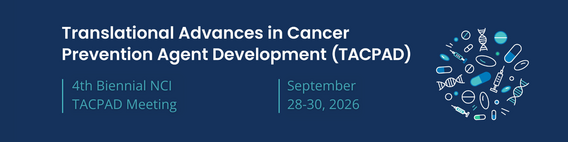 Register now for the TACPAD 4th Biennial Virtual Meeting
Sign up now to attend the TACPAD 4th Biennial Meeting, being held September 28-30, 2026. This free virtual meeting promotes prevention agent development and rapid translation to clinical trials and will engage cancer researchers with novel prevention concepts.
Plenary Sessions include:
- Emerging Targets, Vaccines and Immunomodulatory Agents for Cancer Prevention
- Molecularly Targeted Novel Agents for Cancer Prevention and Interception
- Clinically Relevant Alternative Models for Cancer Prevention
- Cancer Prevention-Interception Clinical Trials
- Panel Discussion – Biomarkers as Intermediate Endpoints for Cancer Prevention Clinical Trials
- Early Investigator Flash Talks
- Meet the NCI Program Directors
Learn more and register.
|
|
Requests for Information and Support |
|
Request for Information: Measuring and Rewarding Scientific Impact

The National Institutes of Health seeks public input on the defining features of modern 21st-century science that should be measured, recognized, and incentivized.
Biomedical research relies on transparent reporting, rigorous replication, careful interpretation of methods and analyses, and the iterative refinement of scientific knowledge.
The NIH Office of Science Policy Request for Information (NOT-OD-26-087) is open through August 19, 2026.
Read the RFI.
|
NCI PREVENT Cancer Program Accepting Funding Applications

Next Application Deadline: November 2, 2026
The PREVENT program supports preclinical development of innovative interventions and biomarkers for cancer prevention and interception. For more information on program support, types of supported projects, and the application visit the PREVENT web page.
|
|
|
|
|